Story Summary:
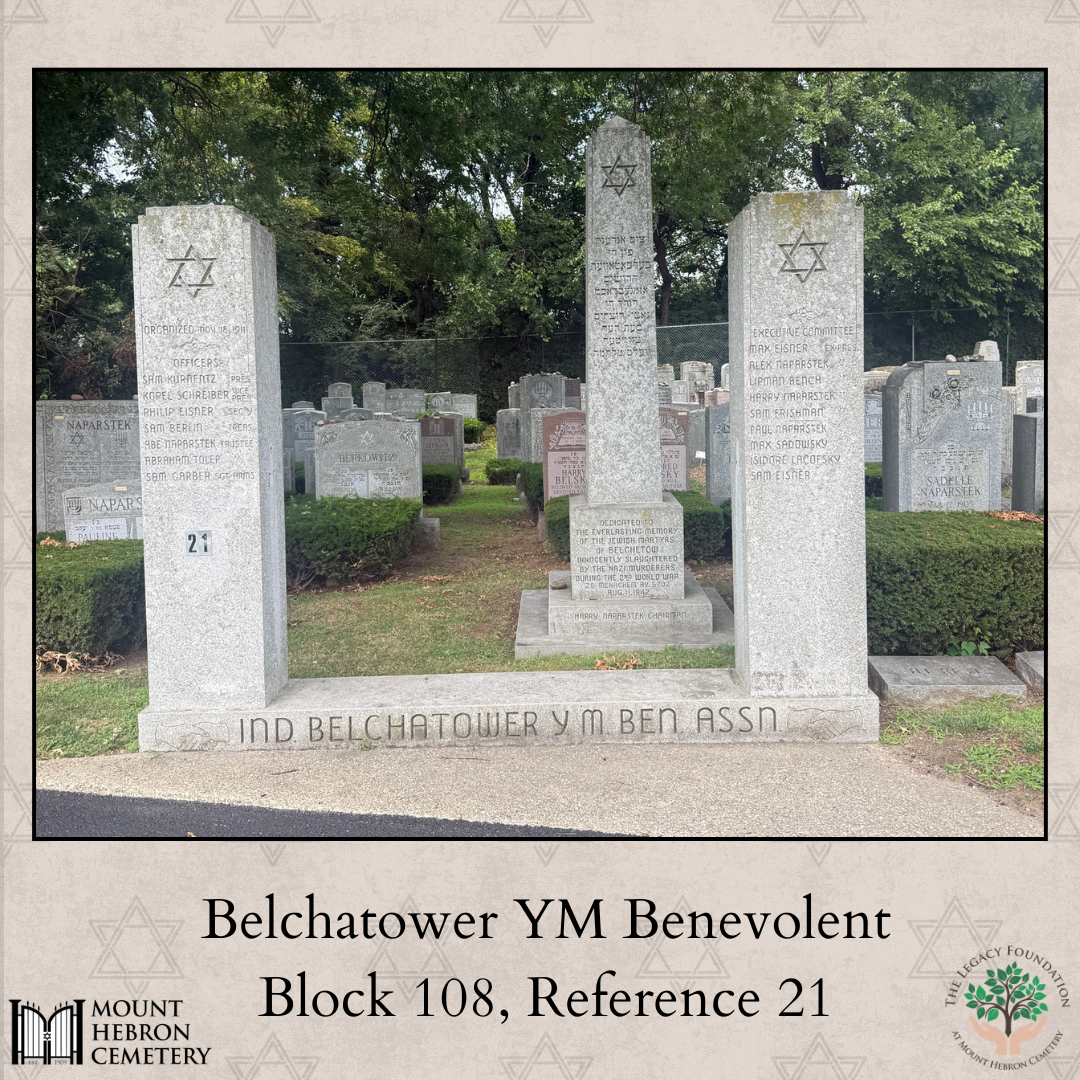
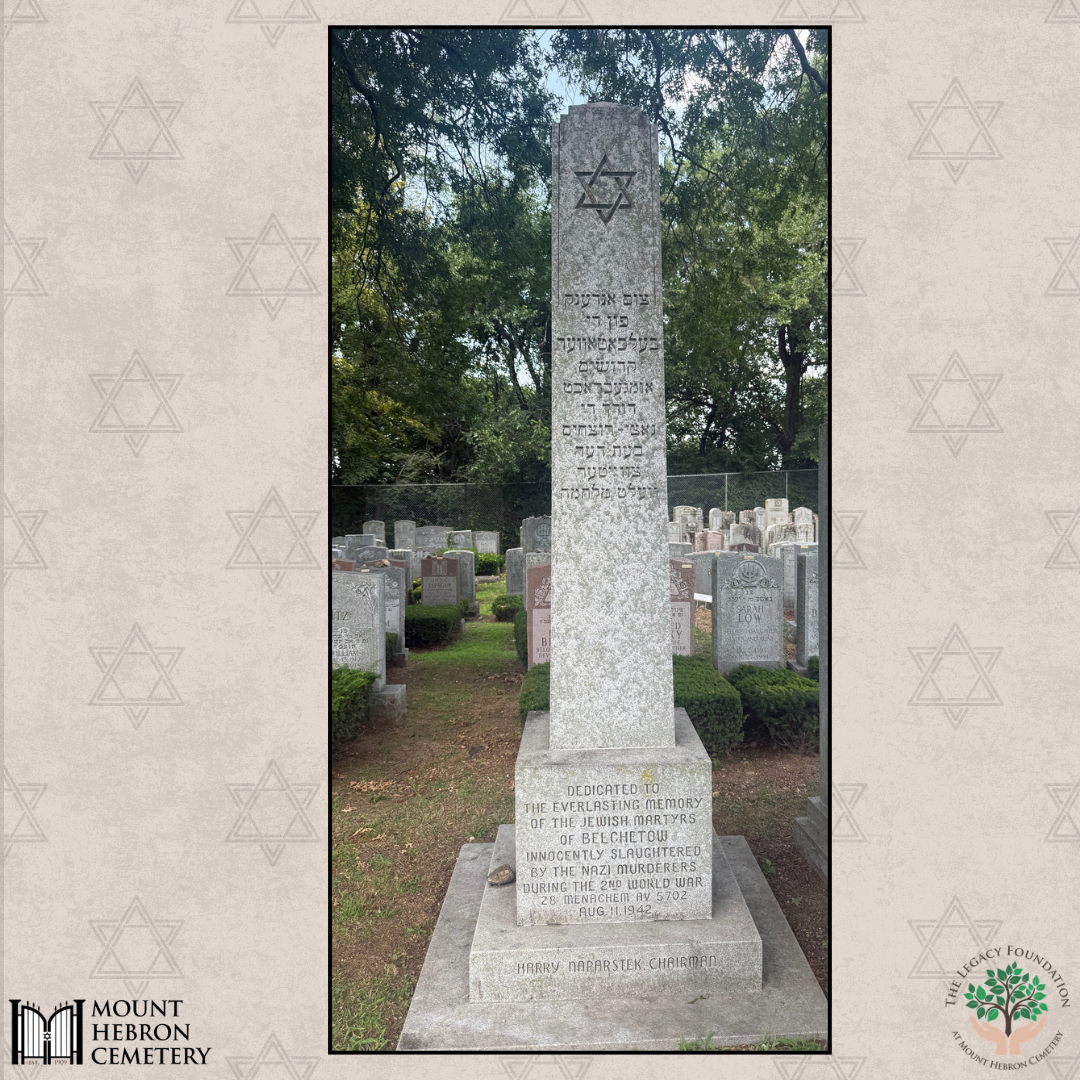
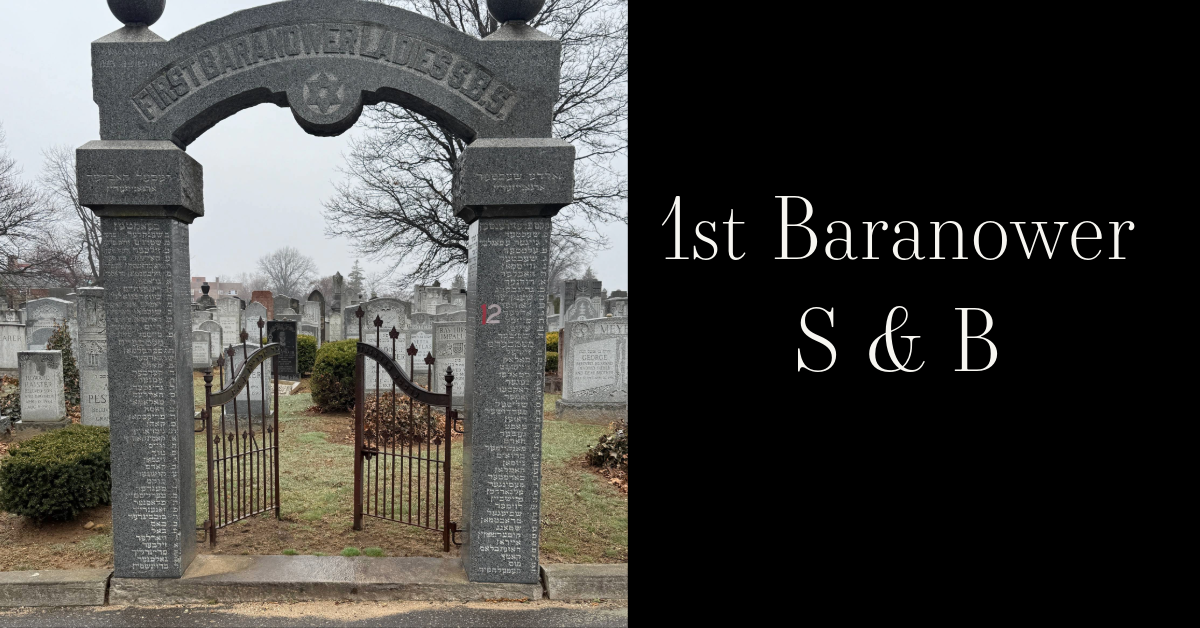
The Independent Belchatower Young Men's Benevolent Association traces its roots to Belchatow, a small town in central Poland where Jews settled over generations and came to dominate the local textile trade. By 1939 roughly half the town, some 5,500 people, was Jewish, until German forces arrived that September and subjected the community to escalating persecution, forced labor, and confinement in an open ghetto. In August 1942 the Germans carried out mass deportations to Chelmno, holding thousands in the synagogue for three days without food or water before sending them to their deaths. No Jewish community was ever reestablished in Belchatow, and the society's monument at Mount Hebron now stands as one of the few lasting memorials to the town's lost Jews.~Blog by Sophie Hunter
From Bełchatów, Poland to Mount Hebron
The Independent Belchatower Young Men’s Benevolent Association is a landsmanshaft that has ties to the town of Bełchatów in Poland. Bełchatów is a small town located in the center of Poland in the district of Piotrkow. In 1764, there were 7 Jews who were recorded as living in the town. Life in the town was very difficult as there was poor soil for growing crops, little natural water and a lack of infrastructure between the town and larger nearby cities. However, over time Jews came to settle in the town from other parts of Poland, usually working in the textile industry as during the 1820s the weaving industry rapidly expanded. By 1867, 13 out of the 16 textile factories in the town were owned by Jews and by 1897 there were 2,897 Jewish people living there out of a total of 3,859 people. The textile industry continued to grow and at the end of the 1800s there were 32 textile factories in the town. Whilst the factories offered employment, wages were often low.
In 1939, around half of the population of Bełchatów was Jewish, this amounted to around 5,500 people. Near the beginning of the Second World War the Germans took over the town. They arrived on the 5th of September 1939 and immediately began tormenting the Jewish people. They took over Jewish people’s apartments, desecrated holy objects and forced them to eat non-kosher foods. Jewish people were also forbidden from trading with non-Jewish people. A Jewish council called a Judenrat was formed. One of the roles of the council was to assign people to forced labor tasks, distribute foods and provide medical care.
In 1940 the Germans considered establishing a ghetto in Bełchatów, however due to the topography of the town they decided this was not possible. However, on March 1st, 1941, they set up an open ghetto, where there were several streets where the Germans allowed the Jews to live. The open ghetto had defined boundaries, but it was not enclosed. As it was not enclosed the Jewish people were allowed to move around the town, however, they had to adhere to a curfew. Conditions were very difficult for Jews living in Bełchatów, many had to sell their personal possessions to buy food. Whilst some traded illegally, they risked being arrested and tortured.
In April 1941 the Judenrat were told that all men between the ages of 18 and 45, who were not employed in garment-manufacturing workshops were required to report to the Kluk Company. From the roughly 2000 men who were rounded up, 250 people were chosen to be sent to the Poznań region for forced labor. Then a few weeks later, a further group of around 500 men were sent to Poznań. The loss of so many men made it very difficult economically for lots of families.
Towards the end of 1941 Jewish people were brought to Bełchatów from neighboring towns, including from Szczerców, Grocholice, Kleszczów and Chabielice. The influx of so many new people led to worsening conditions in the ghetto. Overcrowding and poor living conditions resulted in poor sanitation This, alongside poor medical care led to an outbreak of Typhus near the beginning of 1942. As a result of the outbreak another doctor was allowed into the ghetto.
On the 18th of March 1942, the Gestapo ordered the Gendarmerie to hang 10 Jews in public to create fear within the Ghetto for anyone who repeatedly violated the economic regulations. Later in August of the same year the Germans began deporting large numbers of Jews. The night before, some Jews tried to escape by running in the direction of Piotrków, however, unfortunately, many of them were shot and killed. The Jews left in the open ghetto were rounded up on August 11th early in the morning and taken to the center of the town. Some of the Jews, including the elderly and the sick were taken to the death camp in Chelmno. Whilst around 850 able-bodied Jews were taken to the Łódź ghetto for forced labor. From the remaining Jewish population, of around 4,000, many were forced inside the synagogue. They were locked inside in extremely cramped conditions with no food or water for 3 days, leading to many older people and children dying from suffocation and starvation. After the three days they were deported to Chelmno.
Prior to the deportations the Germans selected around 200 men from the synagogue to go through all the Jewish houses and remove all valuable property. They also had to send any useful mechanical equipment to the Łódź ghetto. On the fourth day, 79 of the men were sent to Łódź ghetto. It is not known what happened to the remaining men.
Whilst the town of Bełchatów now has a population of around 60,000 people, a Jewish community has not been reestablished there.
Sources
https://www.museumoffamilyhistory.com/hm-belchatow-mh.htm
https://muse.jhu.edu/document/2382
https://www.mybelchatow.org/history/
https://jewishvirtuallibrary.org/belchatow
~Blog by Sophie Hunter