A Long Way From Cairo
There is a photograph that exists in the imagination even when it does not exist in a drawer or an album or a shoebox under the bed. It is Cairo in 1946, the year Myra Nahum came into the world, and in that photograph the city is golden and complicated and humming with a kind of life that would not last much longer.
Cairo in 1946 was one of the great cities of the world, though the world did not always think of it that way. It was a place of layers, ancient and modern pressed up against each other at every corner, the call to prayer mixing with the noise of European cafes and tram cars and the smell of jasmine and exhaust and the Nile in the distance, always the Nile, older than everything. Egypt had just emerged from the Second World War largely intact, having served as a crucial Allied base in the North African campaigns. British troops were still stationed in the Canal Zone. King Farouk sat on the throne, rotund and unpopular, and the country was simmering with the kind of political unrest that would, within a few years, boil over entirely.
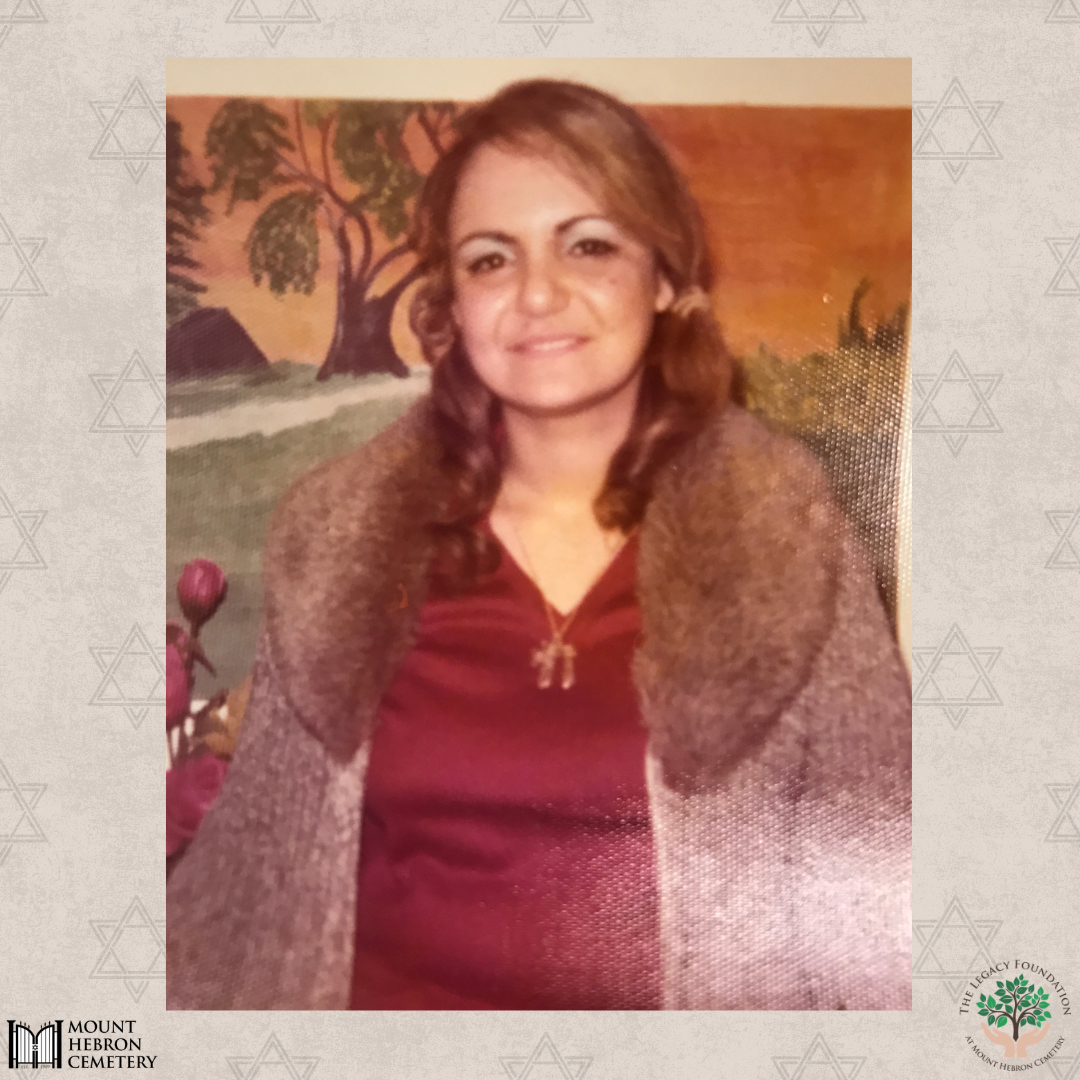
Into this world came Myra, the only child of Ines and William Nahum.
The Nahums were part of Egypt's Jewish community, a community that had existed along the banks of the Nile for centuries, long before most people think of Jewish history in that part of the world. At its peak in the first half of the twentieth century, Egypt's Jewish population numbered nearly eighty thousand people, concentrated largely in Cairo and Alexandria, woven into the fabric of commerce and culture and intellectual life. They spoke French and Arabic and Ladino and sometimes all three in the same sentence. They were bankers and merchants and doctors and artists. They built synagogues and schools and community organizations. They were Egyptian, fully and deeply, and they were also Jewish, fully and deeply, and for a long time those two things coexisted without contradiction.
Myra grew up in that world, the only child of parents who loved her and expected things of her in the way that only children of that community and that era were expected to fulfill. She would marry well. She would marry an educated man, a religious man, an Egyptian Jewish man who would bring stability and respectability to the family. She would conform to the shape that the community had drawn for the daughters of good families. This was not cruelty on her parents' part. It was the only map they had.
But Myra did not fit the map.
She was, by her own nature, someone who moved differently through the world than her parents had imagined she would. She did not bring home the right boys. She did not follow the expected path. Her parents, struggling to understand a daughter who confounded their every expectation, came to believe that something was wrong with her, not merely with her choices but with her mind. They were not entirely wrong. Myra was eventually diagnosed with schizophrenia, a word that in the mid-twentieth century carried a weight of fear and misunderstanding that is difficult to fully appreciate today.
Schizophrenia in those decades was treated with something closer to punishment than medicine. Electroconvulsive therapy, shock treatments as they were called, was administered with a frequency that would today be considered extraordinary. Myra received nineteen of them. Nineteen times she was brought into a room and rendered unconscious by an electric current passed through her brain. By the time it was over, the person who emerged was quieter than the person who had gone in. Childlike, her family said. The treatments had done something to her that the illness alone had not fully done. They had taken the sharp edges off a personality that, in another time, might simply have been called unconventional.
The world was changing around her even as her own world contracted. In 1948 Israel declared independence and the region convulsed. Egyptian Jews began to feel the ground shift beneath them. After the 1952 revolution that brought Gamal Abdel Nasser to power, the situation grew worse. The Suez Crisis of 1956 was the breaking point for many. Thousands of Egyptian Jews were stripped of their citizenship, their property seized, their businesses nationalized. Families that had lived on the banks of the Nile for generations packed what they could carry and left for Israel, France, Brazil, England, the United States. By the 1960s the Jewish community that had numbered eighty thousand was reduced to a few thousand and dwindling. The synagogues emptied. The schools closed. An entire world disappeared so quietly that most of the world did not notice.
The Nahums came to New York, as so many did, carrying their language and their recipes and their memories of a Cairo that no longer existed in the form they had known it. They settled into the life of Jewish immigrants in New York City, a city that had absorbed so many waves of newcomers that it had developed a kind of genius for it, a way of letting people be fully themselves while also becoming fully New Yorkers. But for Myra, the transition was hard. She had no husband, no career, no community of her own. She was, by then, a young woman whose illness and its treatments had left her in a precarious place, dependent on the social safety net of a city that tried, not always successfully, to catch the people who fell through its cracks.
She lived on welfare. She lived in apartments provided by the government in neighborhoods that were not safe, in buildings that were not cared for, in conditions that no one who loved her would have chosen for her. This was New York in the 1970s and 1980s, a city that was itself in crisis, that had nearly gone bankrupt in 1975 and had spent the decade after trying to pull itself back from the edge. The social services that were supposed to support people like Myra were stretched impossibly thin. She fell through the gaps, the way so many people did, not because anyone wanted her to fall but because the gaps were very wide and the net was very frayed.
Her mother grew old. Her father died. And Myra went on living her quiet, difficult life in apartments the government assigned to her, in neighborhoods the city had largely given up on, getting older in the way that people get older when no one is really watching.
And then something shifted.
A family friend, someone who had known the Nahums for years, looked at the situation and decided it was not acceptable. That Myra's mother, now a widow and elderly, deserved to have her daughter nearby. That Myra deserved better than the life she had been living. The friend convinced Myra's mother to act. They went looking for an apartment. Myra's uncle, a wealthy man without children of his own who had watched his niece's life from a distance for years, sent the funds. They found a place in Forest Hills, Queens, a beautiful apartment in a high rise, a real home, the kind of home that Myra had never had as an adult.
She was in her late sixties when she moved in.
She was so happy.
That is a sentence worth sitting with. She was in her late sixties, a woman who had spent most of her adult life on welfare in government housing in difficult neighborhoods, a woman who had received nineteen rounds of electroconvulsive therapy, a woman who had been called troubled and wrong by the people who were supposed to love her most. And she moved into a beautiful apartment in Forest Hills, Queens, and she was so happy.
She cared for her mother in that apartment. Faithfully, tenderly, with the devotion of a daughter who had never stopped loving her parents even when their love for her had been expressed in painful ways. When her mother died, the family friend stepped in fully, providing what Myra needed, making sure she was comfortable, making sure she was not alone. Myra was not demanding. She was not difficult. She was kind and generous and grateful in the way that people are grateful when someone finally sees them.
Her last years were good years. Real years. Years with warmth in them.
She died suddenly at seventy-three. The friend who had helped bring her home grieved her and felt, underneath the grief, something quieter. Gladness that there had been a few years, at the end, when Myra had a home that was worthy of her and a friend who truly knew her and a life that finally felt like enough.
The Jewish community Myra was born into in Cairo in 1946 is gone now. The synagogues have been converted or abandoned. The schools are empty. The families scattered to four continents, carrying their stories with them wherever they landed. Some of those families put down roots in Queens. Myra was one of them.
She was not the woman her parents expected her to be. She was someone who had been through things that would have broken many people and who came out the other side with her kindness intact. That is its own kind of strength.
She deserved every moment of the happiness she found.
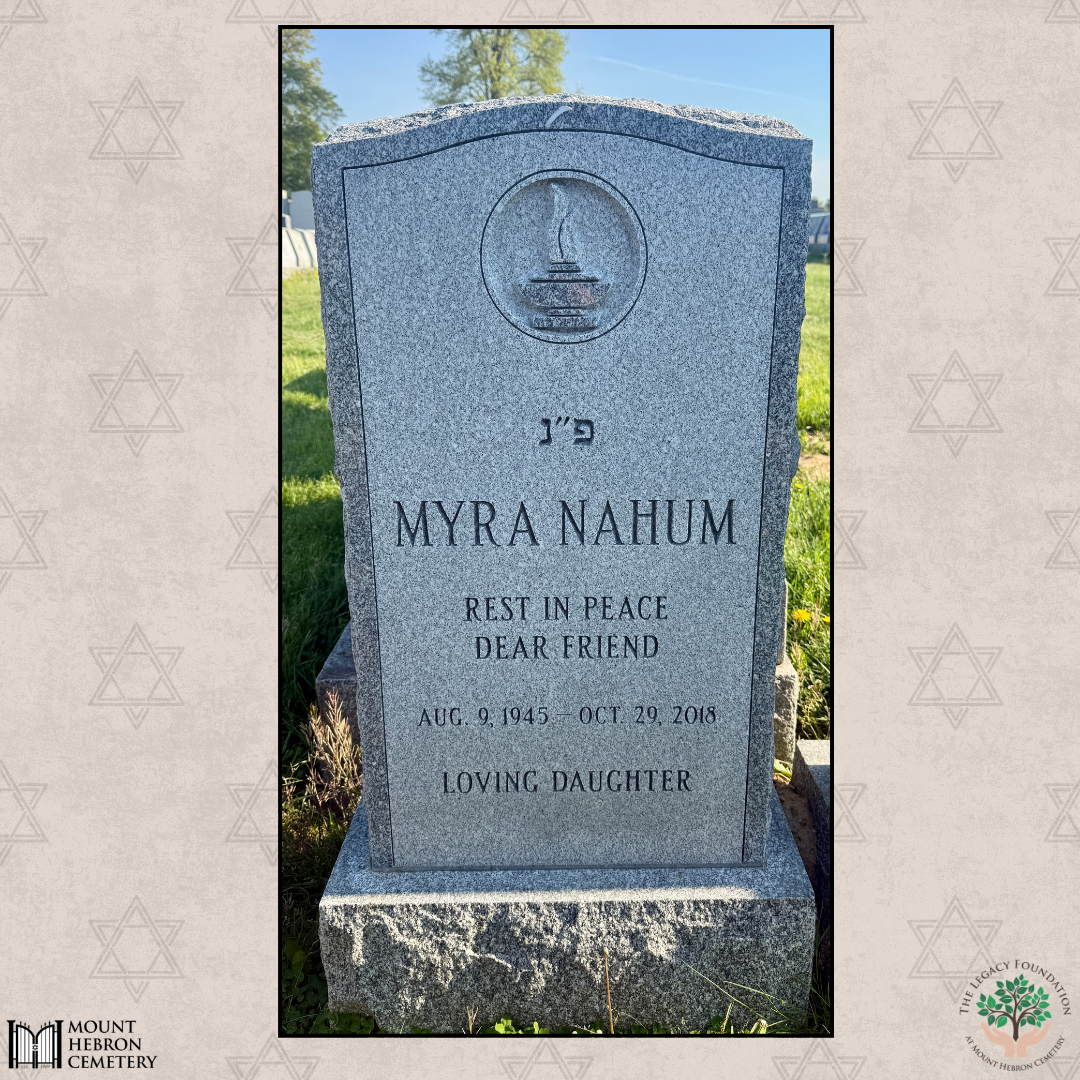
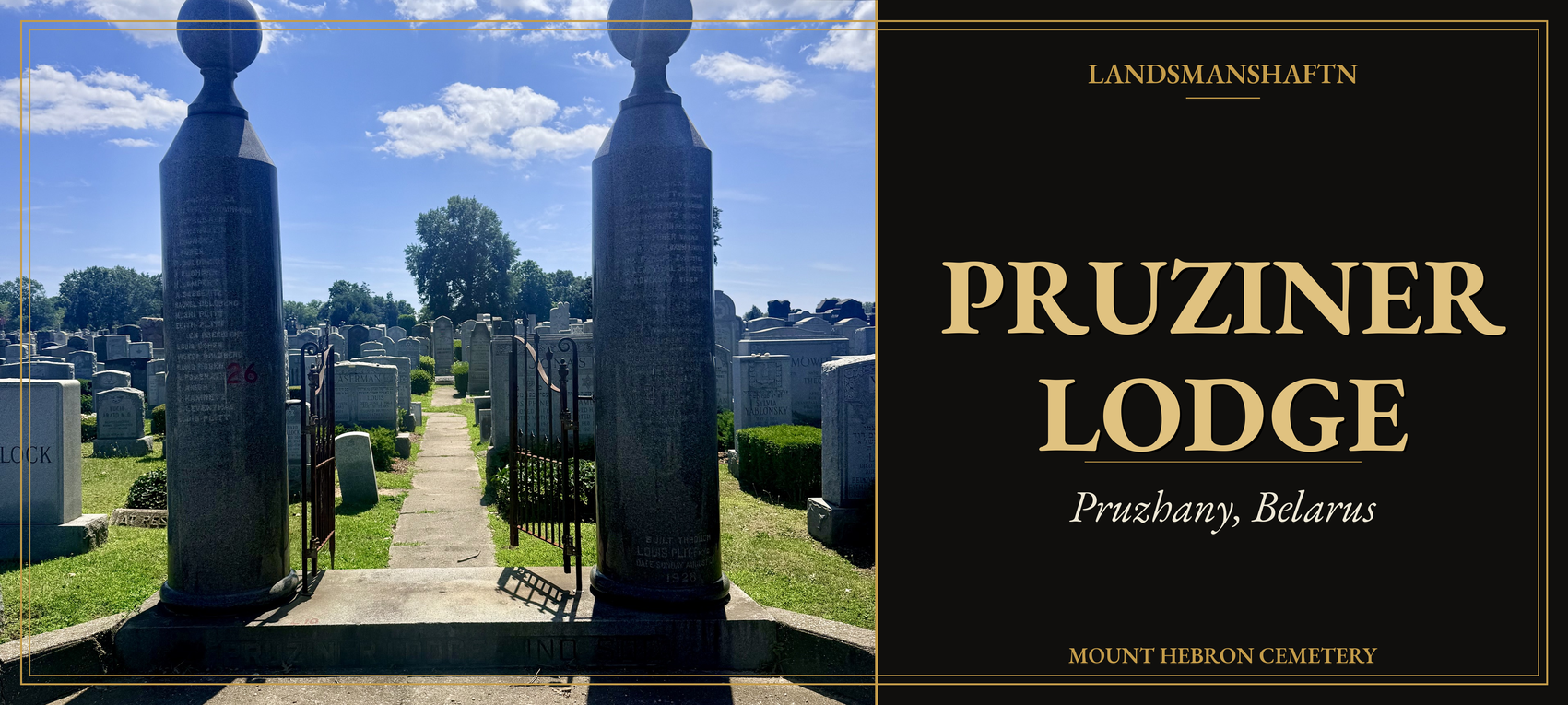
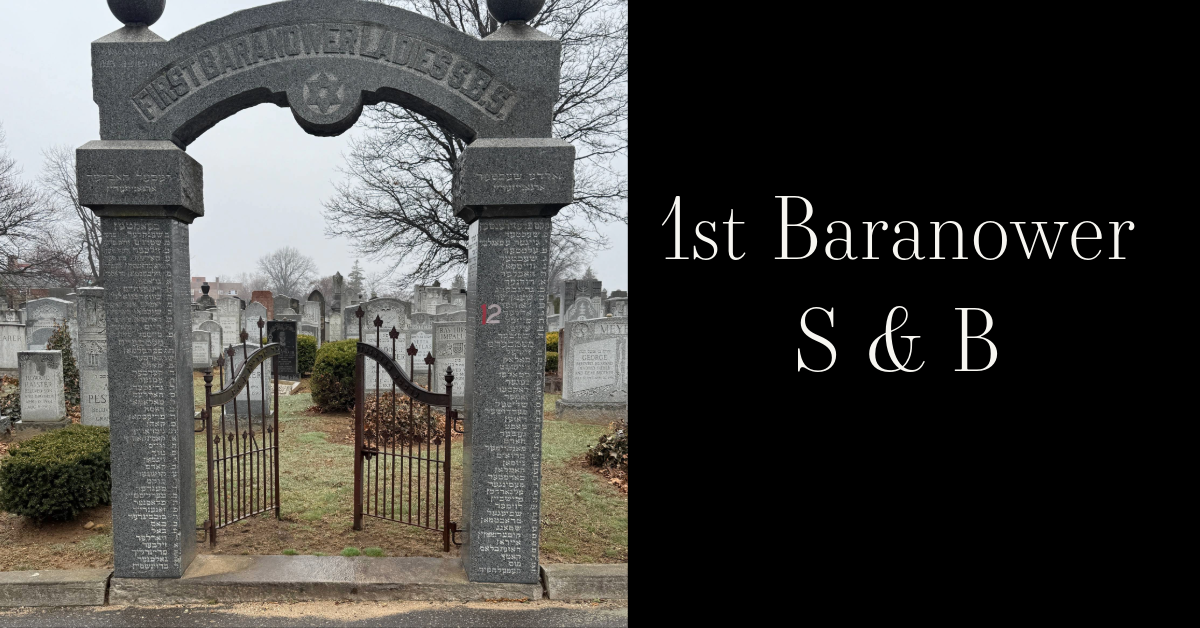
Myra Nahum rests at Mount Hebron Cemetery in Flushing, Queens. She came a long way from Cairo, from the golden complicated city on the Nile where she was born, from the hard years in between, from everything the world asked of her that she never quite deserved. She arrived here, in Queens, where she found peace at last. We are honored to keep her memory.
~Blog by Deirdre Mooney Poulos & Deborah Minch