Story Summary:
The Rozdol Society monument at Mount Hebron Cemetery stands as a tribute to the once vibrant Jewish community of Rozdol, a Galician town in present-day Ukraine. Founded by immigrants who fled persecution and poverty in the early 20th century, the society offered support through burial arrangements and community care. During the Holocaust, most of Rozdol's Jews were deported to Belzec or killed in mass shootings. The society's role became one of remembrance. The granite memorial, engraved with Hebrew prayers and the names of its officers, preserves the memory of a destroyed town and the resilience of those who ensured its legacy would not be forgotten. ~Blog by Deirdre Mooney Poulos
Stone Witnesses: The Rozdol Society and the Memory of a Vanished World
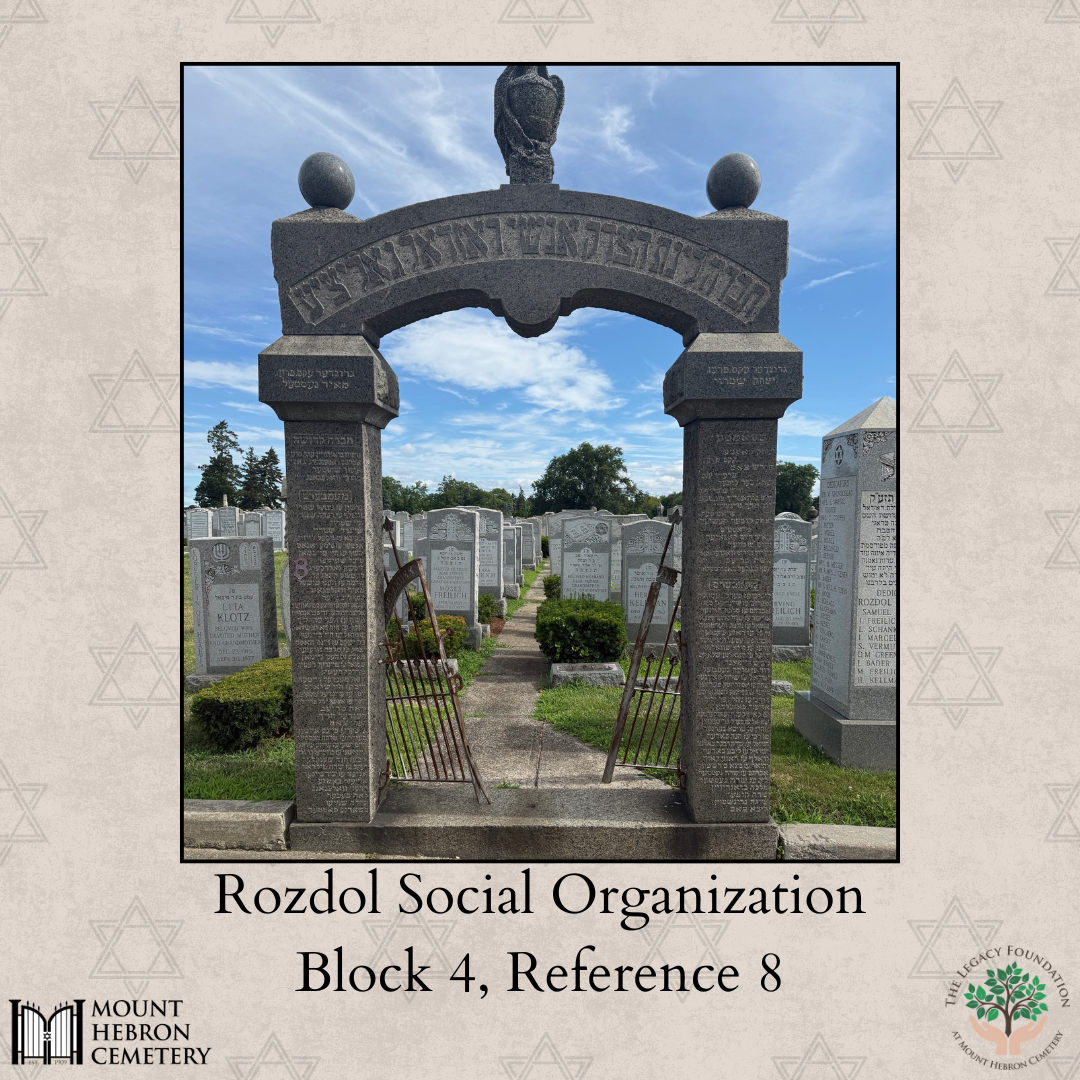
In a quiet row of Mount Hebron Cemetery in Queens, New York, stands a striking gray monument bearing a Hebrew inscription and the engraved names of leaders from a long dormant society. The stone is not simply a grave marker; it is a public act of remembrance. Erected by the Rozdol Society, Inc., this monument honors the Jews of Rozdol, a once thriving Galician town in what is now Ukraine. Though small in number today, the Rozdol Society’s presence in Mount Hebron keeps alive the memory of a Jewish community extinguished by war, yet carried forward by its American descendants.
Rozdol, also spelled Rozdil, is located along the banks of the Dniester River in western Ukraine’s Lviv region. Once a private town of the Polish nobility, Rozdol developed a strong Jewish presence as early as the 17th century. By the 1880s, Jews made up more than half the town’s population. Life in Rozdol was centered around guilds of craftsmen, study halls, a bustling synagogue, and a communal sense of obligation shaped by centuries of rabbinic leadership. As in many parts of Galicia, Jewish Rozdol was steeped in tradition but also faced the creeping shadows of antisemitism, poverty, and periodic outbreaks of violence.
The first major emigration wave began in the late 1800s, following regional unrest and economic collapse. Pogroms elsewhere in the Russian Empire reverberated in the minds of Rozdol's residents, and the promise of opportunity in America grew too powerful to ignore. By the early 20th century, a steady stream of Jews from Rozdol had made their way to New York City. Settling mostly in the Bronx and Brooklyn, they joined or established mutual aid groups known as landsmanshaftn, societies built around shared hometowns.
The Congregation Linas Hazedek Anshe Rozdol Galicia, commonly referred to as the Rozdol Society, was one such organization. More than just a benevolent society, it was a spiritual continuation of the old town. Members paid dues to support the sick, arranged funerals, hosted holiday events, and secured cemetery plots where families could be buried among their own. The society’s name, combining a traditional phrase meaning “those who act with righteousness” with “Anshe Rozdol,” or “People of Rozdol,” reflected its dedication to both faith and communal care.
The granite monument now visible at Mount Hebron tells a story carved in stone. Beneath the Hebrew invocation are the names of society officers: Samuel Strahl, I. Freilich, L. Schankler, and others. Their titles—Chair, President, Treasurer—may seem administrative, but their roles were acts of devotion. These were not just bookkeepers; they were stewards of a collective memory. Their efforts ensured that long after the accents faded and descendants moved to the suburbs, Rozdol would not be forgotten.
But the gravest reason for this memorial lies in what happened to those who stayed behind. In the early years of World War II, Rozdol fell under Nazi control. In September 1942, most of the town’s Jews were deported to the Belzec extermination camp. Those who remained were murdered in mass shootings in February 1943. The wooden synagogue, rebuilt after an earlier fire, was again destroyed. Very few Jews from Rozdol survived.
It is this devastation that gives the Rozdol Society’s monument a deeper meaning. Though built in the safety of postwar America, it memorializes an annihilated world. The Hebrew epitaph commemorates the holy community of Rozdol and prays for their memory to be a blessing. No longer a mere list of officers or names, it stands as a Holocaust memorial in its own right, a sacred marker of what was lost and who cared enough to preserve it.
Today, the Rozdol Society no longer meets. Its leaders have long since passed, and its records are scattered across archives and family albums. Yet the society’s monument remains an enduring voice. In its shadow, visitors glimpse not only the history of Rozdol but also the resilience of those who rebuilt their lives in a foreign land while carrying forward the burden of memory. It is a reminder that while towns may vanish and communities may perish, the act of remembrance keeps their legacy alive.
~Blog by Deirdre Mooney Poulos
Work Cited:
JewishGen:
https://www.jewishgen.org
Yad Vashem:
https://www.yadvashem.org
United States Holocaust Memorial Museum:
https://www.ushmm.org
KehilaLinks - Rozdol:
https://kehilalinks.jewishgen.org/rozdol/rozdol.html
Virtual Shtetl (Museum of the History of Polish Jews):
https://sztetl.org.pl