Story Summary:
The Glogower UV Society, founded in 1896 by Jewish immigrants from Glogow Malopolski, Poland, served as a vital mutual aid organization that provided burial benefits, community support, and cultural continuity for Eastern European Jews in New York. Rooted in traditions brought from their Galician hometown, the society offered a lifeline for immigrants adjusting to American life, while also preserving ties to a community tragically destroyed during the Holocaust. The graves they arranged at Mount Hebron and Acacia Cemeteries now stand as enduring monuments to both the resilience of immigrant life and the memory of a lost Jewish world. ~Blog by Deirdre Mooney Poulos
“From Glogow to Queens: How a Small Town’s Memory Was Etched in Stone”
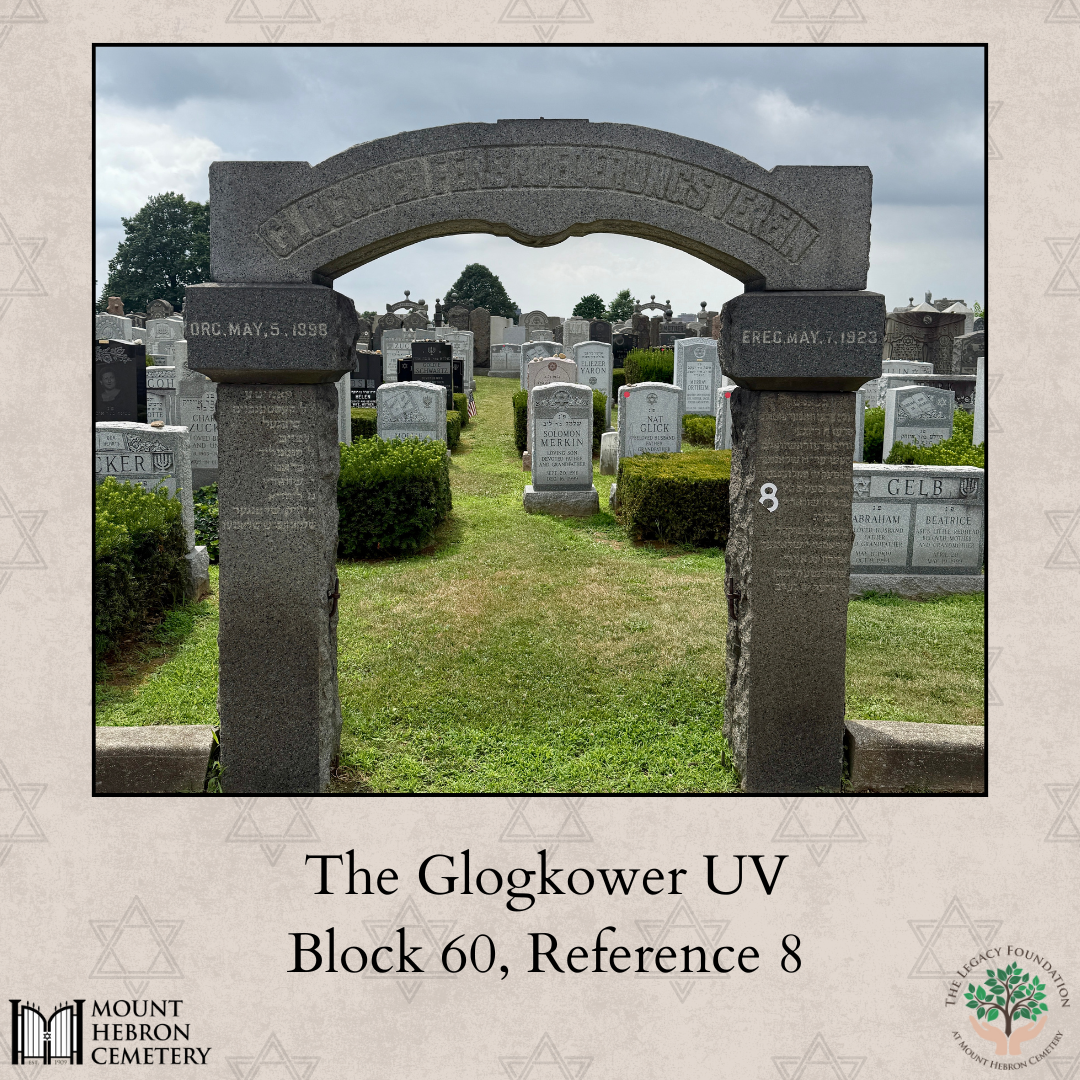
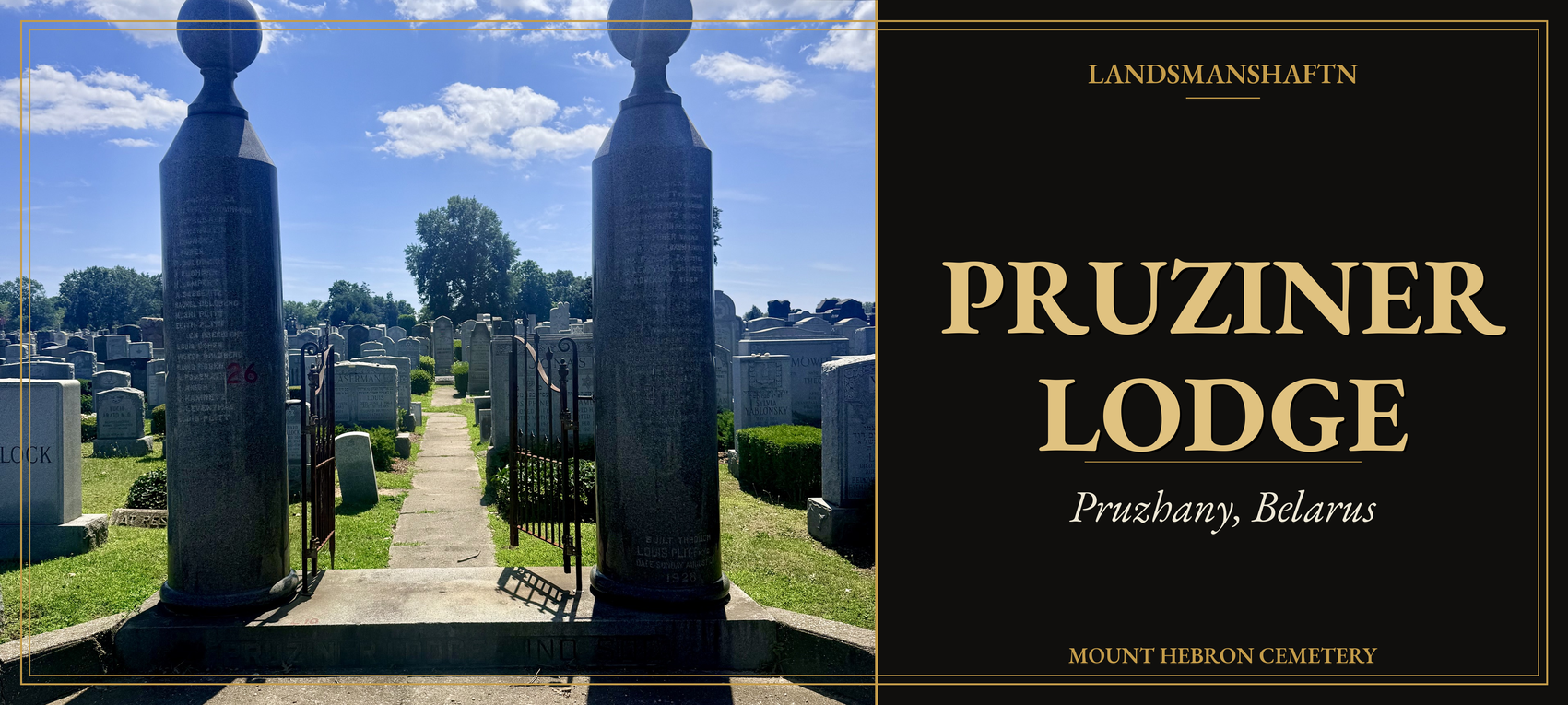
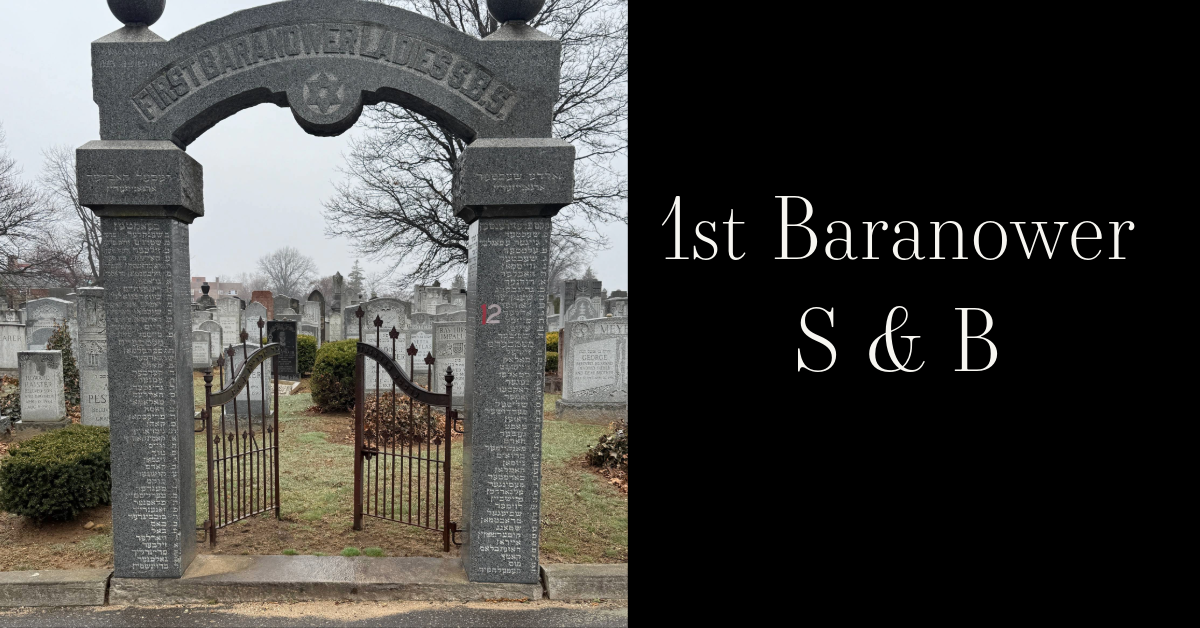
The Glogower “UV” Society, founded in 1896 by Jewish immigrants from Glogoww Malopolski, Poland (formerly part of the Austro-Hungarian Empire and known in German as Glogau), represents a poignant chapter in the American immigrant experience. Like many mutual aid societies established by Eastern European Jews at the turn of the 20th century, the Glogower “Unterstutzungs-Verein” served as a crucial support network. In an era without public welfare systems, societies like this provided sickness and death benefits, organized burials, and helped maintain community solidarity among immigrants struggling to adapt to urban life in America. The Glogower “UV” Society was formally incorporated in 1937 and operated into the late 20th century. It arranged subsidized burials at Acacia and Mount Hebron Cemeteries, particularly in the Cedar Grove section, where headstones still bear its name and legacy (Mount Hebron Cemetery).
The members of the society hailed from Glogoww Malopolski, a town in southeastern Poland with a Jewish presence dating back to at least the 17th century. During the 19th and early 20th centuries, the region was part of Galicia, a multi-ethnic province of the Austro-Hungarian Empire. Jews in towns like Glogow lived in tight-knit communities and were often marginalized politically and economically. Faced with rising antisemitism, military conscription, and economic hardship, many chose to emigrate. Between 1880 and 1920, more than two million Jews fled Eastern Europe, with large numbers settling in American cities like New York. According to the Library of Congress, these immigrants brought with them not only hopes for a better future but also a determination to reestablish the mutual support networks they had relied on in Europe (Library of Congress).
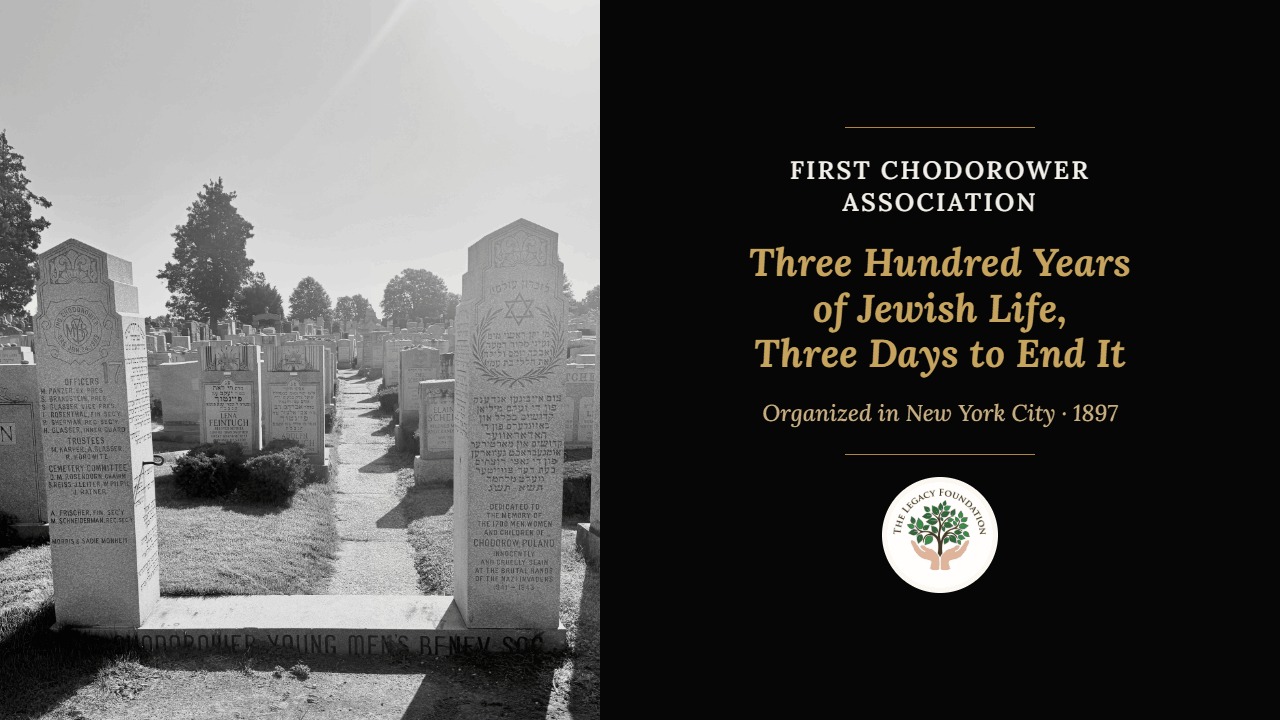
The society’s name, “Glogower UV,” or Unterstutzungs-Verein (Support Association), reflected a Germanic naming tradition common among landsmanshaftn formed by Galician Jews. These were democratic, member-led groups that helped individuals transition into American life while preserving cultural ties to their hometowns. The Glogower UV Society likely served residents of neighborhoods such as the Lower East Side or Brownsville, Brooklyn. In addition to burial benefits, it provided assistance during illness or unemployment, hosted holiday gatherings, and functioned as a cultural anchor. Their burial plots at Mount Hebron and Acacia Cemetery offer more than genealogical insight. They stand as physical testaments to the continuity of memory across generations. Headstones marked with the society’s name evoke a shared identity that survived relocation and reinvention (Mount Hebron Cemetery).
While the descendants of Glogow Malopolski’s Jewish emigrants built new lives in the United States, the town’s remaining Jewish population was erased during the Holocaust. By 1941, only 45 Jews were left in Glogow, and all were eventually deported to ghettos and forced labor camps. One known figure, Edek Rebhum, served in the Jewish police in the local ghetto, escaped, joined the partisans, and was later killed. His portrait and story are preserved in the archives of the United States Holocaust Memorial Museum (USHMM). No Jewish community reemerged in Glogow after the war, and today a monument stands where the synagogue once stood, commemorating the lives that were lost. The society members buried in New York, in contrast, are among the few who were able to preserve a collective memory of the town and its people.
Today, research into societies like the Glogower “UV” is critical to understanding the foundation of Jewish communal life in America. The cemeteries where these societies purchased plots function as outdoor museums. Each stone, each Hebrew inscription, is a piece of history. For genealogists, students, and descendants, these stones connect the personal with the historical. Digital tools such as JewishGen’s KehilaLinks and the USHMM’s survivor and photograph archives allow for deeper understanding of towns like Glogow Malopolski and the communities lost to war. These organizations enable users to reconstruct Jewish life in prewar Poland, including traditions, family structures, and the catastrophic rupture of the Holocaust. Through these efforts, and through the physical legacies left in cemeteries like Mount Hebron, the memory of Glogow’s Jewish community continues to endure.
~Blog by Deirdre Mooney Poulos
Work Cited:
United States Holocaust Memorial Museum – Edek Rebhum Photograph
https://collections.ushmm.org/search/catalog/pa17192
Library of Congress – “A People at Risk” Immigration Article
https://www.loc.gov/classroom-materials/immigration/polish-russian/a-people-at-risk/
JewishGen KehilaLinks – Głogów Małopolski Town History
https://kehilalinks.jewishgen.org/Kolbuszowa/sokolow/Sokolow7.html