Story Summary:
Rzeszow, Poland had a Jewish community dating back to 1550, and by 1931 nearly half the city's population was Jewish. German forces occupied the city in September 1939 and immediately imposed forced labor, curfews, and identifying armbands on Jewish residents. By December 1941 the entire Jewish population, nearly 22,000 people, was sealed inside a ghetto with little food or medicine. On July 7, 1942 SS troops marched residents to the old Jewish cemetery and deported most of them to Belzec Extermination Camp, where they were killed. The ghetto was finally closed in September 1943, and the last survivors were sent to Szebnie or Auschwitz.~ Wriiten by Sophie Hunter
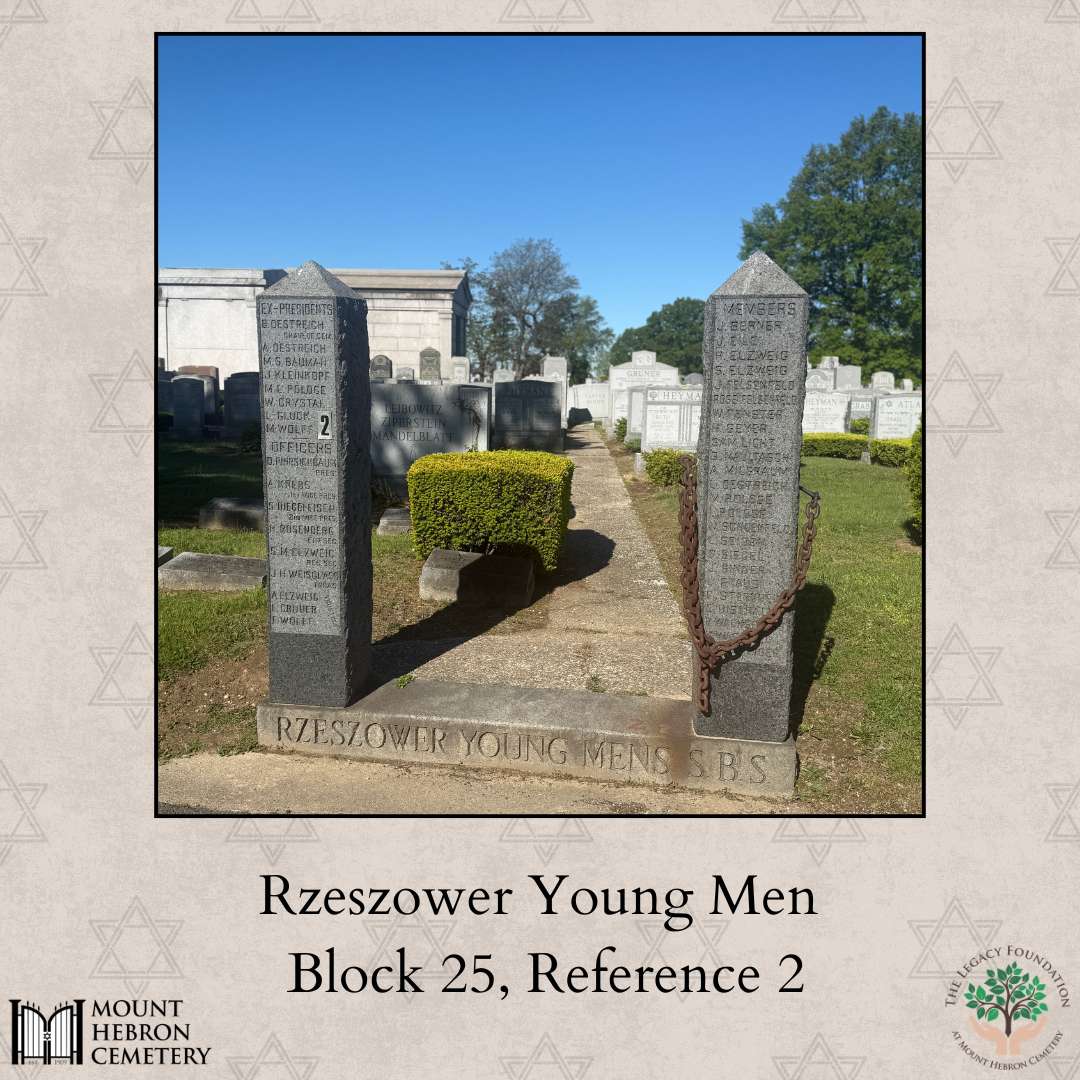
Rzeszower Young Men: A Community Remembered
RZESZOWER YOUNG MEN Rzeszow, Poland
Rzeszow is a city founded in 1354, located in southeastern Poland. The private owners of the town supported the residence of Jews, and records indicate that Jewish people have lived there since 1550, making their living as traders and artisans. By 1592 there were six Jews who owned houses in the city.
By 1931 there were 11,228 Jewish people living in Rzeszow out of a total population of 26,902. In September 1939 the Germans arrived and by September 10th the entire city was under occupation. Upon arrival, the Germans demanded a census of the population, including a separate listing of all Jewish residents. Jewish people were required to perform menial labor such as street cleaning and bridge construction, while others were assigned to work in offices. The changes came quickly. Synagogues were vandalized and damaged. The Jewish hospital was converted into a military installation. Germans seized the apartments of wealthy Jews.
By the end of October 1939, a Jewish council called a Judenrat was established. It was made up of 30 people and led by an attorney. The Judenrat was required to raise funds to hand over to the Germans and to organize the forced labor quota. A Jewish police force was also founded. The Germans imposed strict regulations on the Jewish population. Everyone over the age of 12 was required to wear a blue Star of David armband. A 7pm curfew was enforced and freedom of movement was severely restricted.
In December 1939 Jews from surrounding areas were forcibly relocated to Rzeszow. Those deemed physically fit by a physician were required to register with the Arbeitsamt, the Labor Office. In 1941 the Germans, who had renamed the city Reichshof, began establishing a ghetto. In June 1941 Jewish residents were ordered to leave their homes and move to streets designated as part of the ghetto, though the ghetto was not officially announced until December 1941. In some parts of the city, buildings fell within the ghetto boundaries while the streets outside did not. Residents in these areas were forced to navigate by making holes in walls, crossing balconies, or using improvised passageways.
By December 1941 all Jewish residents were confined to the ghetto. In January 1942 notices were posted stating that no one from outside could enter without a special pass. On January 10, 1942 the ghetto was sealed and the windows and doors along its perimeter were boarded up. Approximately 12,500 people were forced to live inside. High rates of illness and a severe lack of sanitation led to significant mortality. The Judenrat established a small hospital, but it lacked beds and medical supplies. Food was scarce, though the Judenrat was granted permission to grow potatoes in a nearby field. A limited number of residents were sent outside the ghetto for forced labor, working at a Luftwaffe factory, on farms, or at military camps.
Within the ghetto, some Jews managed to establish small workshops serving German clients, which allowed them to obtain additional food. An elementary school was set up and vocational training programs were created to teach skills needed for survival, including nursing, carpentry and agricultural work.
On April 30, 1942 German police arrested a number of Jewish residents on accusations of being communists. They were taken to prison, tortured and killed.
By early 1942 the ghetto population had swelled to approximately 22,000 people as Jews continued to be brought in from surrounding towns. Overcrowding became severe and multiple families were forced to share a single room.
The Germans then notified the Judenrat that the ghetto would be evacuated within days. Those deemed unable to work were among the first to be taken. They were told to bring minimal belongings and food for two days.
On July 7, 1942 SS troops, the German police and the Security police forced the Jewish population to leave the ghetto and gather at the old Jewish cemetery. Anyone who moved too slowly was shot on the spot. At the cemetery, possessions were confiscated and the majority were transported to Belzec Extermination Camp, where they were murdered in the gas chambers. Those unfit for labor, including the elderly and hospital patients, were taken to the Rodna Forest and killed. A small number of essential workers and their families were kept at the ghetto.
The ghetto was then reduced in size and divided into two sections, separating those able to work from those who were not. In August 1942 women with children were rounded up and transported to Belzec. In November 1942 an additional 1,500 children were also sent there.
In September 1943 both sections of the ghetto were closed. The approximately 3,000 Jews still living there were rounded up. Some were sent to Szebnie, a forced labor camp. Others were deported to Auschwitz. Around 400 Jews remained at Reichshof, forced to work at an aircraft factory until the summer of 1944.
Sources
https://data.jewishgen.org/wconnect/wc.dll?jg~jgsys~ajhs_pb~r!!1110
https://encyclopedia.yivo.org/article/482
https://www.holocausthistoricalsociety.org.uk/contents/ghettosj-r/rzeszow.html
~Written by Sophie Hunter