Story Summary:
The Progressive Starobiner Benevolent Association was a Jewish mutual aid society founded in New York by immigrants from Starobin, a small town in present-day Belarus, to provide burial support, financial assistance, and community connection for its members. Reflecting the values of many landsmanshaftn, the society offered a way for Starobin's Jews to preserve their identity and traditions in a new land while ensuring dignified burials in plots such as those at Mount Hebron Cemetery. After the Holocaust destroyed the Jewish community of Starobin, the association's work became a lasting memorial to the town's lost Jewish life, preserving its legacy through cemetery gates, society records, and the collective memory of descendants. ~Blog by Deirdre Mooney Poulos
From Starobin to Queens:
The Story of the Progressive Starobiner Benevolent Association
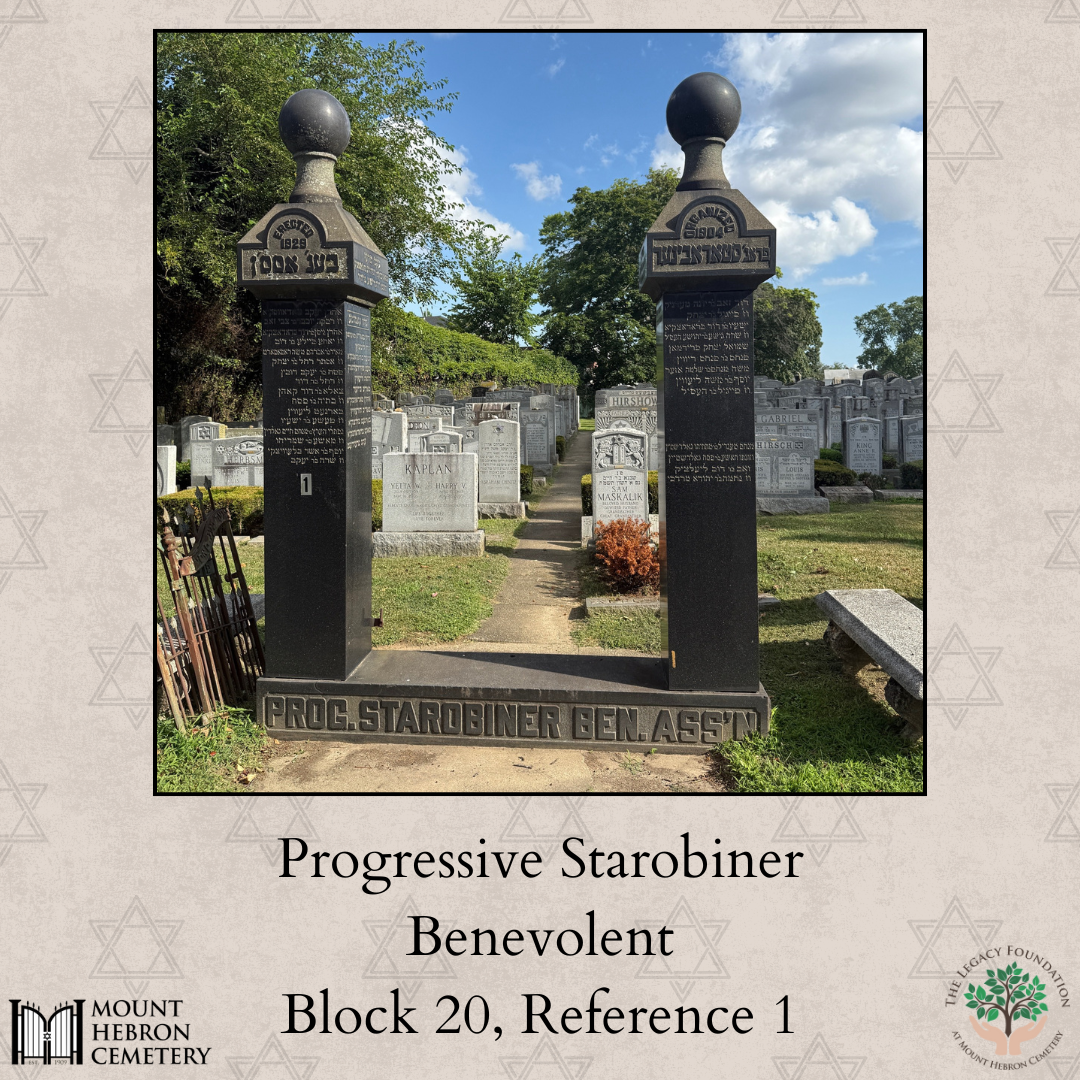
The Progressive Starobiner Benevolent Association is one of the many Jewish immigrant societies established in New York by Jews who came from Eastern Europe in the late 19th and early 20th centuries. This particular society was formed by immigrants from Starobin, a small town in present-day Belarus, to offer mutual aid, burial services, and a sense of community to its members. Like other landsmanshaftn, or hometown societies, the Progressive Starobiner Benevolent Association provided vital support for Jewish immigrants adjusting to life in a new country while maintaining ties to their shared place of origin. The association secured burial plots in cemeteries such as Mount Hebron in Queens, New York, where members could be laid to rest among fellow townspeople, preserving their bond to Starobin even in death.
Starobin, located in the Minsk region of Belarus, was once part of the Russian Empire and later the Soviet Union. It had a small but active Jewish community that traced its roots back several centuries. By the 19th century, Jews in Starobin played an important role in the town’s economy and religious life, with synagogues, schools, and a market-based livelihood. Like many towns in the Pale of Settlement, Starobin’s Jews experienced harsh restrictions, economic hardship, and waves of antisemitic violence, prompting many to emigrate. The mass emigration of Jews from the Russian Empire began in the 1880s and intensified into the early 20th century. Many of those who left Starobin found new homes in New York, where they relied on the support of societies like the Progressive Starobiner Benevolent Association.
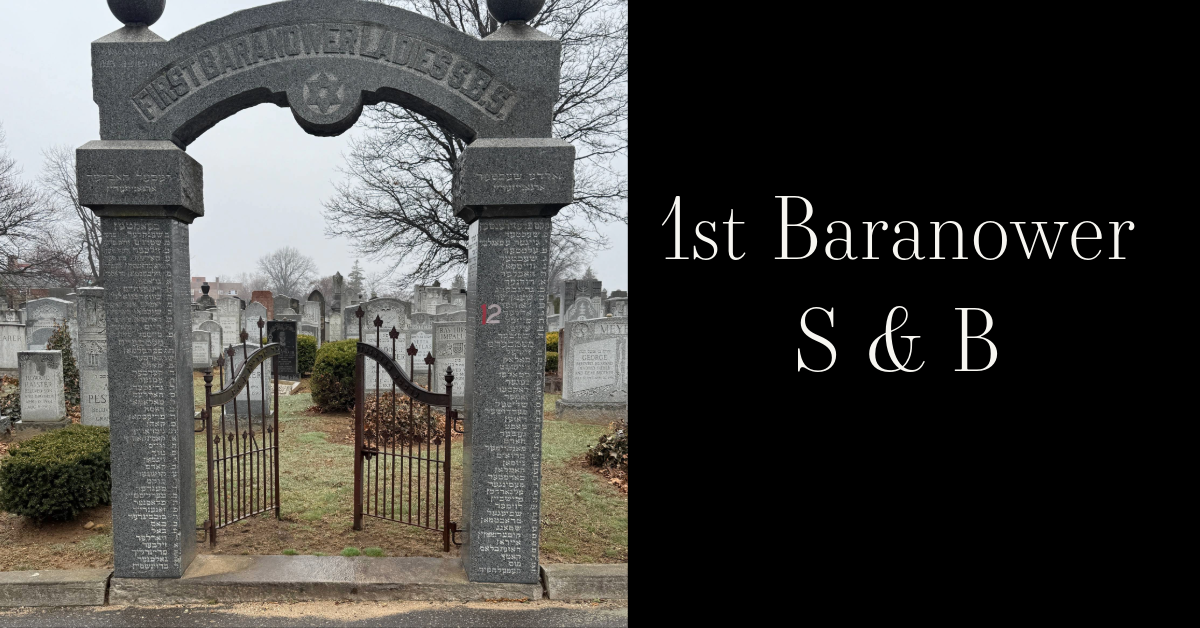
The goals of the association mirrored those of other mutual aid societies: to offer sick benefits, funeral support, burial arrangements, and opportunities for social connection. Members paid regular dues, attended meetings, and participated in religious and cultural events. The burial plots purchased by the association were part of a wider effort among immigrant Jews to ensure a dignified and traditional Jewish burial, often in plots marked with gates bearing the town’s name. These plots became communal resting places that reflected the deeply rooted sense of belonging and identity among immigrants who had left so much behind. The name Progressive Starobiner Benevolent Association suggests a forward-thinking approach that balanced tradition with the challenges of modern immigrant life.
During the Holocaust, the Jewish community of Starobin was destroyed. When the Nazis occupied Belarus, they carried out mass executions of Jews in towns and villages across the region. In Starobin, hundreds of Jews were murdered in mass shootings in 1941 and 1942, erasing a community that had existed for generations. Few survivors remained. As a result, the burial societies and memorials created by earlier immigrants became not only tools of support but also the last surviving links to these lost communities. The Progressive Starobiner Benevolent Association thus took on an additional role: it preserved the memory of Starobin and its Jewish inhabitants through its burial plots, records, and the descendants who continued to honor their ancestors.
Even as active membership in such societies declined over the decades, their legacies endure in cemeteries, historical documents, and family histories. The Progressive Starobiner Benevolent Association remains a symbol of how immigrant communities came together to protect one another and preserve their identities in a foreign land. Through their work, the history of a small town in Belarus lives on in New York, remembered not only in stone but in the stories passed down by generations.
~Blog by Deirdre Mooney Poulos
Work Cited:
JewishGen Communities Database – Starobin: https://www.jewishgen.org/Communities/
United States Holocaust Memorial Museum – Belarus: https://encyclopedia.ushmm.org
Yad Vashem – Central Database of Shoah Victims’ Names: https://yvng.yadvashem.org
Find A Grave – Mount Hebron Cemetery: https://www.findagrave.com/cemetery/65403/mount-hebron-cemetery
Jewish Genealogical Society of New York – Burial Society Index: https://www.jgsny.org
Jewish Virtual Library – History of Jews in Belarus: https://www.jewishvirtuallibrary.org
New York Public Library – Jewish Landsmanshaftn Records: https://www.nypl.org