Lilly Berman – From Paris to New York
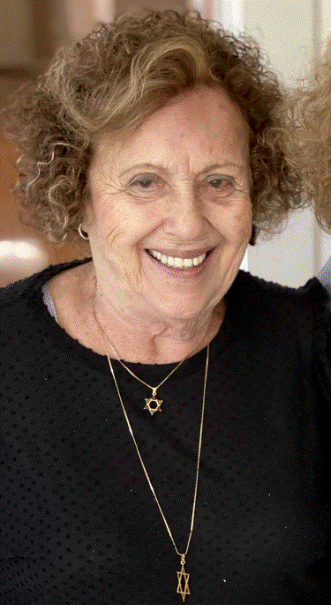
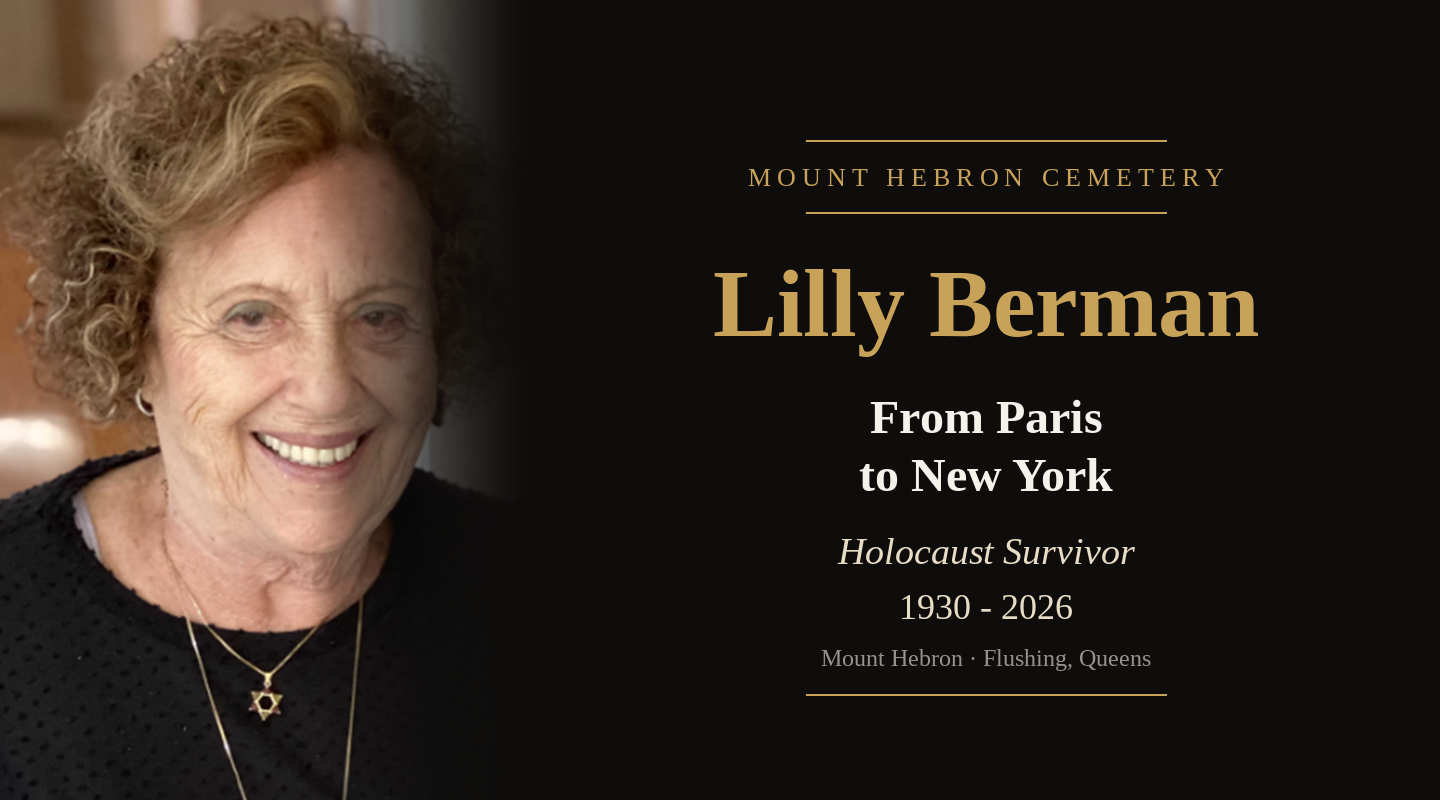
Lilly Berman, born Amélie Gutnic, was born on December 16, 1930, in Paris, France. Before the war came to Paris, she enjoyed a good childhood in the city and loved to read as a child. Her father, Hers Lieb Gutnic, had immigrated from Iasi, Romania, and her mother, Fanny Zaks, had come to Paris from Lodzkie, Poland. They married in 1929 and gave birth to Lilly the next year. Lilly lived with her parents in Paris until the war arrived, and was described as being happy, and especially loving to read throughout her childhood. Unfortunately, this peaceful, normal childhood would be brought to a halt by the outbreak of the Second World War, as the Nazis would occupy Paris in June 1940.
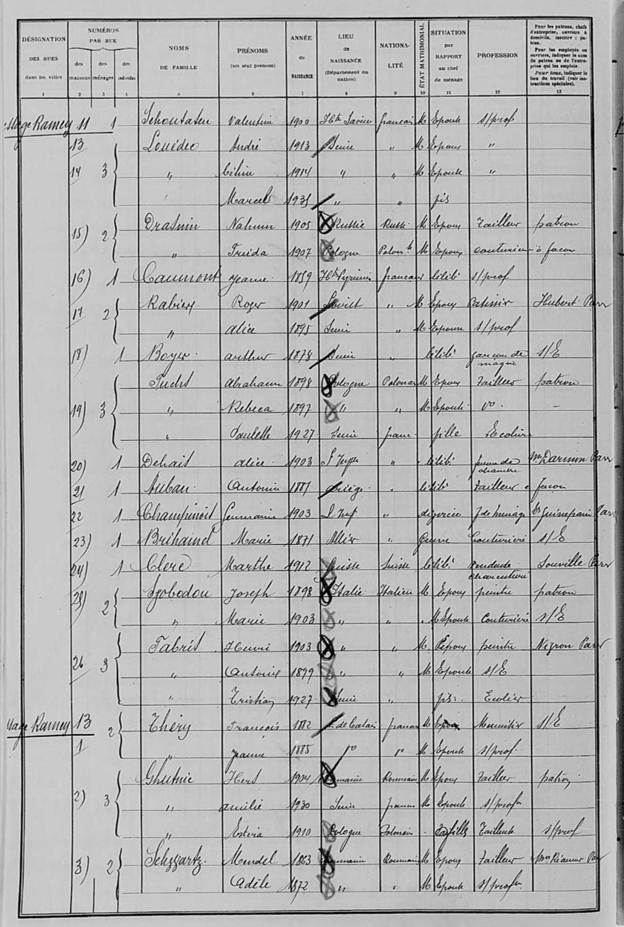
Lilly Berman, listed in the 1936 French Census. She is listed in the Ghutnic household (fourth from bottom), as Amilie, under her father, Hers.
Lilly’s mother worked in Paris as a seamstress, and her father was a tailor. In the early stages of the Nazi occupation, Lilly continued living with her mother in the city, while her father was separated by the Germans and placed in a holding camp in Drancy, Paris. The camp, run by the Vichy France government and police, was a long, four-story building that had been built first as a housing project and had later been converted for use by the Paris Gendarmerie. It was in these conditions that Lilly’s father, Hers Lieb, lived, separated from his family. Lilly recalled the emaciated state her father would be in, especially towards the end of his time in the Drancy detention camp. The food supplies in the camp were meager – the camp was constantly overcrowded, with over 70,000 Jews passing through the camp over its three years of operation, between 1941 and 1944, and the camp held around 4,500 prisoners at its peak. Food was distributed in extremely small amounts – estimates place the daily food rations at 600 to 800 calories. Lilly, together with her mother, was forced to quickly adjust to life under the German occupation, recalling how her mother, who had been working as a seamstress, would take great care in ensuring that her Star of David was sewn on neatly and tightly. Lilly’s mother also went to great lengths to take care of her husband to the best of her ability, smuggling goods into the detention camp when she was passing by. Lilly recalled one such instance, where her mother had baked a cake for her husband with cigarettes inside, smuggled into the camp. As the occupation continued into 1942, conditions for Lilly’s father worsened considerably. By the last time she saw him, she recalled that he was so thin from emaciation that his trench coat would wrap completely around his body. Shortly after, Hers Lieb was taken away from Drancy in a transport bound for Auschwitz II-Birkenau, where he was murdered. Of the 64,000 Jews deported from Drancy, less than 2,000 survived the Holocaust. Hers Lieb was killed on July 20, 1942, at the age of 38.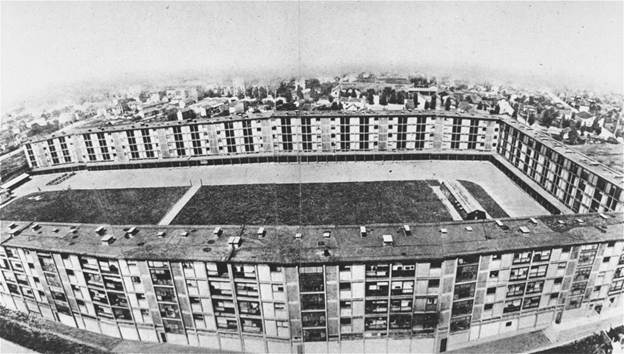
The Drancy camp, located in a suburb of Paris, where thousands of Jews, including Lilly’s father, were held prior to being deported. The vast majority were killed after being transported to concentration camps such as Auschwitz.
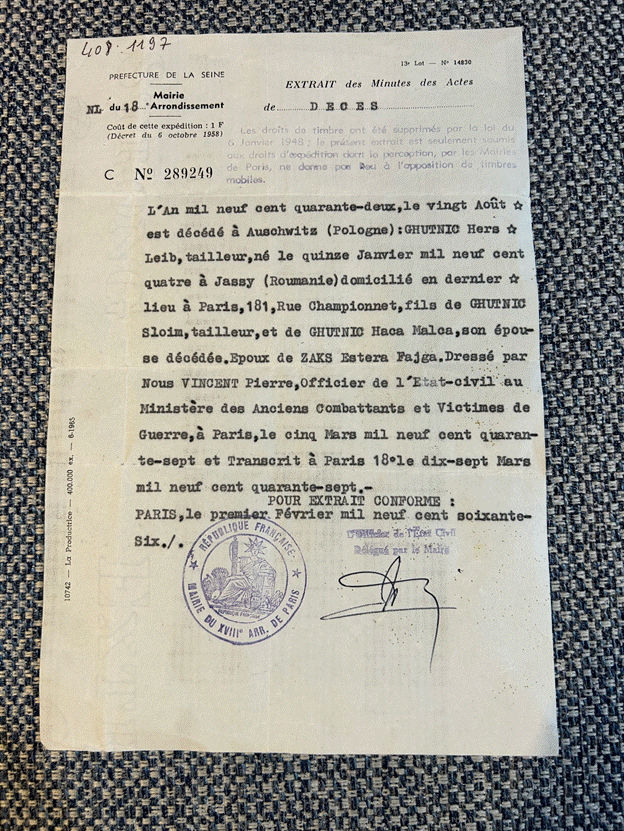
The death certificate of Lilly’s father, Hers, received by her many years after his death at Auschwitz on August 20, 1942.
In Paris, Lilly and her mother continued life as best as they could, protected from German roundups by her uncle. As the occupation of the city progressed, Lilly’s uncle, who had been a shoemaker before the war, continued operating his business throughout the occupation and attracted attention from Nazi soldiers who would visit his shoe repair shop. While he was looking out for Lilly and her mother in Paris, he felt that he was getting close with some of the Nazi soldiers who would frequent his business, almost becoming friendly with them. As a result, Lilly’s uncle was able to see the next list of Jews scheduled for roundup and deportation, where he found Lilly's and her mother’s name, and facilitated their escape from Paris into the countryside. Both Lilly and Fanny survived the war thanks to her uncle’s efforts, as well as those of the people who sheltered them outside of Paris. Her uncle, who had managed to get both of them out of the city before the next roundups, was killed some time later during the war. After she left Paris, Lilly was moved around the country by HIAS, the Hebrew Immigrant Aid Society. The European headquarters of HIAS, which were located in Paris, France, were displaced by the initial Nazi invasion of the city and fled to neutral Lisbon, Portugal, from which they moved people around and helped refugees procure immigration documents to the United States. HIAS itself reported in 1944 that the organization had helped over 250,000 men, women, and children escape Nazi persecution throughout territories occupied by the Germans. While Lilly was moving around the countryside of France, she was sheltered by nuns in various monasteries across the nation over the several years that she spent displaced, as well as staying with her aunts, one of whom worked as a cook in a monastery where Lilly had been staying. Lilly and Fanny were both sheltered at her aunt’s house in the country as the occupation continued, helping with cooking and picking fruits and vegetables in their fields. This life continued on throughout the end of the war in France, and Lilly returned to Paris at the age of 14 with her mother after the liberation of the city. Both of Lilly’s maternal grandparents had also been killed in Nazi concentration camps during the war, in Birkenau, Germany, and Maidanek, Poland, leaving her alone with her mother.
After the war, Fanny married another man, Azriel Buk, who had lost his son during the war. Lilly met a man from Poland, Seymour, who had lost his father and some of his sisters and had immigrated to Paris with his mother and his younger brother shortly after the end of the war. Lilly and Seymour first met at the famous Moulin Rouge cabaret in Paris, and Seymour immigrated to the United States several years later, with his case being complicated by his Polish citizenship – as the nation had become a communist country, US authorities were much more stringent in distributing visas, as Poland had become a communist country directly after the war. Seymour immigrated and moved in with cousins who lived on Long Island, after which Lilly was able to go to the American Consulate in Paris and obtain a visa to live with Seymour. On July 16, 1953, Lilly boarded the S.S. Liberte in Le Havre, France, and arrived at the Port of New York six days later.
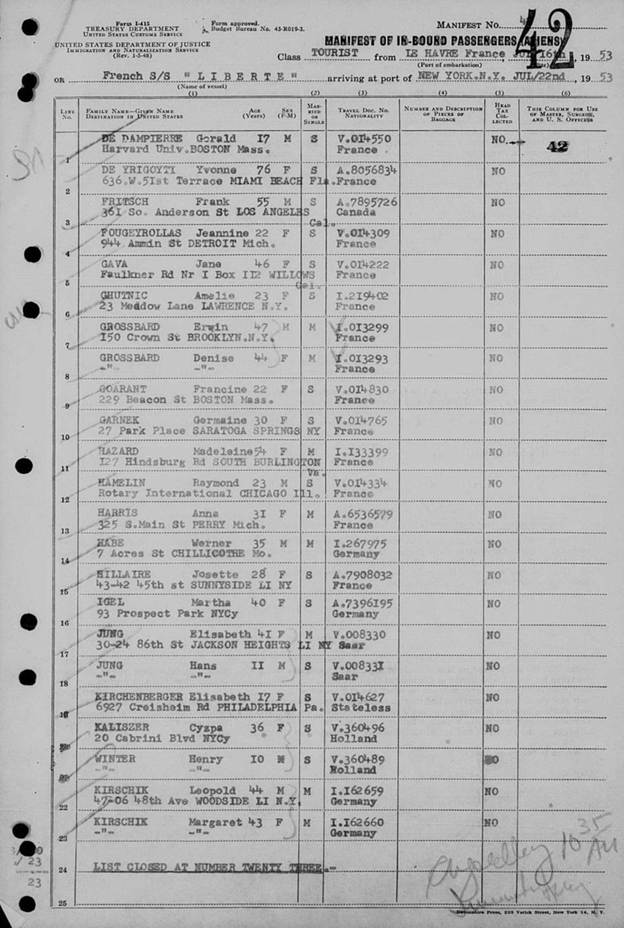
Lilly is named on this passenger manifest, having arrived in the United States on board the French S.S. Liberte in New York on July 22, 1953. She is listed, sixth from the top, as Amelie Ghutnic.
Following Lilly’s arrival and reunion with Seymour, she married him in August of that same year at the Long Island house. Upon their arrivals, Lilly and Seymour had nearly no money to speak of, borrowing a wedding dress from friends and holding the small ceremony in the cousins’ house, being officially registered in Brooklyn, NY on August 10. Neither of them spoke any English before immigrating, as Lilly spoke only French and Yiddish, and had not been able to complete her schooling in France – she had been only ten years old when the war came to France. Seymour had a gift for picking up languages, and was able to adapt rather quickly to life in the United States, getting into the Brooklyn knitting business. After living for some time in Brooklyn, they bought a house in Rego Park, where they would live for many years. Seymour went on to co-own a knitting mill in Brooklyn, while Lilly stayed home and raised their three children. Life for Lilly and Seymour had stabilized at that point, as they had a social circle made up of friends from France, and while Seymour’s Brooklyn knitting mill had to close as business declined, he bought another one closer to home as the sole proprietor. At their Queens home, Lilly and Seymour were surrounded by many Jewish neighbors who had also immigrated as a result of the war, including those who were forced to relocate as a result of German occupation, and some who had survived the camps themselves. As with many other Holocaust survivors, many of their own stories went untold due to the traumatic associations. Despite this past, Lilly’s life took a significant turn for the better after immigration, a testament to her perseverance throughout all stages in life. Lilly had come from experiencing occupation at ten years of age, having lost an incredibly large and important part of her childhood to the Nazi invasion, as well as losing several family members to the war, including her father. After her return to Paris after the end of the occupation, she had no opportunity to finish her interrupted schooling, compounding her troubled childhood. Upon immigrating to the United States, neither she nor her husband spoke English; however, she managed to complete her GED and independently learn the English language, leveraging her love of reading to create an environment in which her resilient nature allowed her to make the best of the cruel situation she was dealt as a young child, being able to carve out a very good life for herself and her family. She had been able to visit France as well, allowing her children to visit their grandmother, Fanny, as well as Fanny’s husband, Azriel, and their two children, with Lilly’s children spending many of their summers visiting family back in France.
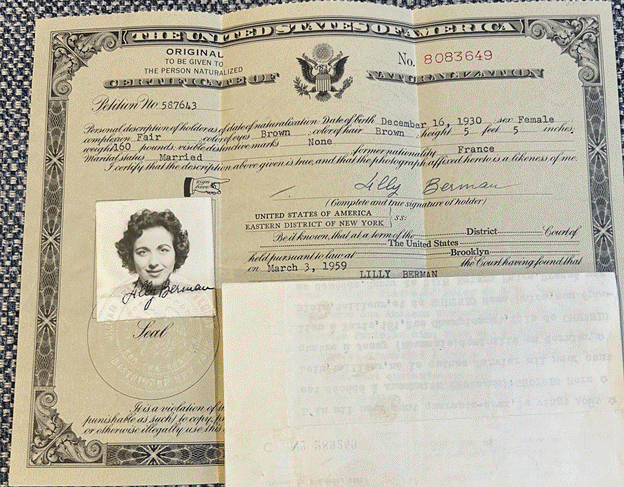
Lilly’s Certificate of Naturalization, received on March 3, 1959, six years after her arrival from France.
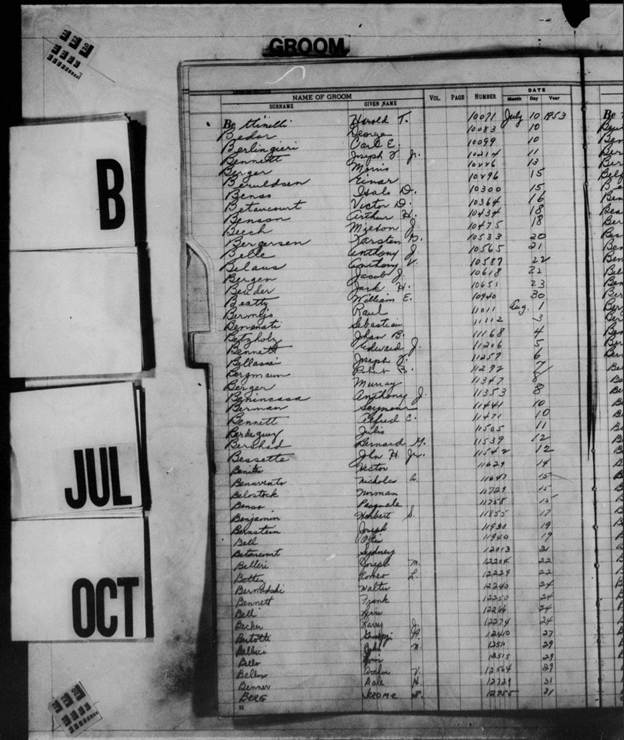
Lilly and Seymour’s marriage was registered in Brooklyn, NY, on August 10, 1953. Seymour Berman is listed here as the groom (25th from the top).
In Rego Park, Lilly took care of the household and raised three children together with her husband. As Seymour’s demanding work at the factory often called for long hours, with him at times returning after dinner, Lilly had the responsibility of raising her three children and managing the household. At times, Lilly would join him, working at the factory to help her husband and provide for the family, and while times hadn’t always been easy, Lilly had been able to move up from her shattered life in Paris, to immigrating to the United States without any money to speak of between herself and Seymour, to being able to finally carve out a good life for herself, her husband, and her children. After Seymour retired and stepped away from the knitting mill he had owned, they moved from Queens to New Jersey. Seymour passed away in 2010, at the age of 87, and Lilly passed away from illness at the age of 95 in 2026.
Lilly’s story and legacy is one of strength, and above all else, resilience. From having lost her childhood and having her family decimated by the war, from being forced out of her home city in the face of roundups, hiding out in the French countryside during her first teenage years, having had her schooling disrupted and to immigrating to a foreign nation with no money or English, and being able to sprout roots strong enough to not only sustain herself but to also raise a family is indeed a representation of her strength in the face of incredibly difficult circumstances. As with many other survivors, she and her neighbors would rarely speak about the events of the Holocaust due to the trauma and memories they brought forth – she had collected reparations money from the Claims Conference for only a few years towards the end of her life, and many other survivors refused any reparations at all, considering them “blood money”. Recounting the story of Lilly is crucial in both documenting her experiences and personal tragedies as a Holocaust survivor, as well as in depicting her inspiring resilience that had allowed her to live and thrive in the United States, along with creating a good life for her children and family.
Lilly and Seymour Berman are buried at Mount Hebron Cemetery, and the Legacy Foundation is honored to be able to tell their stories.
Sources:
Original oral interview with Alan Berman (Son of Lilly Berman)
https://encyclopedia.ushmm.org/content/en/article/drancy
https://www.yadvashem.org/holocaust/this-month/december/1942.html
https://www.ancestry.com/family-tree/person/tree/159491861/person/132397695634/story
https://www.ancestry.com/family-tree/person/tree/159491861/person/132397696015/story?usePUBJs=true