The Rebel Who Built Local 802: Jacob Rosenberg, Musician, Union Leader, and Fighter for the Working Man
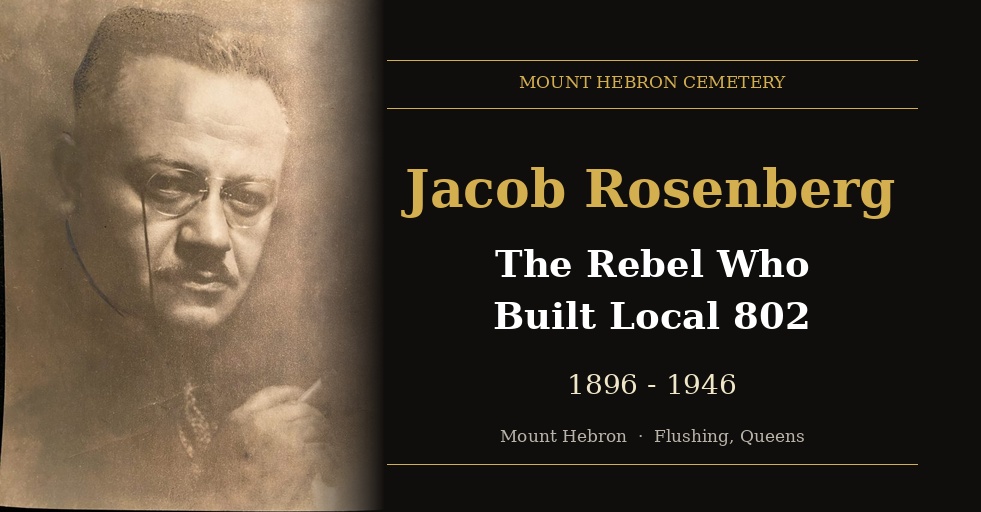
There are names that appear in the footnotes of history. Men and women who built the institutions that shaped American life without ever becoming household names. Jacob Rosenberg is one of them. He was the first president of Local 802 of the American Federation of Musicians, the most powerful musicians' union in the country, and he built it from nothing during one of the most turbulent periods in American labor history. He was a drummer, a songwriter, a civil rights advocate, a politician, a radio board member and a union leader who never once forgot whose side he was on.
He was born in 1896 in Austria, the youngest of eleven children. His family came to New York during his early childhood, settling into the dense and vibrant world of immigrant New York where musicians could find work in theater pits, dance halls, clubs and radio studios. His father was a musician and encouraged his son to follow him into the trade. Rosenberg showed considerable talent early. By the age of seven he had played his first professional engagement as a drummer. By the time he reached adulthood he was skilled enough to earn a seat with the New York Philharmonic and later the prestigious NBC Symphony Orchestra, one of the most coveted positions available to a musician in New York City.
He served in World War I and returned to New York to complete formal musical training before moving into the radio and recording studios of NBC. Alongside his work as a performer he formed a successful songwriting partnership with pianist and lyricist Ira Shuster. Together they composed popular songs that were recorded by Rudy Vallee, Gene Krupa, the Ink Spots, Charlie Spivak, Paul Whiteman and Vaughn Monroe. He wrote a regular column for Swing magazine called "The Labor Side of It," which tells you everything you need to know about how he understood his place in the world. He was a musician who saw himself as a worker first.
His union career began in Local 310, the New York musicians' local, where he served on the executive committee and later as union secretary. The circumstances that would define his life came to a head in 1921. American Federation of Musicians President Joseph Weber had declared a nationwide musicians' strike ban during World War I and kept it in place for years after the armistice, ignoring the impact on membership. New York's theater musicians, already struggling through a poor contract, had enough. They took on not only the Broadway producers but the Federation itself. Weber attempted to break the strike and expelled the entire New York local. On August 27, 1921, Local 802 was chartered directly to the American Federation of Labor. Weber had no choice but to recognize it, but he placed it under strict AFM trusteeship that lasted fifteen years.
When Local 802 was finally permitted to hold elections in 1936, Jacob Rosenberg was elected its first president. He would hold that office for more than eleven years, through the Great Depression, two of his own runs for political office, the tumultuous Petrillo-led AFM recording ban and the Second World War. His term ended only with his unexpected death in July 1946, just weeks before the fifteenth anniversary of the union he had built.
What Rosenberg built in those eleven years went far beyond contract negotiations and membership drives. He understood from the beginning that a union's power was moral as much as economic, and that the labor movement could not claim to speak for workers while tolerating the racism that divided them. In 1936 he attended the founding meeting of the National Negro Congress in Chicago, where his interracial delegation called for desegregated unionism at a time when the American Federation of Labor was still shaped by segregation, chauvinism and xenophobia. From the first day of his presidency, Rosenberg pledged that Local 802 would not only be racially unified but loudly opposed to discrimination of any kind. He appointed African Americans to positions on the union staff including Assistant Treasurer, Tax Recorder, Controller and Business Representatives. During his tenure the first African American Executive Board member was elected. This was not a gesture. This was policy, put in place and defended at a time when it cost something to do so.
His political relationships reflected the same values. He was aligned with the Roosevelt administration, including the Music Program of the Works Progress Administration, which put musicians to work during the Depression and brought music to communities that had never had access to it. He was close to Mayor Fiorello LaGuardia, who hand-selected him for a seat on the board of WNYC radio to, as the station announced at the time, increase the cultural and educational importance of the station. Rosenberg was the only union officer on that board. He was also a trustee of the New York City Central Trades and Labor Council, a board member of the national Fight for Freedom Committee and held a seat on the board of City Center, one of the most important cultural institutions in New York.
In 1938 he ran for Congress on the American Labor Party line, the same party that had endorsed Franklin Roosevelt and Fiorello LaGuardia. His campaign drew support from the mayor, the governor, a wide array of unions, the Negro Labor Committee, the New York State AFL, the Amsterdam News, the Yiddish press and the George Gershwin Lodge of the Knights of Pythias, among many others. Two years later he ran for New York City Council. Neither campaign ended in electoral victory but neither was without consequence. He was building something larger than a seat. He was making the voice of workers within electoral politics harder to ignore.
He saw clearly what was coming. In 1941, five years before his death, he wrote: "The enemies of labor have set themselves the task of poisoning the minds of the general public. Through their newspapers they have been carrying on an insidious campaign of slander and misrepresentation. They are preparing the public mind for an acceptance of legislation which, if it is voted by Congress, will throw labor back to the dark days before the New Deal and the Wagner Labor Relations Act." He was writing about 1941. He could have been writing about any number of moments in American history before or since.
Jacob Rosenberg died in July 1946 at the age of fifty. His eulogy was delivered by Vice President Richard McCann at a service held at Town Hall, where McCann called him a "comrade-in-arms" and cited his outstanding contribution as "the victorious struggle for local autonomy." Billboard magazine editorialized that month: "During most of his 51 years, Jacob Rosenberg was a rebel. He was talented enough to become the highest paid drummer in the business, a mainstay of the New York Philharmonic and NBC Symphony orchestras. He was smart and scrappy and rebellious enough 11 years ago to wrest the leadership of Local 802 from an administration which was going nowhere. Jacob Rosenberg was used to being a winner." The magazine's September 1946 issue of Allegro, Local 802's publication, was dedicated entirely to his memory. Condolences came from New York Mayor O'Dwyer, AFM President Petrillo, ILGWU President David Dubinsky, the Friars Club, ASCAP, ABC, CBS, NBC and Bing Crosby, among many others. William Morris wrote simply: "It is a serious loss these days when men of his high ideals are needed."
After his death, his son Lewis inherited a collection of Local 802 documents and memorabilia, which passed in turn to his grandson, also named Jack Rosenberg, a contractor and community member in the Hudson Valley. Jack donated the entire collection to Local 802 because, as he explained, he wanted his grandfather's legacy remembered. The collection included letters from Mayor LaGuardia on City Hall stationery, a 1938 communique from Governor Herbert Lehman, campaign materials, greetings from Leopold Godowsky and Rudy Vallee, honors from the Police Athletic League and the Selective Service Commission, Rosenberg's ASCAP documents, his invitation to the Waldorf Astoria anniversary celebration of NBC and his 1917 military discharge papers. A complete record of a complete life.
Jacob Rosenberg rests at Mount Hebron Cemetery in Flushing, Queens, among the musicians, labor leaders, survivors and builders whose stories the Legacy Foundation is honored to preserve.
May his memory be a blessing.
Blog by Deirdre Mooney Poulos
Works Cited
Allegro. American Federation of Musicians Local 802, Sept. 1946. Dedicated memorial issue for Jacob Rosenberg.
Billboard. Editorial on Jacob Rosenberg. Aug. 1946.
Crosswaith, Frank. Condolence letter. Allegro, Sept. 1946. Negro Labor Commission.
Dubinsky, David. Condolence letter. Allegro, Sept. 1946. ILGWU.
Goldberg, Jacob. History of Local 802. American Federation of Musicians Local 802.
LaGuardia, Fiorello. Correspondence with Jacob Rosenberg. 1938-1941. Jack Rosenberg Family Collection, Local 802 Archive.
Lehman, Herbert. Communique to Jacob Rosenberg. 1938. Jack Rosenberg Family Collection.
McCann, Richard. Eulogy for Jacob Rosenberg. Town Hall, New York. 2 Aug. 1946.
Morris, William. Condolence letter. Allegro, Sept. 1946.
National Negro Congress. Founding meeting records. Chicago, 1936. Schomburg Center for Research in Black Culture, New York Public Library.
O'Dwyer, William. Condolence letter. Allegro, Sept. 1946. Office of the Mayor of New York City.
Petrillo, James. Condolence letter. Allegro, Sept. 1946. American Federation of Musicians.
Rosenberg, Jacob. "The Labor Side of It." Swing magazine, 1938-1946.
Rosenberg, Jacob. Campaign materials. 1938 and 1940. Jack Rosenberg Family Collection, Local 802 Archive.
Rosenberg, Jack. Personal interview and donation of family collection to Local 802. Poughkeepsie, NY. On file with Local 802.
Works Progress Administration Music Program Records. National Archives, College Park, Maryland.
WNYC Radio Board Records. New York City Municipal Archives.