Hebron's Stories
If a story is important, then it must be told. We can portray dreams of what the future may hold, or allow introspection on what has occurred in the past. A story is a narrative that can relay lessons and warnings. A story can teach us about hope and remind us how important and meaningful our lives are. We are unearthing stories about those buried at Mount Hebron Cemetery.
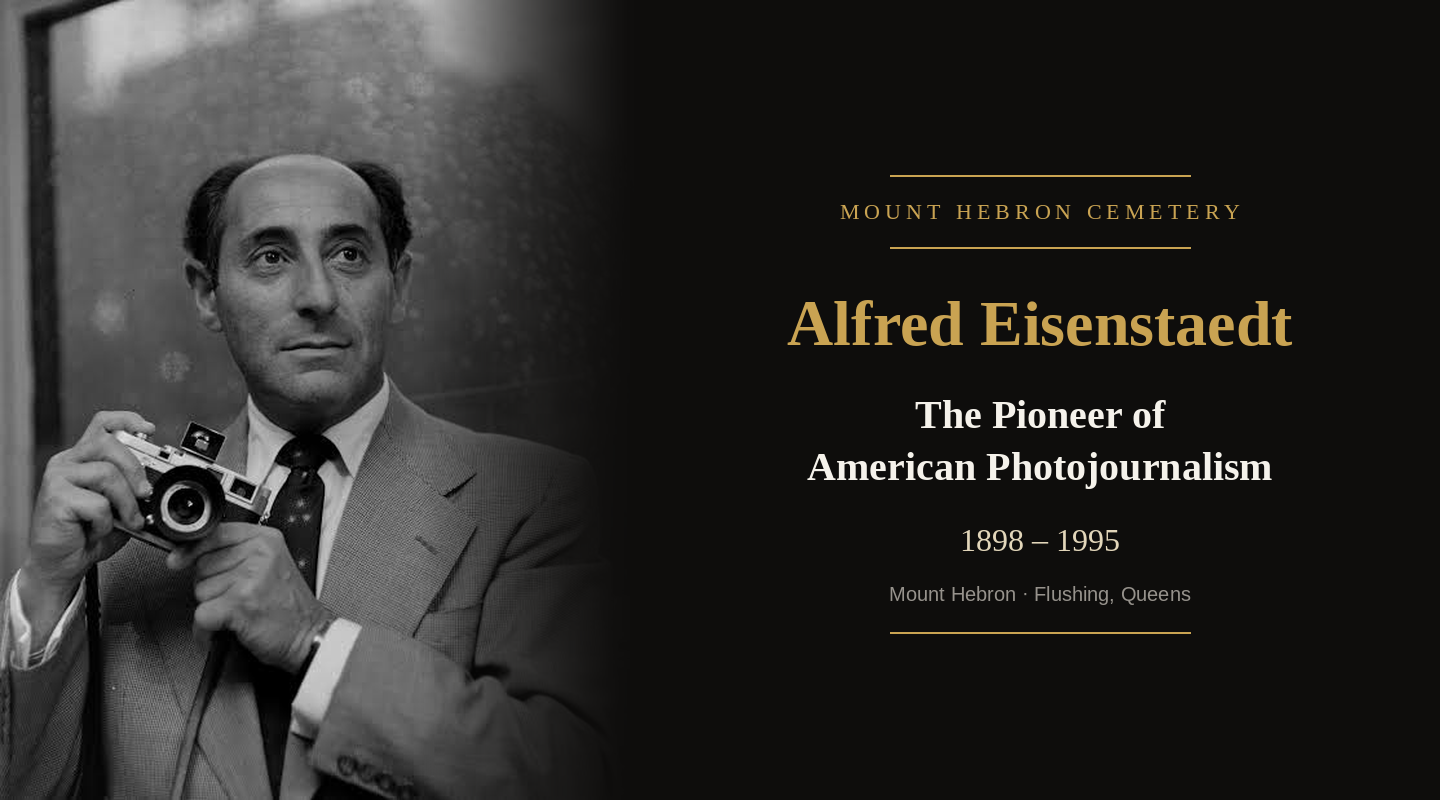
He was fourteen when his uncle gave him a Kodak camera. Alfred Eisenstaedt survived the trenches of World War I and taught himself photography in Berlin. In 1933 he stared down Joseph Goebbels through his lens and captured pure hatred on film. When the Nazis pushed him out, he sailed to New York and became one of Life magazine’s first four photographers. He used natural light and a small Leica. People barely noticed him. That is how he caught a sailor kissing a nurse in Times Square on V-J Day. He photographed Einstein, Hemingway, Monroe, and Kennedy. He lived in Jackson Heights. Today he rests at Mount Hebron with his wife, Kathy.
~Blog by Daniel Khaitov
Learn More
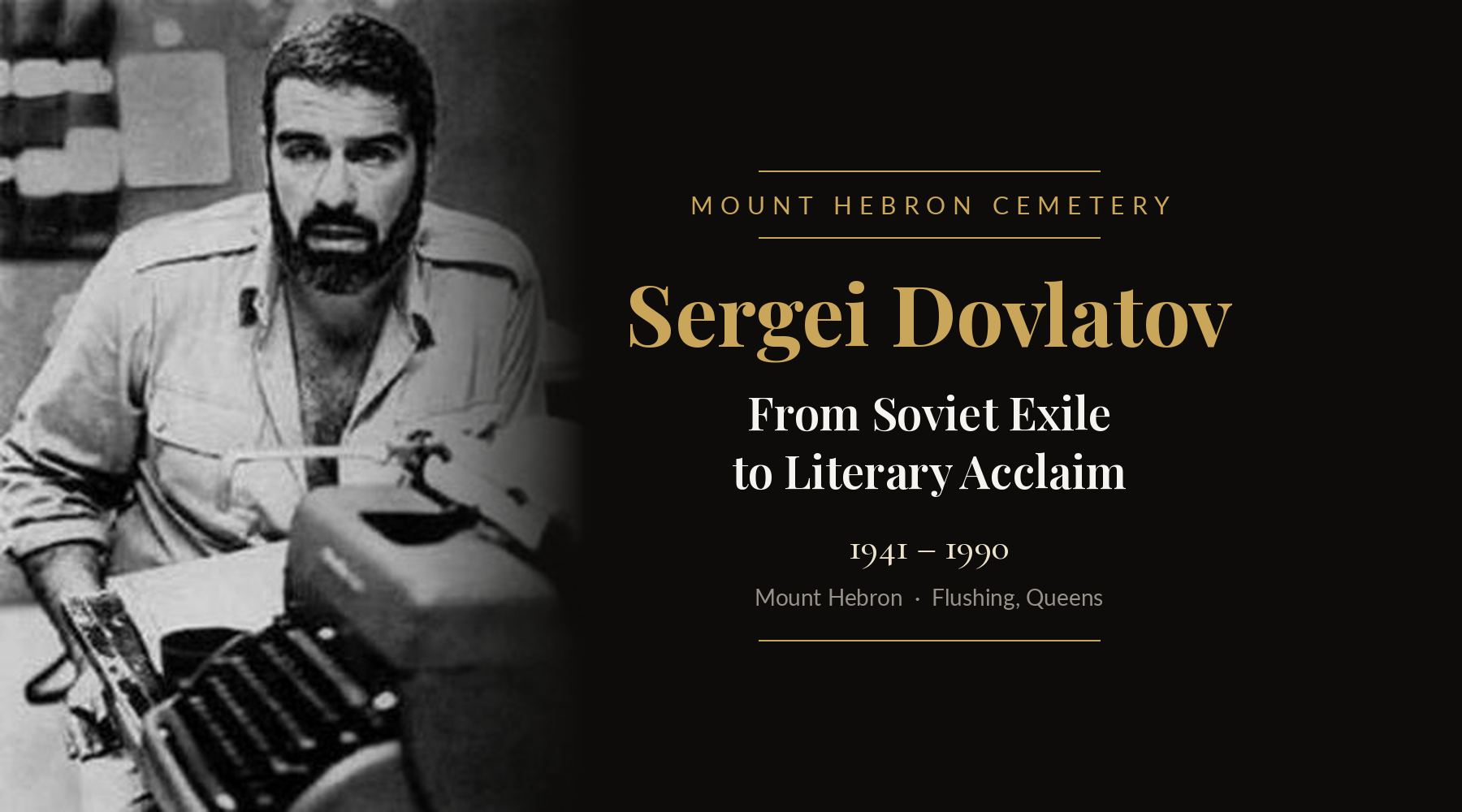
Sergei Dovlatov was born in 1941 while his family fled the war. He grew up in a crowded Leningrad communal apartment and served as a guard at a remote prison camp. Those years gave him his voice. He wrote dry, funny stories about the absurdities of Soviet life, and the authorities banned nearly all of them. The KGB destroyed his first book before it reached print. In 1978 he was pushed into exile and settled in Forest Hills, Queens. There he wrote freely, published twelve books and appeared in The New Yorker. He died in 1990 at just 48. Today he is beloved in New York and Russia. ~Blog By Daniel Khaitov
Learn More
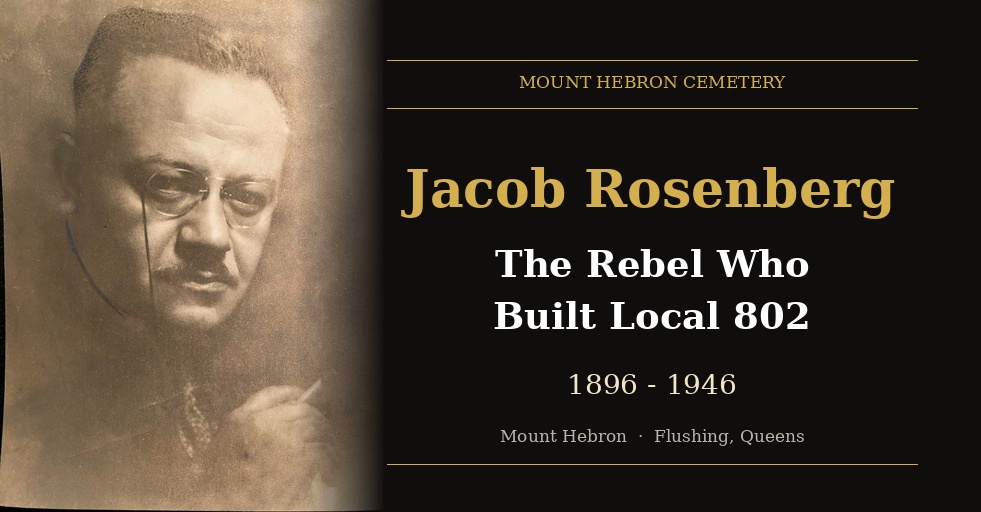
Jacob Rosenberg was born in Austria in 1896, the youngest of eleven children, and played his first professional engagement as a drummer at seven. He went on to seats with the New York Philharmonic and the NBC Symphony, and wrote songs recorded by Rudy Vallee and the Ink Spots. In 1936 he became the first president of Local 802, the New York musicians' union, and from his first day pledged it would stand against discrimination of any kind. He appointed African Americans to union staff, ran for Congress, and sat on the WNYC board at Mayor LaGuardia's request. He died suddenly in July 1946 at fifty and rests at Mount Hebron. ~Blog by Deirdre Mooney Poulos
Learn More
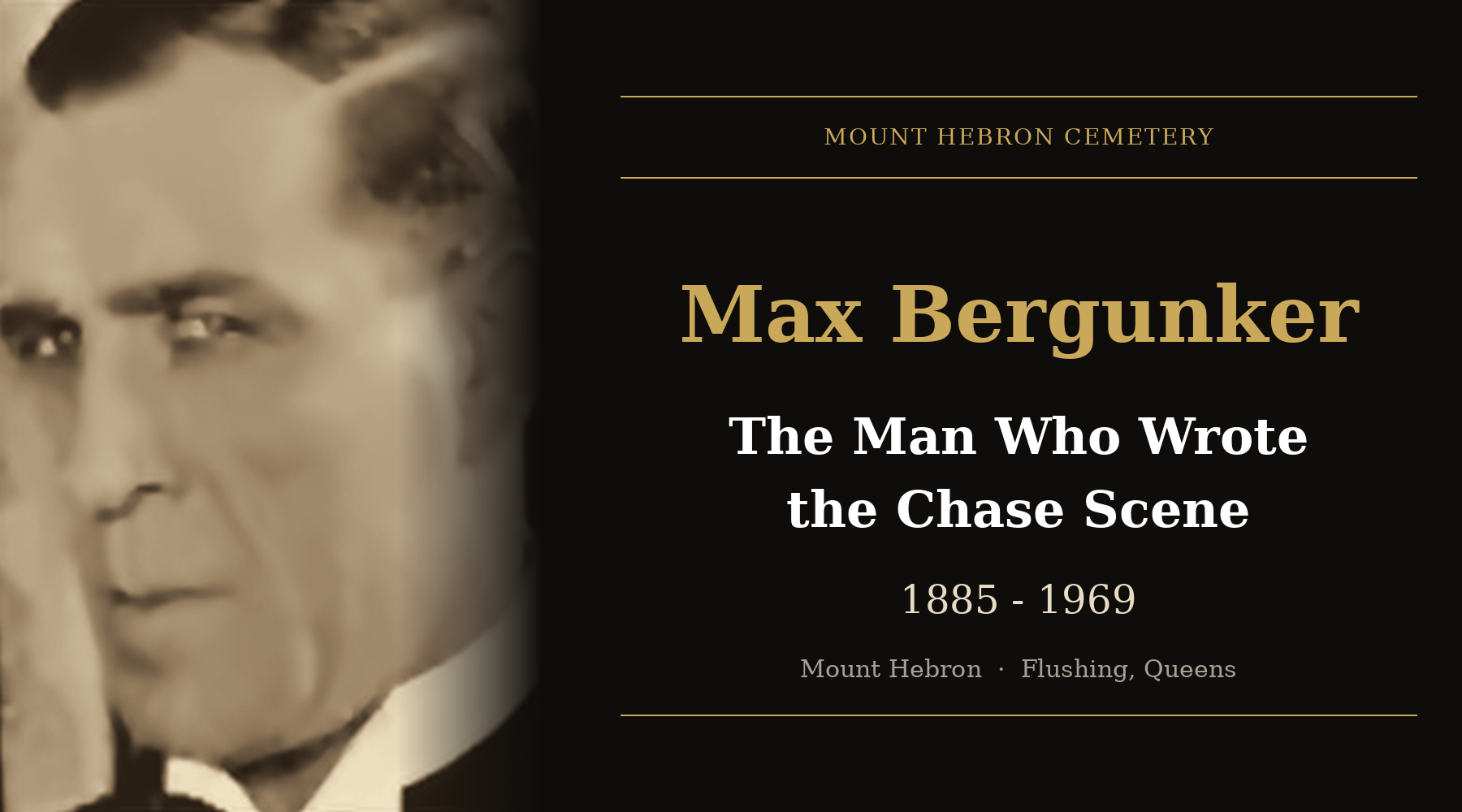
Max Bergunker was born in Mykolaiv, a shipbuilding city on the Black Sea, in 1885. He survived pogroms, war, and famine, and reached New York in 1924 at thirty nine, in the last season before the gates closed. He went straight to work as a pianist in the silent movie houses. In 1927 he wrote five mood pieces for G. Schirmer's Photoplay Series, music played in theaters across America, and one was called for on the cue sheet for Murnau's Sunrise. Sound film arrived and the profession vanished almost overnight. He lived in Brooklyn until his death in 1969. His scores survive at the Library of Congress. He rests at Mount Hebron. ~Blog by Deirdre Mooney Poulos
Learn More
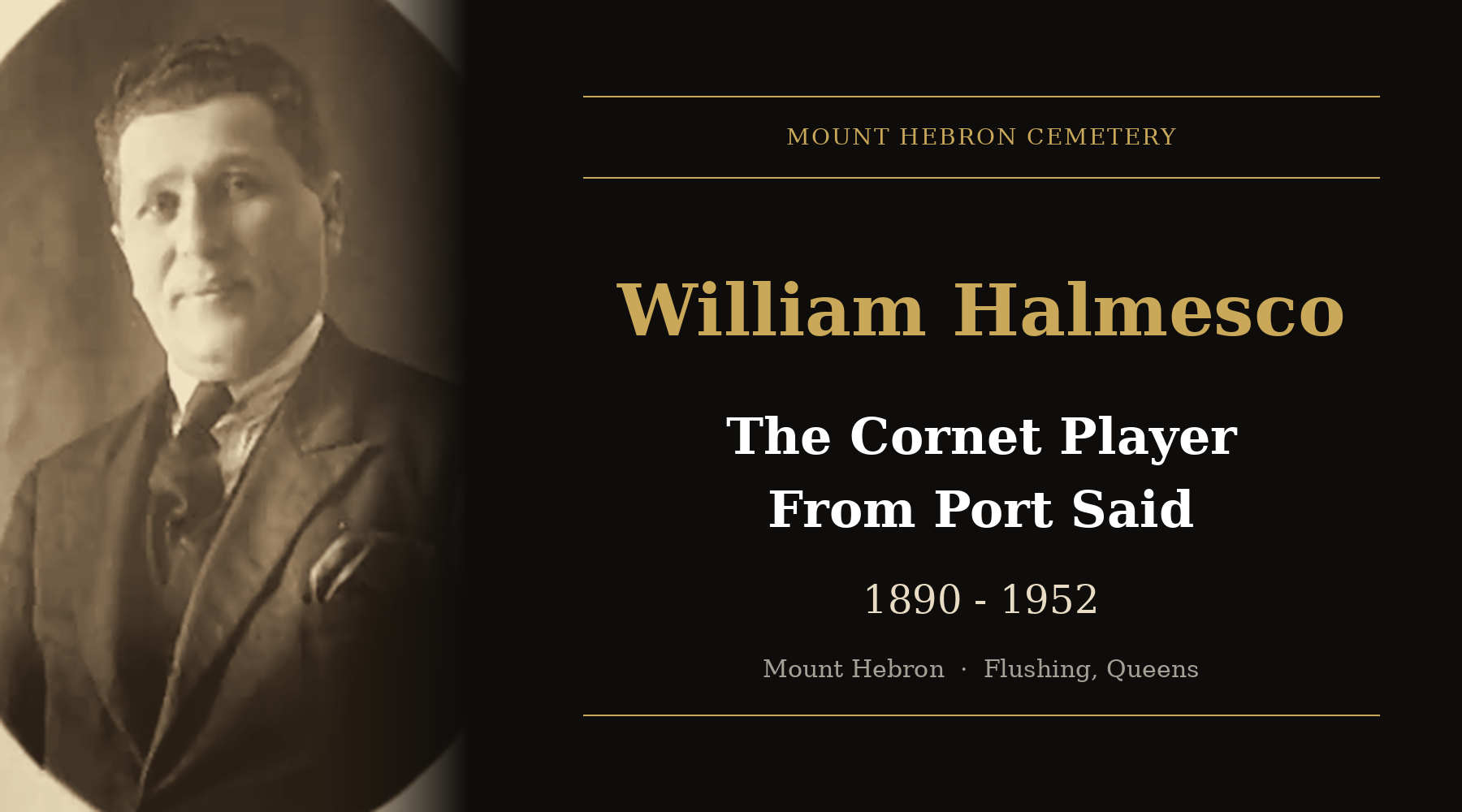
William Halmesco was born in Port Said, Egypt, in 1890, a city built for the Suez Canal. His family name was Halm. He changed it to sound Italian, because in Egypt that was what the music trade required. Family memory holds that he was interned in Malta during the First World War. He and his wife Mathilda sailed from Alexandria in 1927 and settled in the Bronx, where he played cornet and joined the Progressive Musical Benevolent Society, a burial society built by klezmer musicians. Mathilda died in 1931 giving birth to their daughter. He died in 1952 and rests at Mount Hebron. A handwritten klezmer tunebook in his hand survives him. ~Blog by Deirdre Mooney Poulos
Learn More
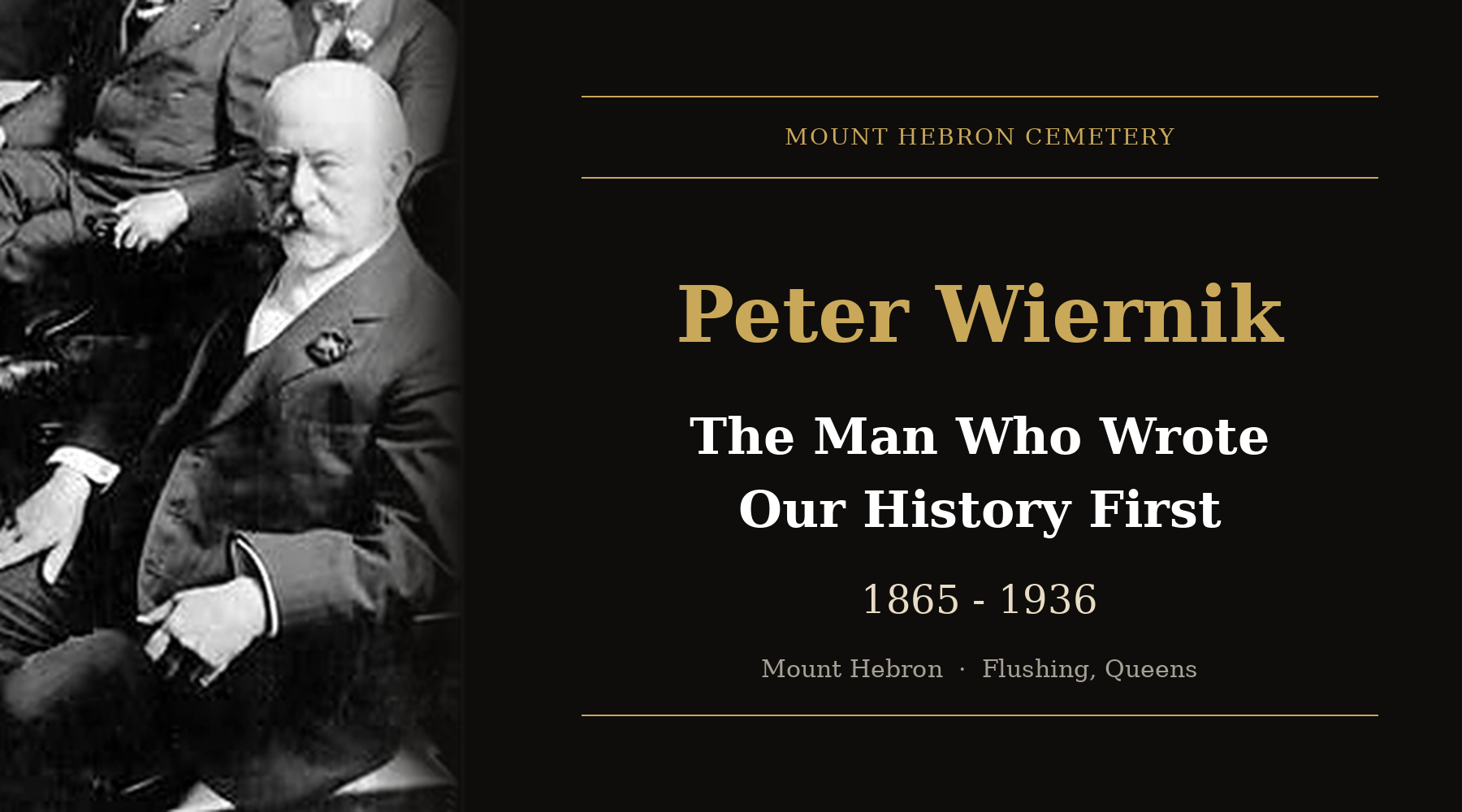
Peter Wiernik was born in Vilna in 1865 and came to America at the start of the great Jewish migration. For more than three decades he edited the Morgen Zhurnal, one of the most influential Yiddish newspapers in the country, guiding hundreds of thousands of immigrant readers through the questions of their new American lives. In 1912 he published the first comprehensive history of Jews in America, opening an entire field of scholarship before anyone thought to give it a name. The man who wrote our history first rests at Mount Hebron Cemetery in Flushing, Queens.~Blog by Deirdre Mooney Poulos
Learn More
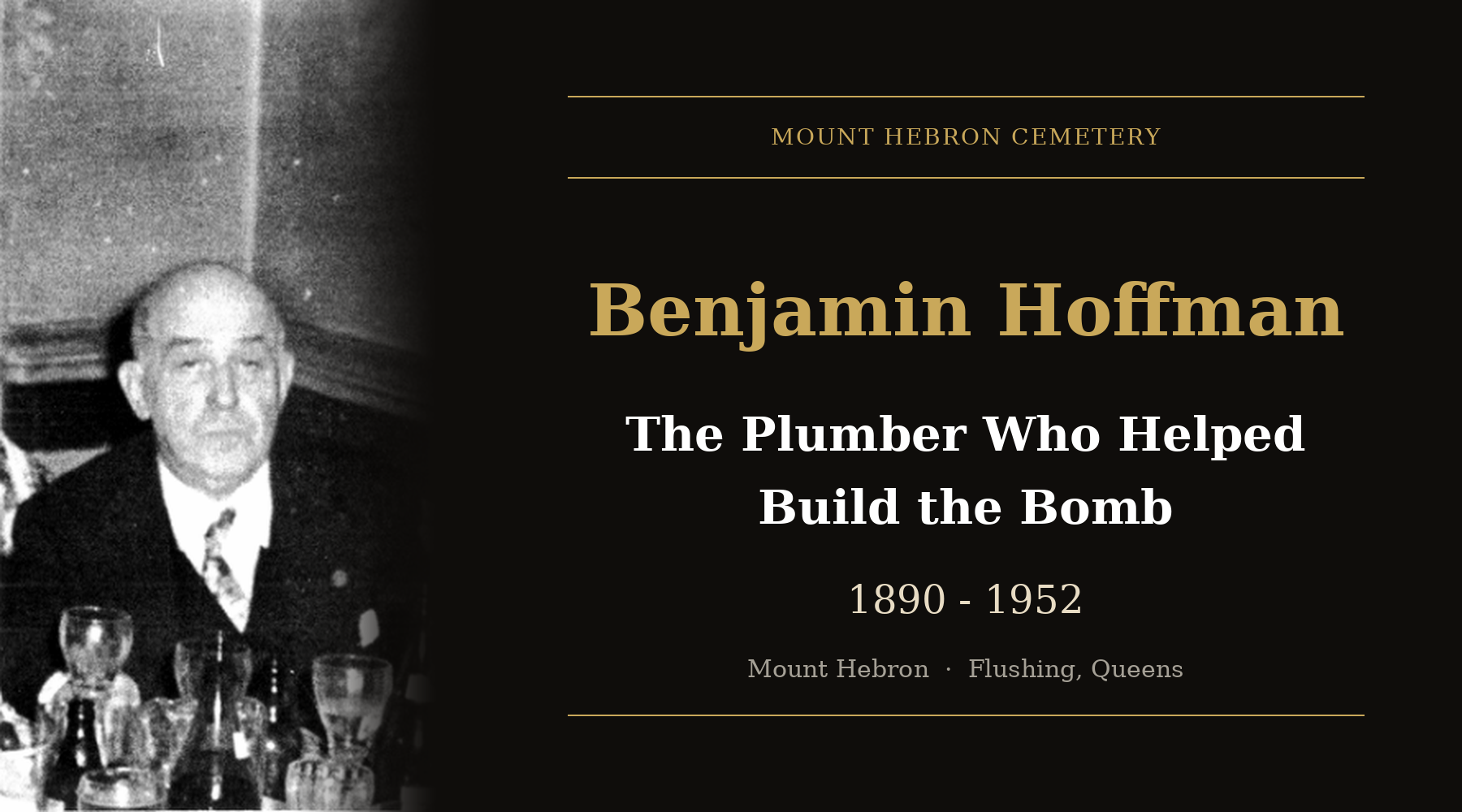
Benjamin Hoffman was born in Galicia in 1890 and arrived in New York as a boy of eleven. He worked as a teenage plumber on the Lower East Side before earning his engineering degree at Cooper Union. In his fifties he was recruited to Oak Ridge, Tennessee, where he spent the war years on the Manhattan Project without being able to say what he was building. On August 6, 1945, the day the world learned the secret, the War Department certified his work with a certificate signed by the Secretary of War. He died in 1952 and rests at Mount Hebron Cemetery in the Lineal family plot. ~Blog by Deirdre Mooney Poulos & The Lineal Family
Learn More
Sammy Fuchs grew up on the Bowery and worked his way from busboy to saloon owner. In 1934, in the depths of the Depression, he opened Sammy's Bowery Follies at 267 Bowery. The bar ran twenty hours a day and drew everyone from derelicts to uptown socialites, earning a famous Life magazine feature in 1944. What set Sammy's apart was its stage, where aging vaudeville performers who had nowhere left to go sang night after night. The saloon lasted thirty-six years, closing in 1970, one year after Sammy died at eighty-four. He rests today at Mount Hebron Cemetery in Flushing, Queens. ~Blog by Deirdre Mooney Poulos
Learn More
Isidore Nagler came to New York alone at fourteen and went to work as a cutter in the garment trade. He joined the ILGWU at sixteen and served as its vice president for thirty years. He won the 40-hour week, fair pay, pensions, and health benefits for thousands of workers. He also fought to keep Communists out of the union and believed the fight for workers and for Jewish survival were one and the same. When he died in 1959, two thousand people came to his funeral, including Golda Meir. He rests at Mount Hebron Cemetery, where the Legacy Foundation is honored to tell his story. ~Blog be Deirdre Mooney Poulos
Learn More
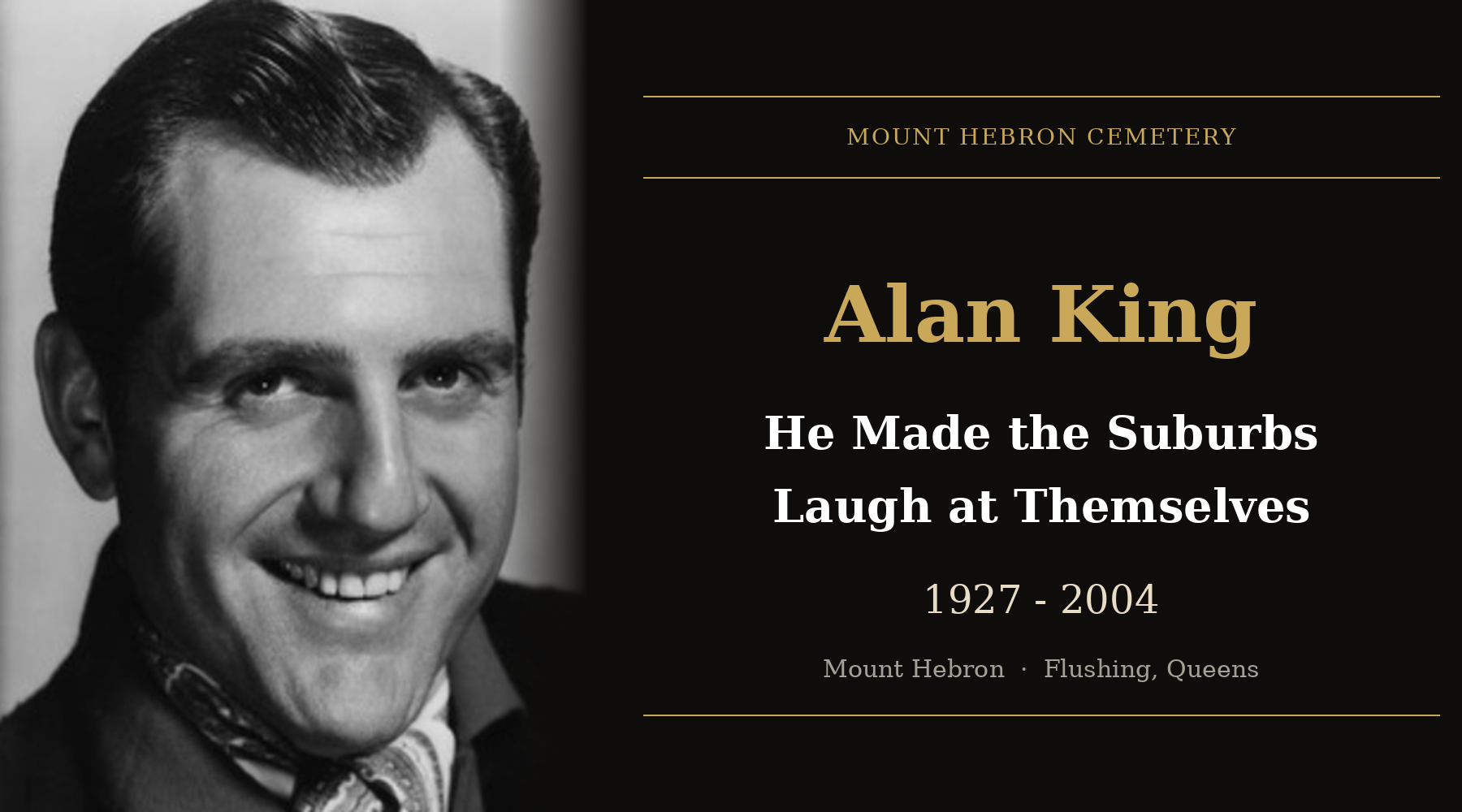
Alan King (born Irwin Alan Kniberg, December 26, 1927-May 9, 2004) was an American comedian, actor, author, and philanthropist whose sharp-witted, observational humor made him one of the most recognizable figures in comedy from the 1950s through the 1990s. Known for his humorous rants and his ability to find comedy in everyday middle-class struggles, King made a lasting mark in stand-up, television, film, and literature. Beyond entertainment, he was also a producer, playwright, and devoted philanthropist, contributing to causes that reflected both his Jewish heritage and his personal battles with illness. ~Blog by Jonathan Moskowitz
Learn More
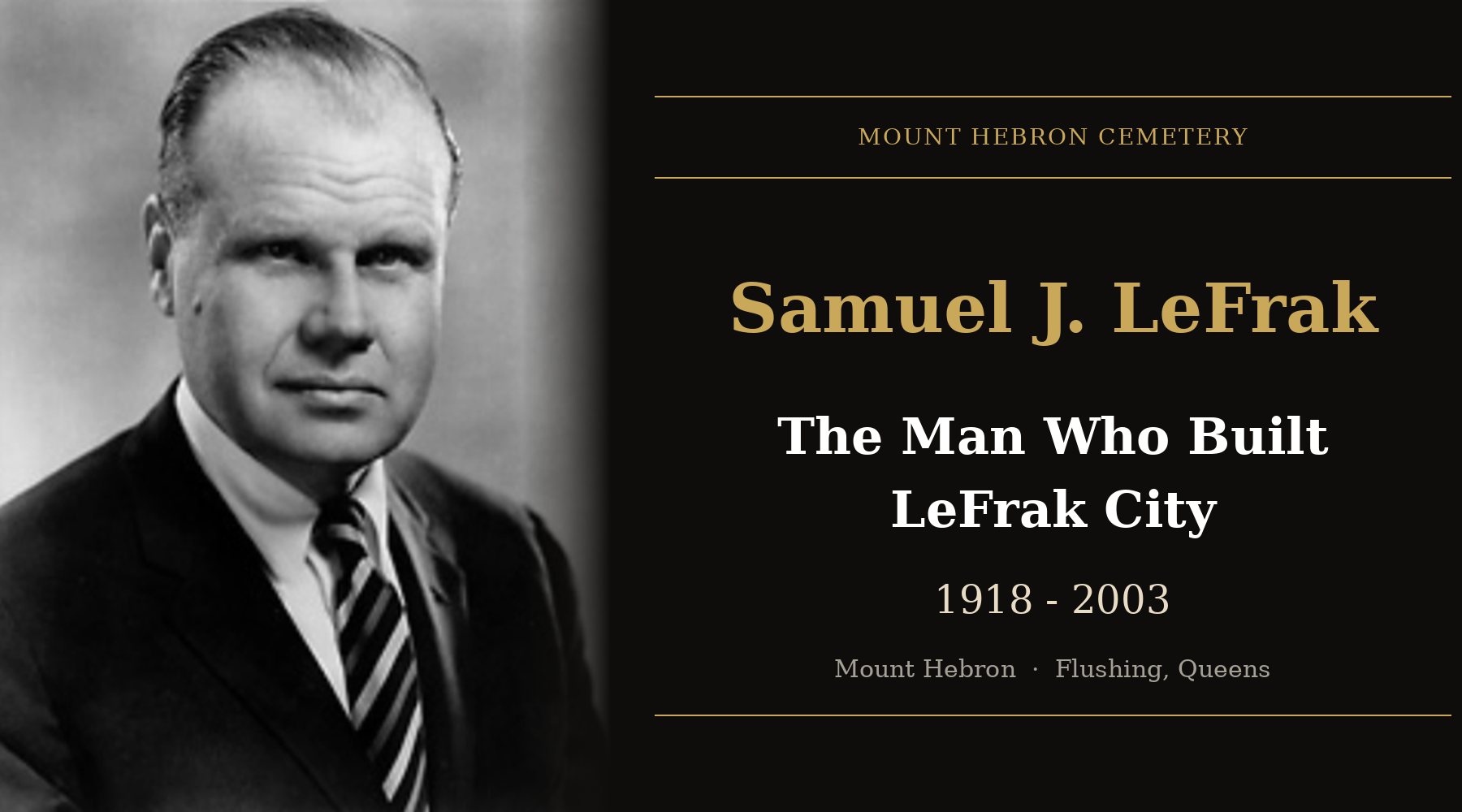
Samuel J. LeFrak was a transformative American real estate developer who reshaped postwar urban housing by creating large-scale, affordable residential communities for the middle class. As head of the LeFrak Organization, he led the development of iconic projects like LeFrak City in Queens and the Newport complex in Jersey City, pioneering cost-efficient construction techniques and integrated living spaces. Known for his bold vision and commitment to accessibility, LeFrak also championed diverse housing and urban revitalization. Beyond real estate, he was a generous philanthropist, supporting institutions like the American Museum of Natural History and Columbia University. His legacy continues through the communities he built and the lives he impacted. ~Blog by Deirdre Mooney Poulos
Learn More
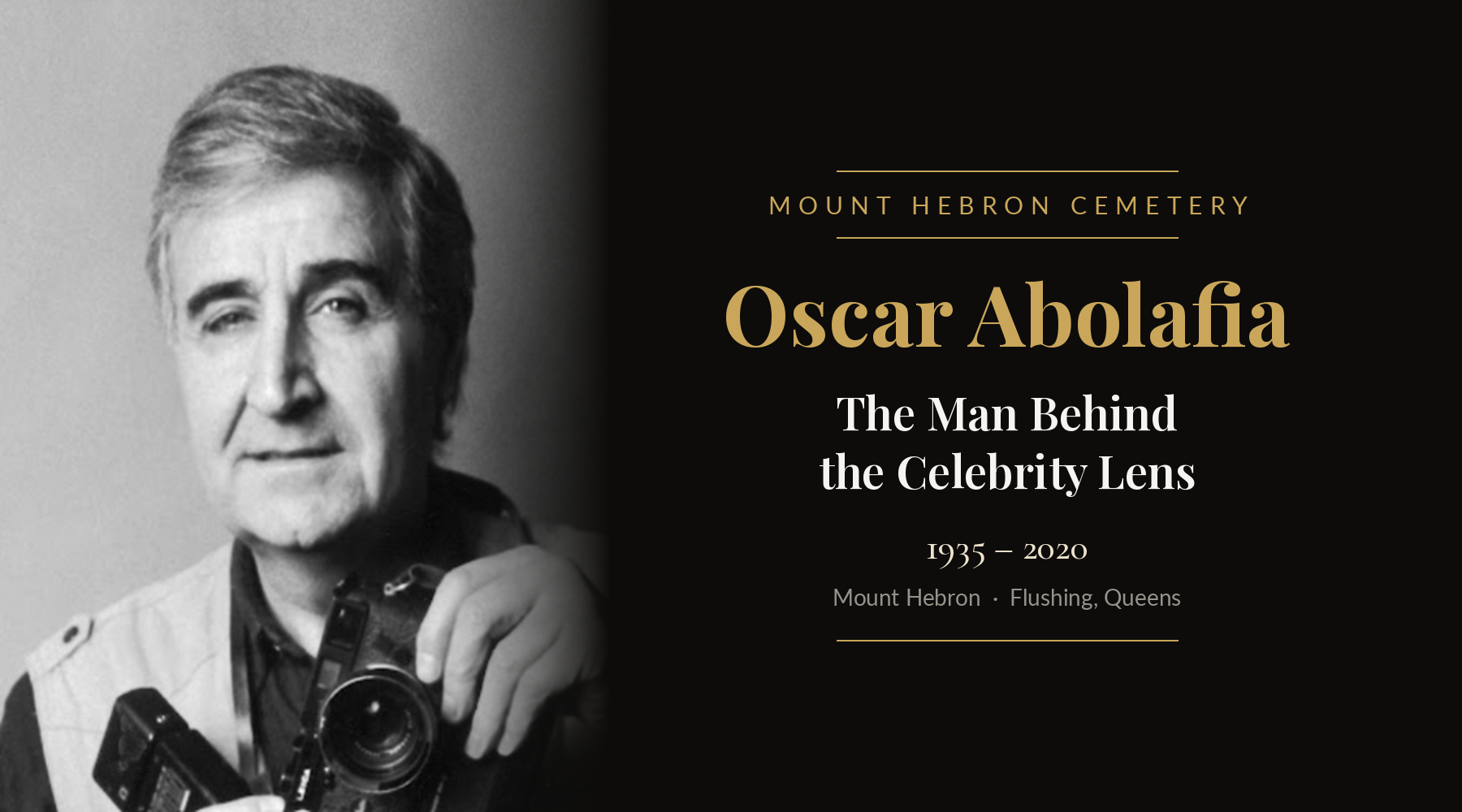
Oscar Abolafia, the son of Turkish Sephardic Jewish immigrants, grew up in New York City and discovered photography after his father bought him a pawnshop camera. He rose from hotel and resort photography to mingling with Andy Warhol's circle and capturing striking fashion and celebrity images. Oscar went on to photograph the Beatles, Elizabeth Taylor, Elvis Presley, Audrey Hepburn, and countless others for Life, Time, Harper's Bazaar, and Vanity Fair, as well as working on more than 20 films. Married to Joanna, he lived in New York until his death in 2020, and is buried at Mount Hebron Cemetery in Queens.~Blog by Renee Meyers
Learn More
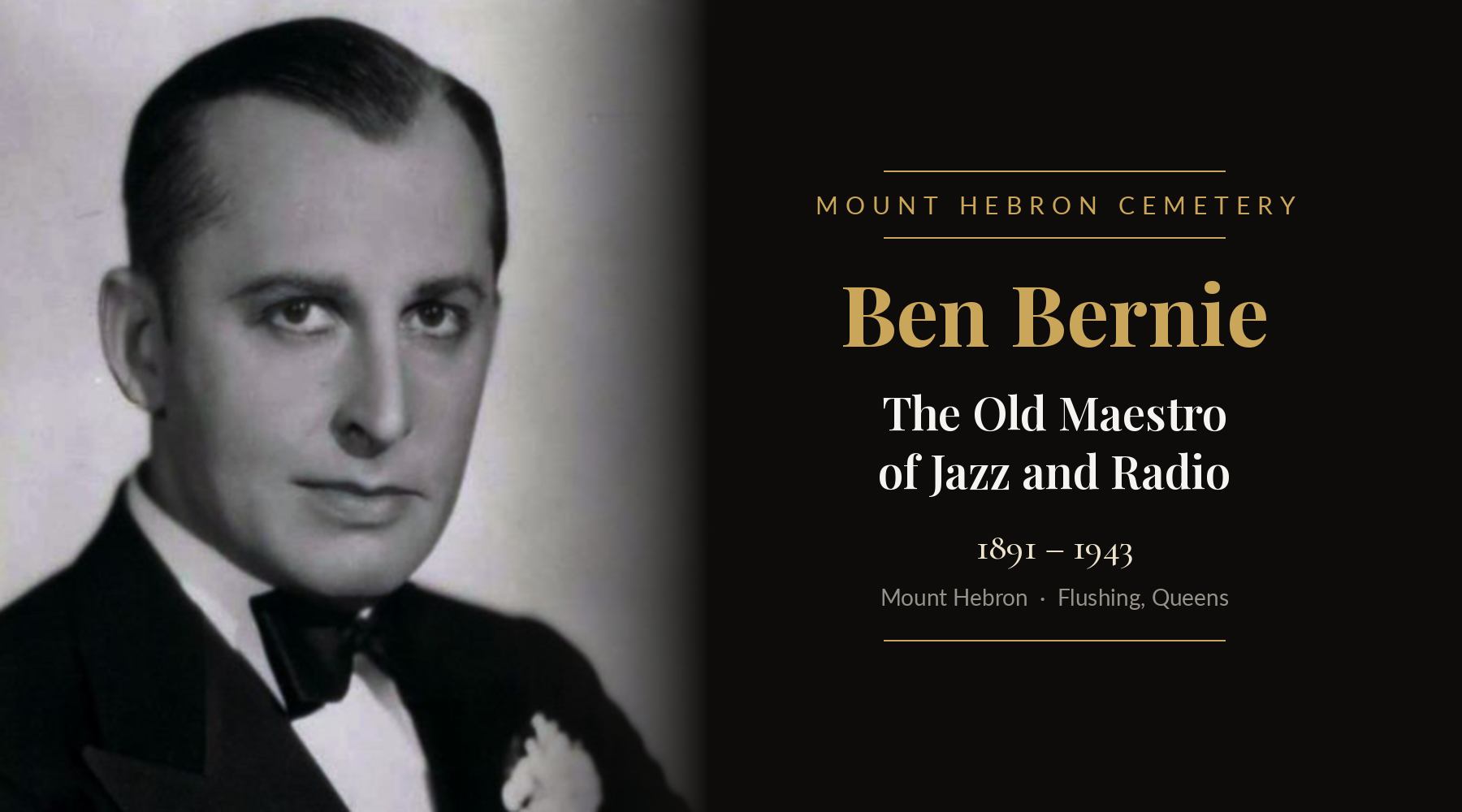
Benjamin Anzelevitz, professionally known as Ben Bernie, was a celebrated American jazz violinist, band leader, and radio star. Often introduced as "The Old Maestro", he was renowned for his showmanship, charm, and quick-witted banter. He belonged to the first generation of American music stars, alongside legends like Paul Whiteman, Ted Lewis, and Al Jolson. Famous for his catchphrase "Yowsah, yowsah, yowsah," he helped shape early radio entertainment in the 1930's and 1940's. His life story reflects both the glamour of the Jazz Age and the resilience of an artist navigating the Great Depression and the dawn of broadcasting.~Blog by Jonathan Moskowitz
Learn More
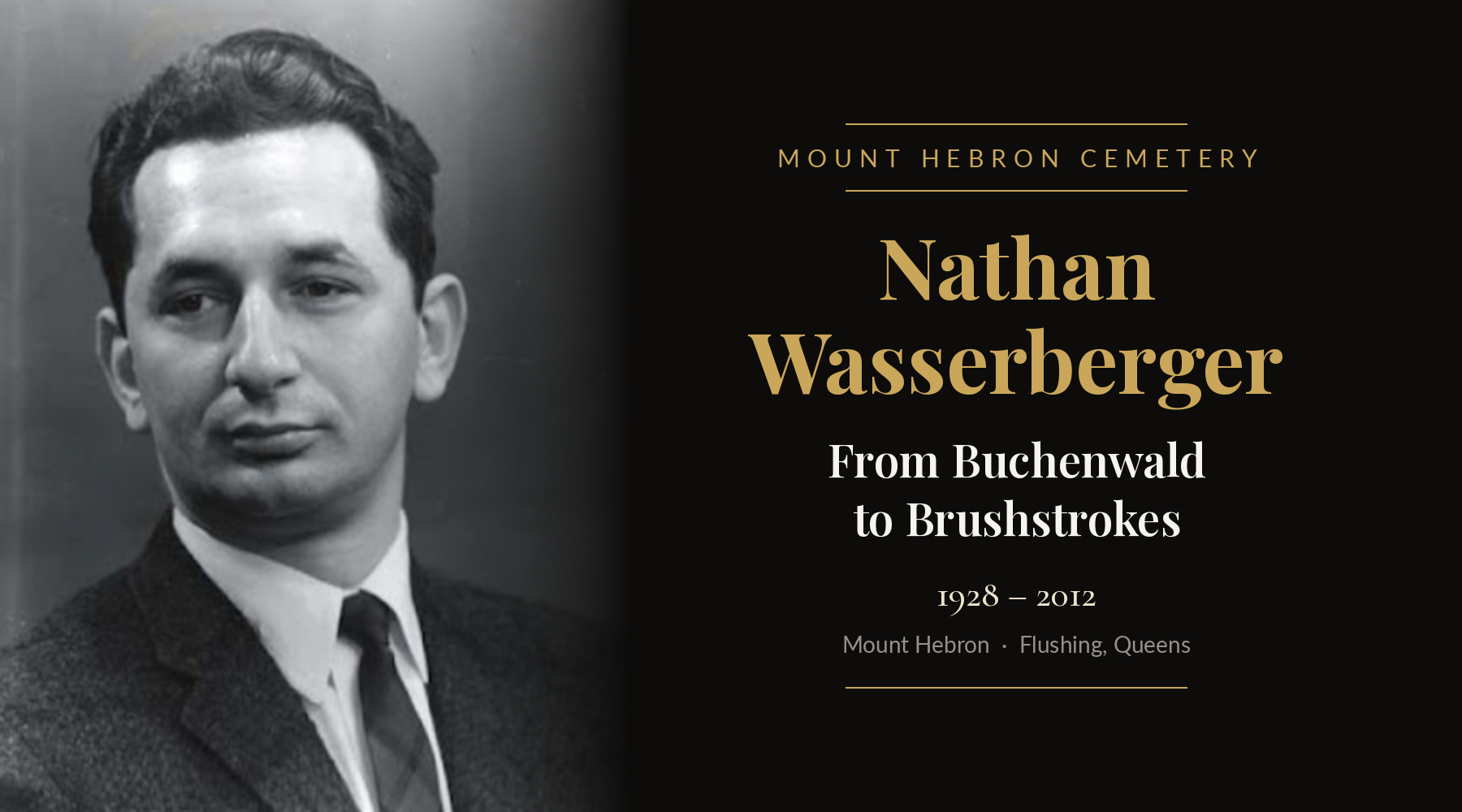
Nathan Wasserberger (1928-2012) was a Polish-born Jewish American painter and Holocaust survivor whose art journey led from the trauma of Buchenwald to luminous portraits of women in kimonos and serene nudes. After emigrating to the U.S. in the late 1940's, he studied at renowned art institutions in New York and Paris, eventually shifting from dark Holocaust themes to vibrant, introspective figure painting. His work, celebrated for its sensuality and emotional depth, became a means of healing and reclaiming beauty in the face of past horrors. Today, Wasserberger's legacy lives on in the Smithsonian's archives, reflecting his transformation from survivor to celebrated artist. ~Blog by Deirdre Mooney Poulos
Learn More
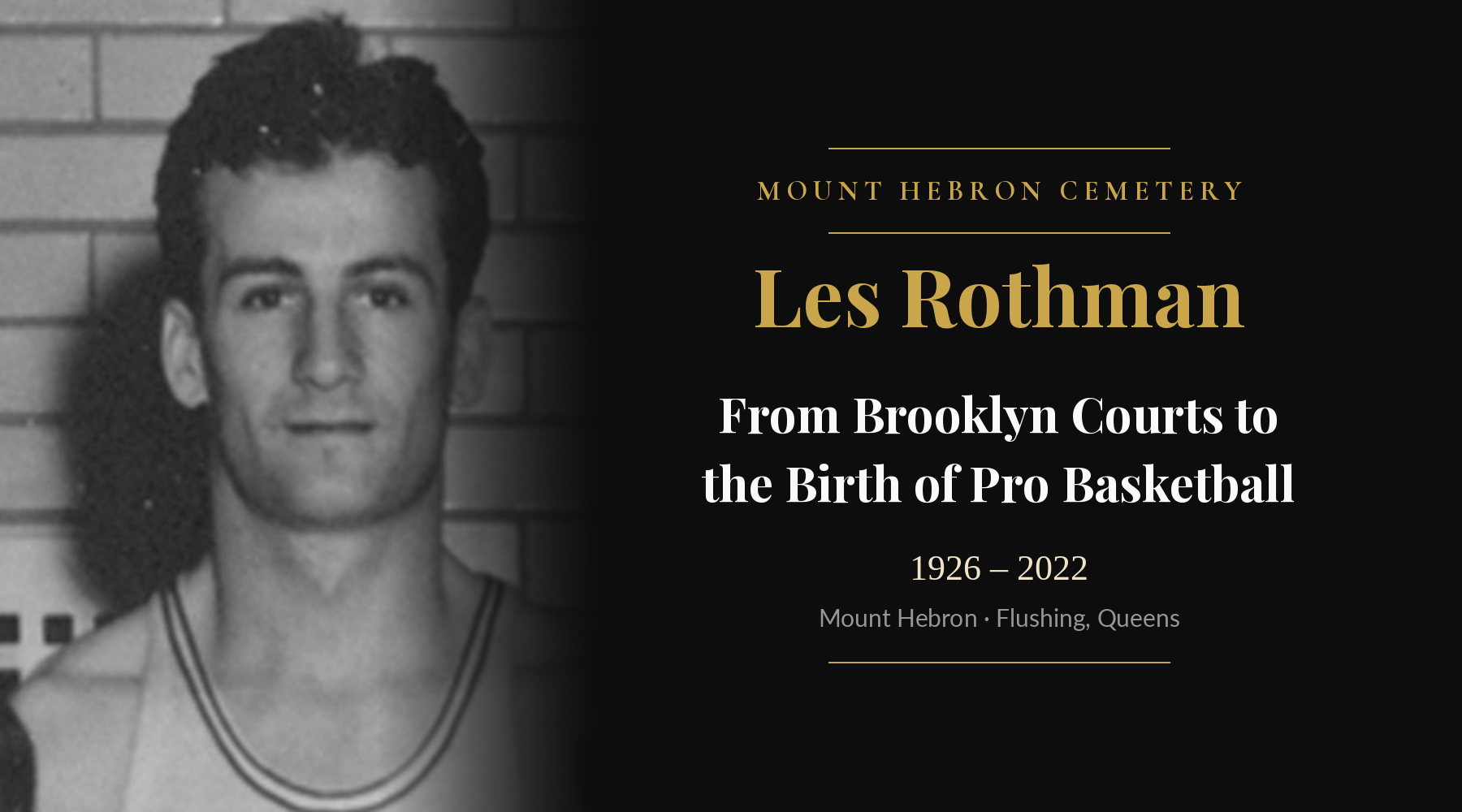
Les Rothman was a New York kid who could play anything. He starred at Stuyvesant High School, then at LIU under coach Clair Bee. In 1945, he played outfield for two Yankees farm teams. But the court called him back. He played in the American Basketball League, then made the jump to the National Basketball League in 1946, suiting up for the Chicago American Gears and the Syracuse Nationals, the team that would become the Philadelphia 76er's. When his playing days ended, he became a high school principal and a summer camp director. Les Rothman died in 2022, weeks shy of 96, and rests at Mount Hebron. ~Blog by Deirdre Mooney Poulos
Learn More
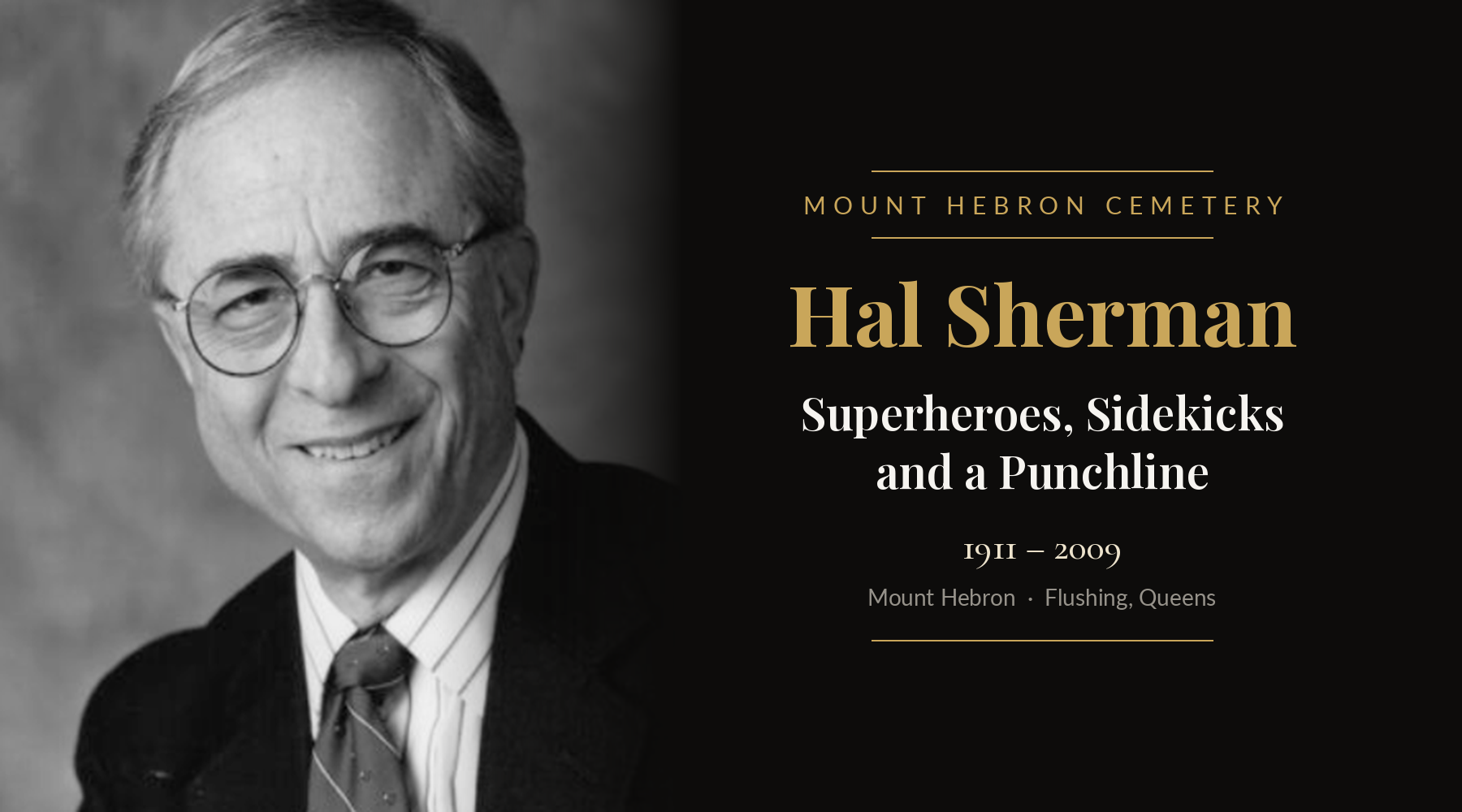
Hal Sherman was born Harold Sicherman in 1911. He was a cartoonist who lived in two worlds at once, patriotic superheroes and gag cartoons. In 1941 he and Superman co-creator Jerry Siegel launched The Star-Spangled Kid and Stripesy. They flipped the old formula. The hero was a teenager, and his sidekick was his grown chauffeur. The series ran for 86 issues as America headed into World War Two. But his heart belonged to humor. He went on to draw The Little Friar, a mischievous monk, and filled magazines and cocktail napkins with jokes that landed in a few strokes of a pen. He died in 2009 at 97 and rests at Mount Hebron. ~Blog by Deirdre Mooney Poulos
Learn More
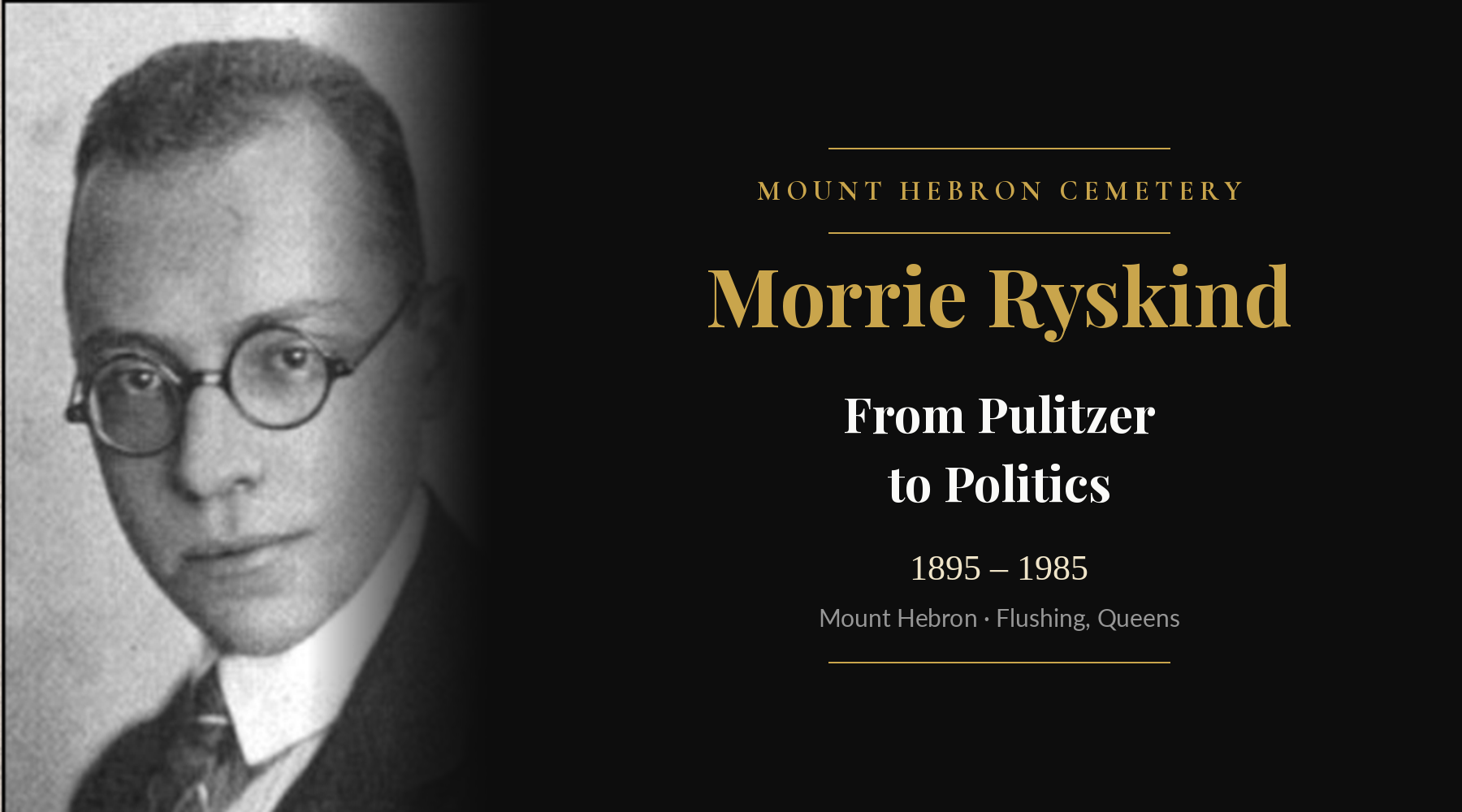
Morrie Ryskind was born in Brooklyn in 1895 to Russian Jewish immigrants. Columbia expelled him six weeks before graduation over an editorial, then later gave him an honorary degree. With George S. Kaufman, he wrote The Cocoanuts and Animal Crackers for the Marx Brothers. Their musical Of Thee I Sing, with songs by the Gershwins, became the first musical to win the Pulitzer Prize. In Hollywood, he helped write A Night at the Opera and My Man Godfrey and earned two Oscar nominations. Later, he turned to politics as a conservative columnist and helped found National Review. He died in 1985 and rests at Mount Hebron Cemetery. ~Blog by Deirdre Mooney Poulos
Learn More
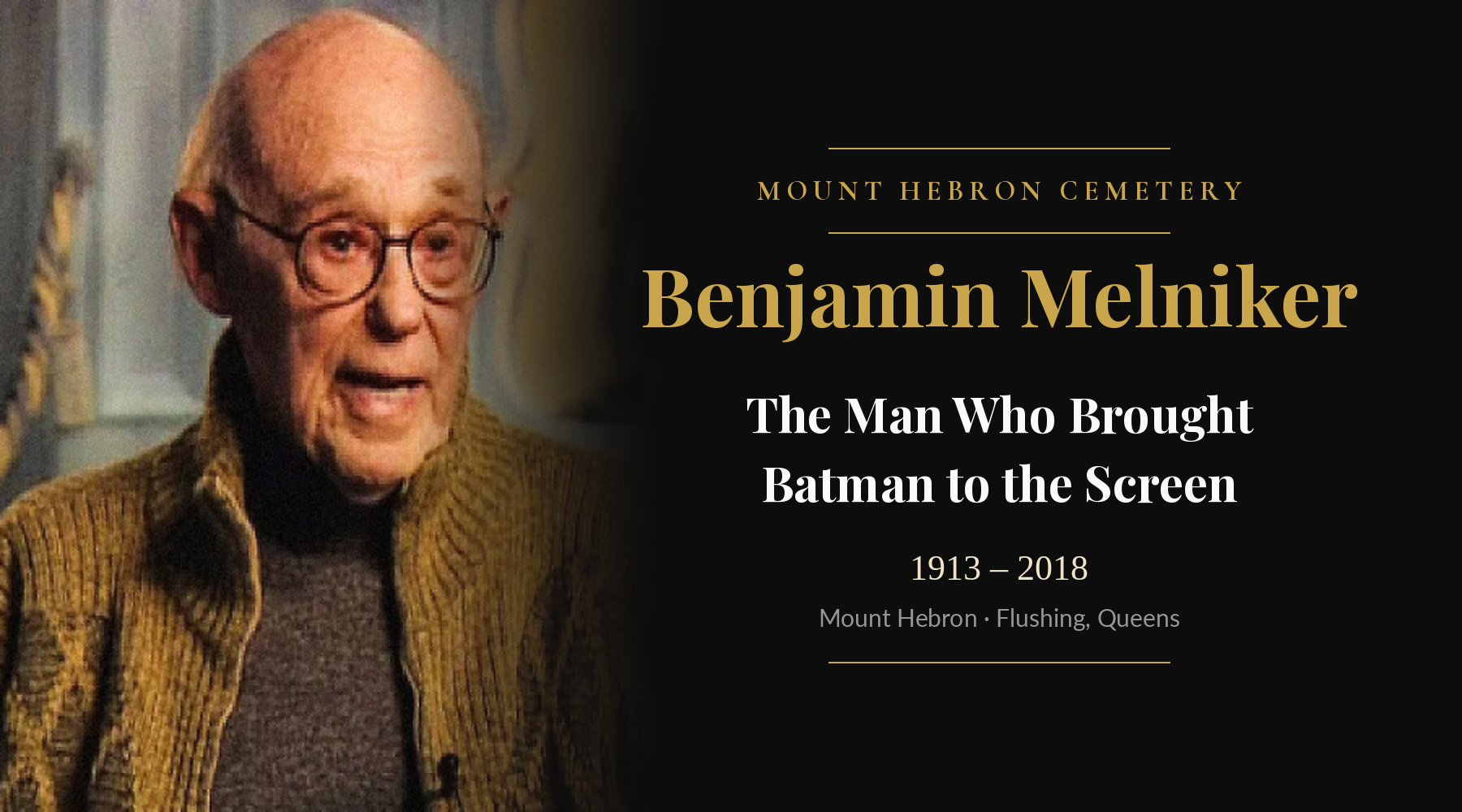
Benjamin Melniker was an Emmy winning executive producer who, along with Michael Uslan, purchased the rights to Batman. They became the Producers on the Batman film series and other DC Comics films. Melniker was an Entertainment Attorney, Hollywood producer, Vice President at MGM studios and President and CEO at Jerry Lewis Cinemas. He won an Emmy for Where on Earth is Carmen Sandiego. Melniker was involved with some of the most memorable films ever made, including Ben-Hur, Dr. Zhivago, 2001: A Space Odyssey, and Gigi. ~ Blog by Renee Meyers
Learn More
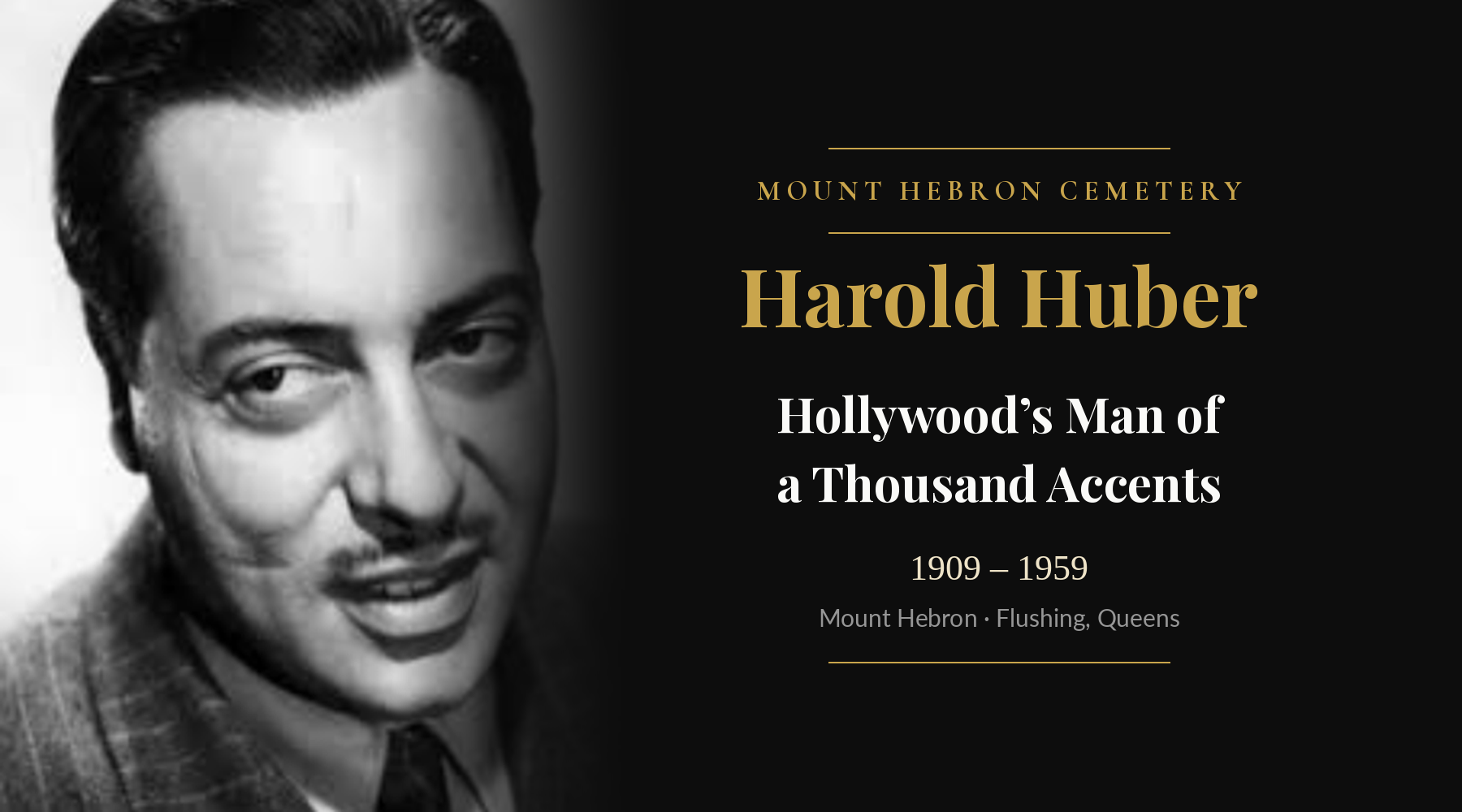
Harold Huber could be almost anyone on screen. He played Chinese, Mexican, and French characters in films like The Thin Man, Charlie Chan on Broadway, and Parachute Jumper. He made his Broadway debut in 1930 in A Farewell to Arms and appeared in five Broadway productions in all. After his credited screen debut in 1932, he averaged nearly nine films a year for eleven years. Off camera, he was an amateur fencing champion, a scholar of antiques, and a man who spoke five languages. Costars called him a delightful person. At home, he was devoted to his wife, Ethel, and daughter, Margaret. Harold Huber rests at Mount Hebron Cemetery. ~Blog by Renee Meyers
Learn More
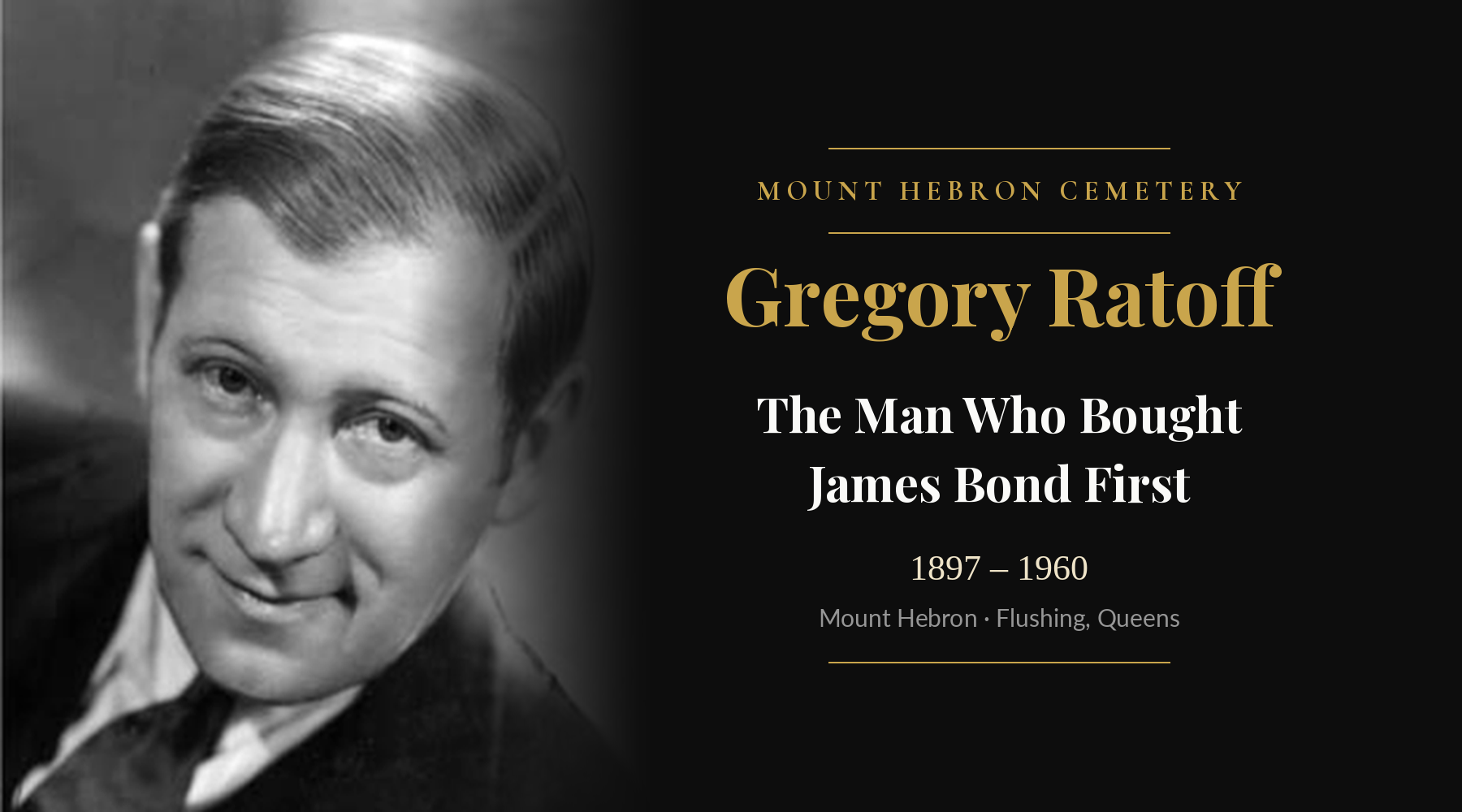
Gregory Ratoff was a Russian born American man who was famous for performing in all three capacities including producing, directing and acting. . His most famous role was portraying the Broadway producer Max Fabian in "All About Eve." As a film director, Ratoff , one of his most notable film credits was directing the classic, "Intermezzo: A love story." Ratoff was one of the two producers to have purchased and developed the original rights to the James Bond franchise from Ian Fleming in the 1950's.
Learn More
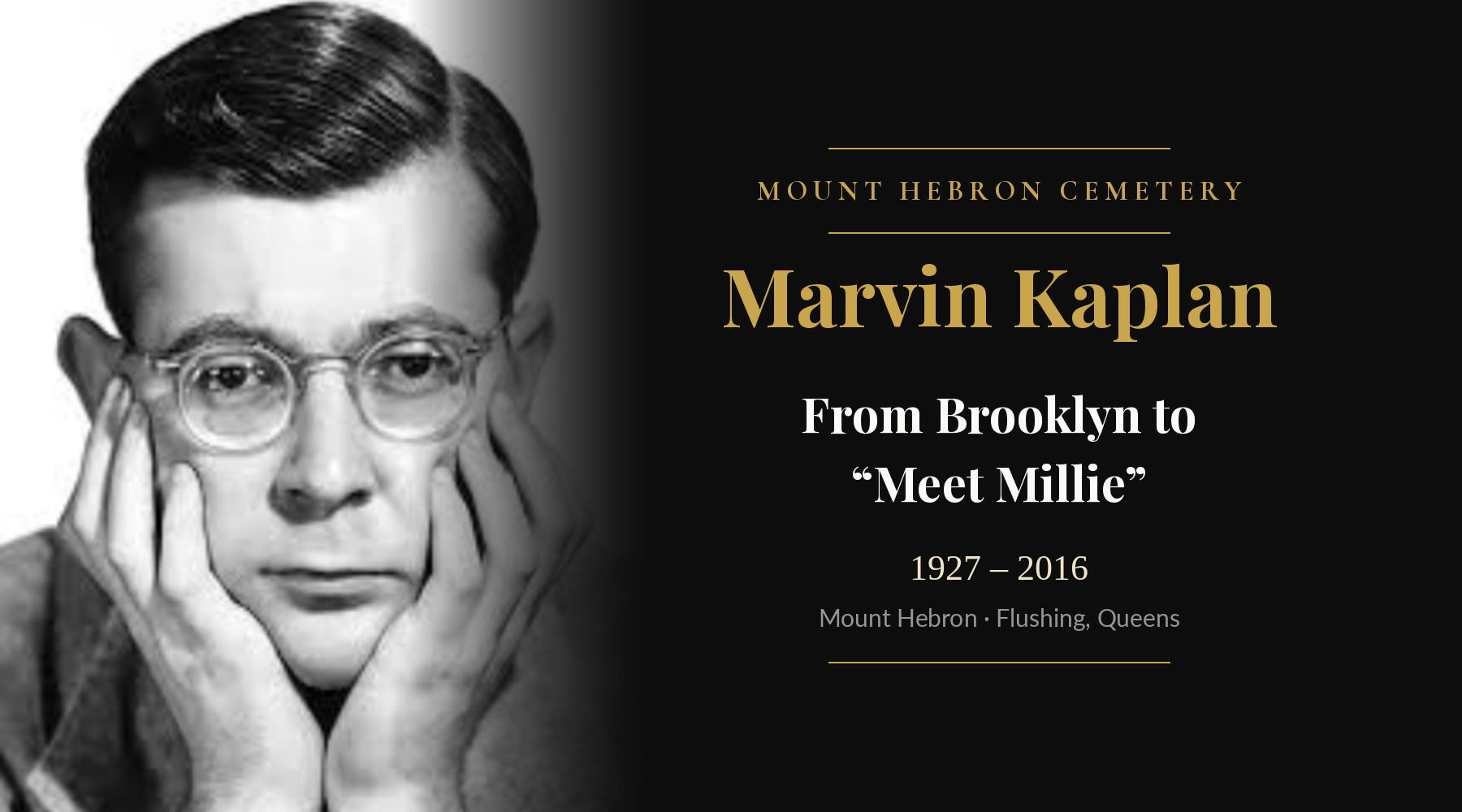
Marvin Kaplan was a Brooklyn boy whose father hoped he would become a doctor. A chemistry lab explosion settled that. In Los Angeles, he was stage-managing a play when he won a small part, reading every line in his thick Brooklyn accent. One night, Katharine Hepburn was in the audience. She told him he was awfully good and recommended him for Adam's Rib. "Changed my whole life," he said. With his thick glasses and dull, flat voice, he became a beloved actor, from It's a Mad, Mad, Mad, Mad World to Henry on Alice and Choo-Choo on Top Cat. He died in 2016 and rests at Mount Hebron. ~Blog by Renee Meyers
Learn More
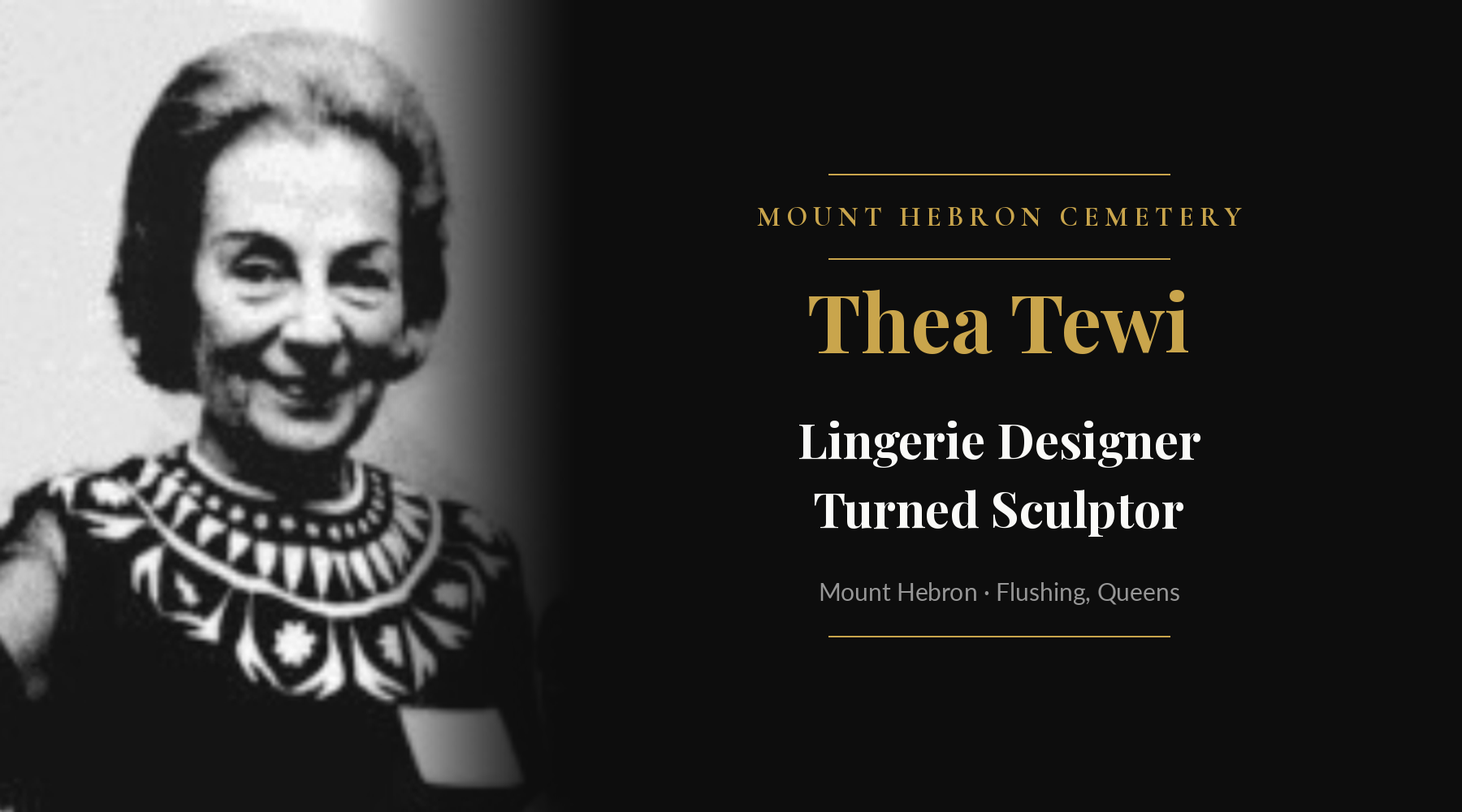
Thea Tewi made beautiful things with her hands, first in silk and then in stone. She was born Thea Wittner in Berlin in 1902 and trained as an artist. In 1938, she and her husband fled the Nazis for America. In New York, she opened a custom lingerie business. It took off. She won a Neiman Marcus Fashion Award in 1945, and by 1947 she was named America's top lingerie designer. Her silk gowns are now in the Metropolitan Museum of Art. In 1950, she returned to her first love, sculpture. She carved flowing forms from marble and onyx. Her work is in the Smithsonian. Thea Tewi rests at Mount Hebron Cemetery.
Learn More
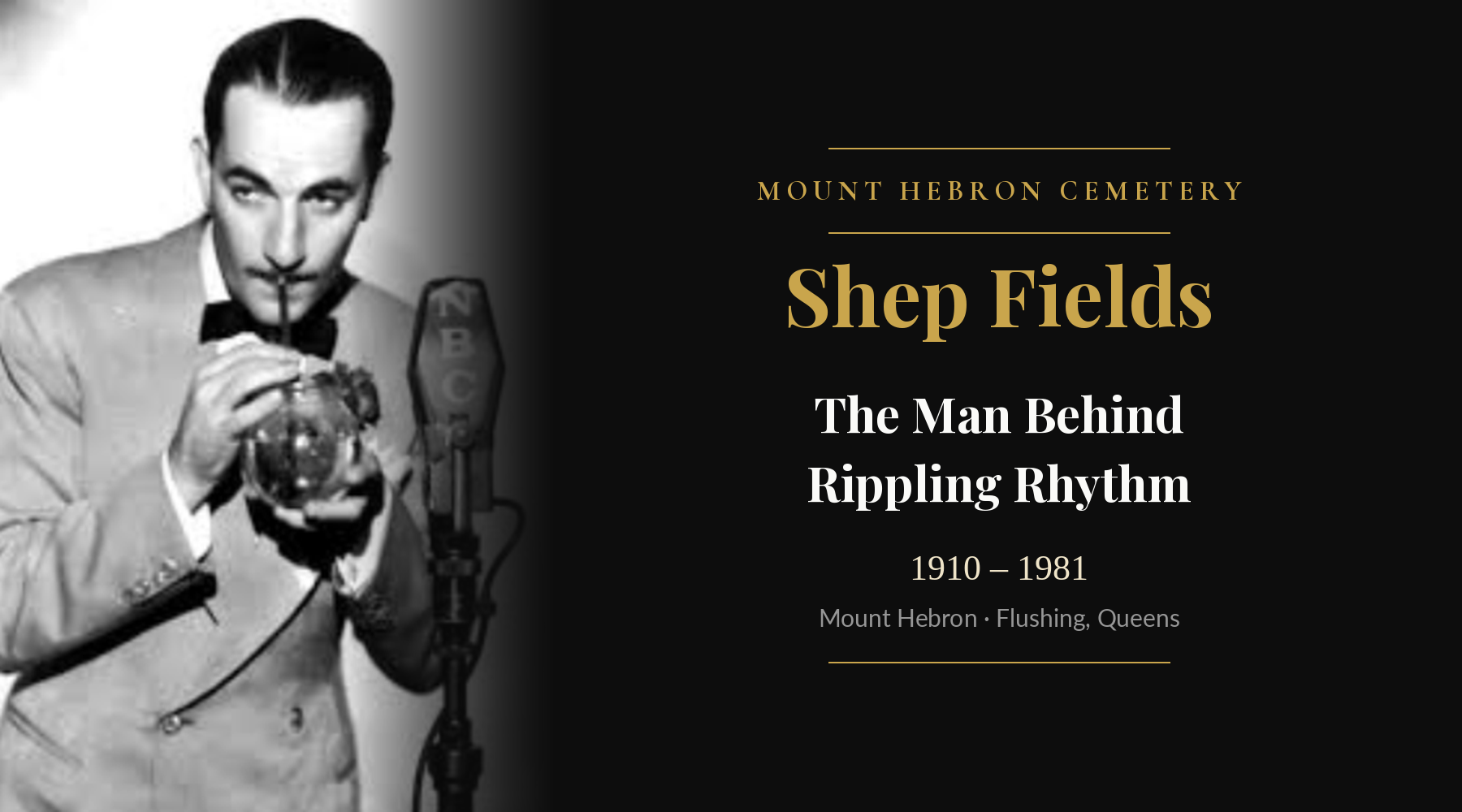
Shep Fields was a popular jazz band leader of the 1930s and '40s, best known for his "Rippling Rhythm" trademark, which featured Fields blowing bubbles into a bowl of water at the beginning of every song and wood-block playing by the band's drummer. Among the highlights of Shep Fields career was his band being featured in the film "The Big Broadcast of 1938," which starred W.C. Fields and Bob Hope, and conducting his band. He had his own NBC coast-to-coast radio broadcast and conducted his orchestra at the Academy Awards ceremony in Los Angeles in 1939.
Learn More
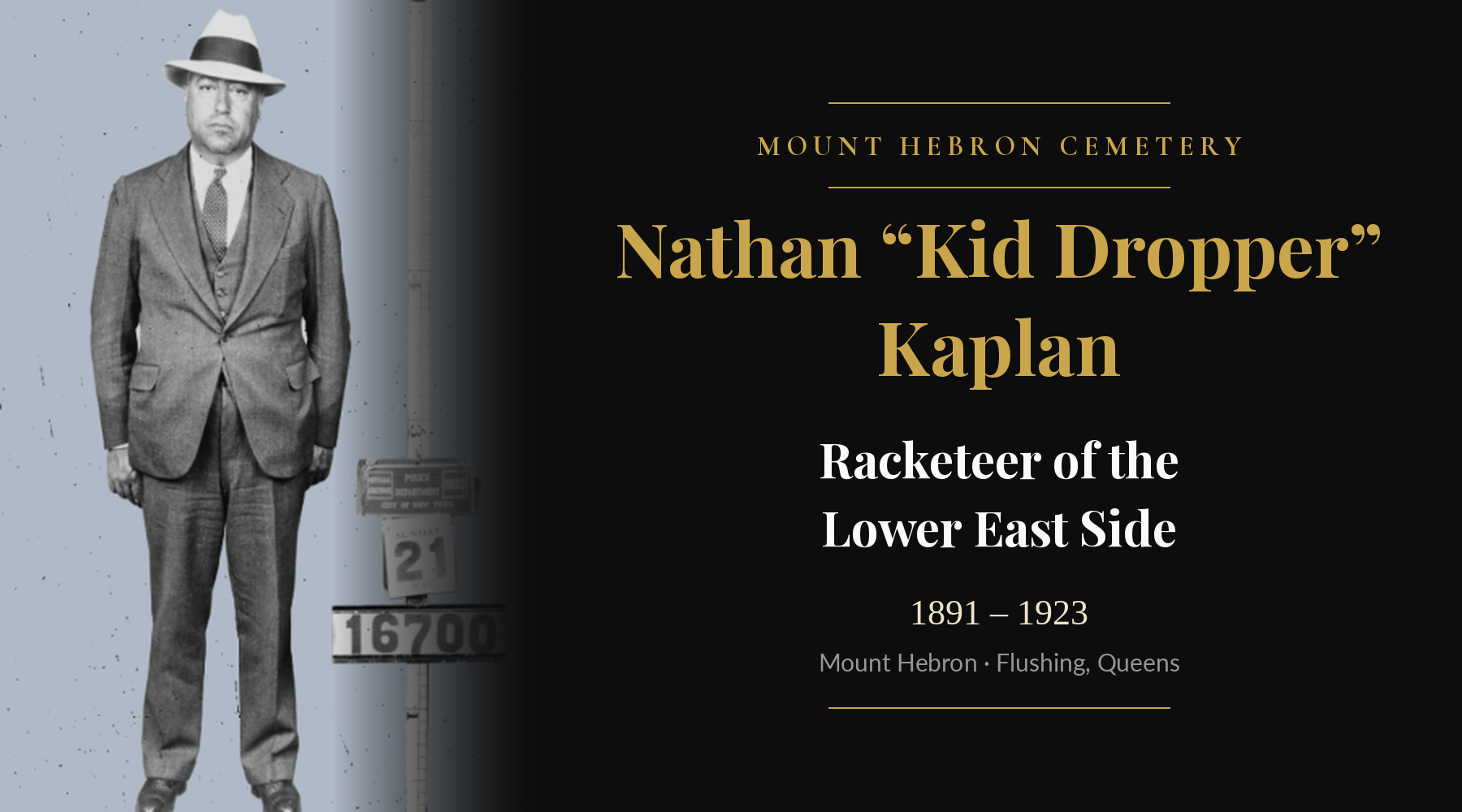
Nathan Kaplan was born on the Lower East Side in 1891, and the streets raised him. He ran with the Five Points Gang and served seven years in Sing Sing for robbery. The world came to know him as Kid Dropper. From 1919 to 1923, he ruled the labor rackets of New York. Unions, and sometimes bosses, paid for his muscle. His rivals feared him. But by 1923, Little Augie Orgen wanted his crown. On August 28, Kaplan left the Essex Market Courthouse surrounded by police. A young gunman named Louis Cohen shot him anyway. He was just 32. Three thousand people crowded his funeral. Kid Dropper rests at Mount Hebron Cemetery.
Learn More
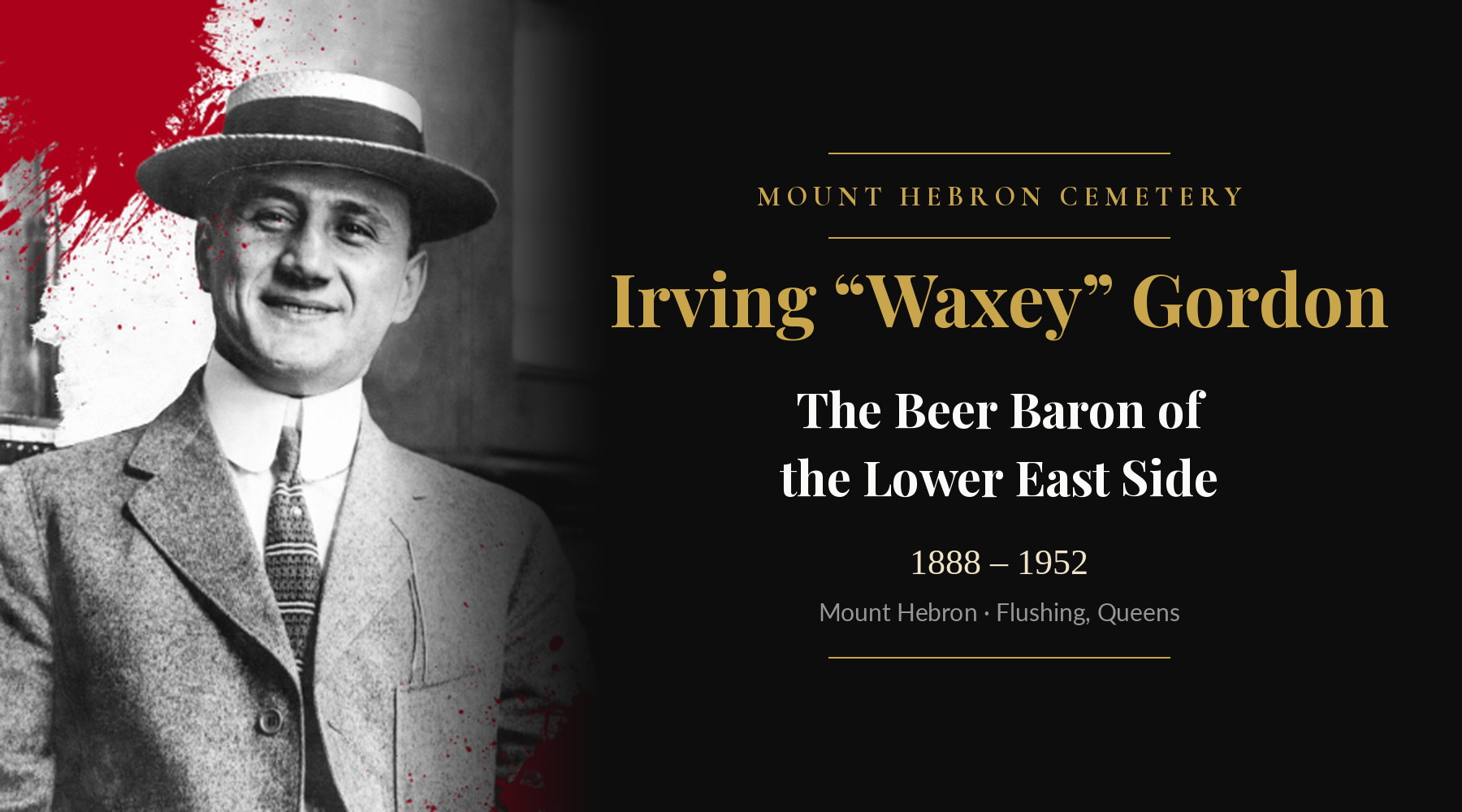
Irving "Waxey" Gordon was dubbed one of the Prohibition Era's most sinister underworld figures. He began as a common pick pocket and ended as the head of a nationwide narcotics ring. In a "profession" where many men died in a hail of bullets or were sent to jail for half of their lives, Irving was a survivor. His criminal career endured for nearly 50 years from 1905 to 1952. In that period, he had some close calls and made more than a few enemies. He spent a total of 14 years in prison- the longest stretch was from 1933-1940. He spent decades as a thief, gangster, tax cheat and bootlegger. Irving "Waxey" Gordon was a career criminal and knew no other way to live his life.
Blog by Renee Meyers
Learn More
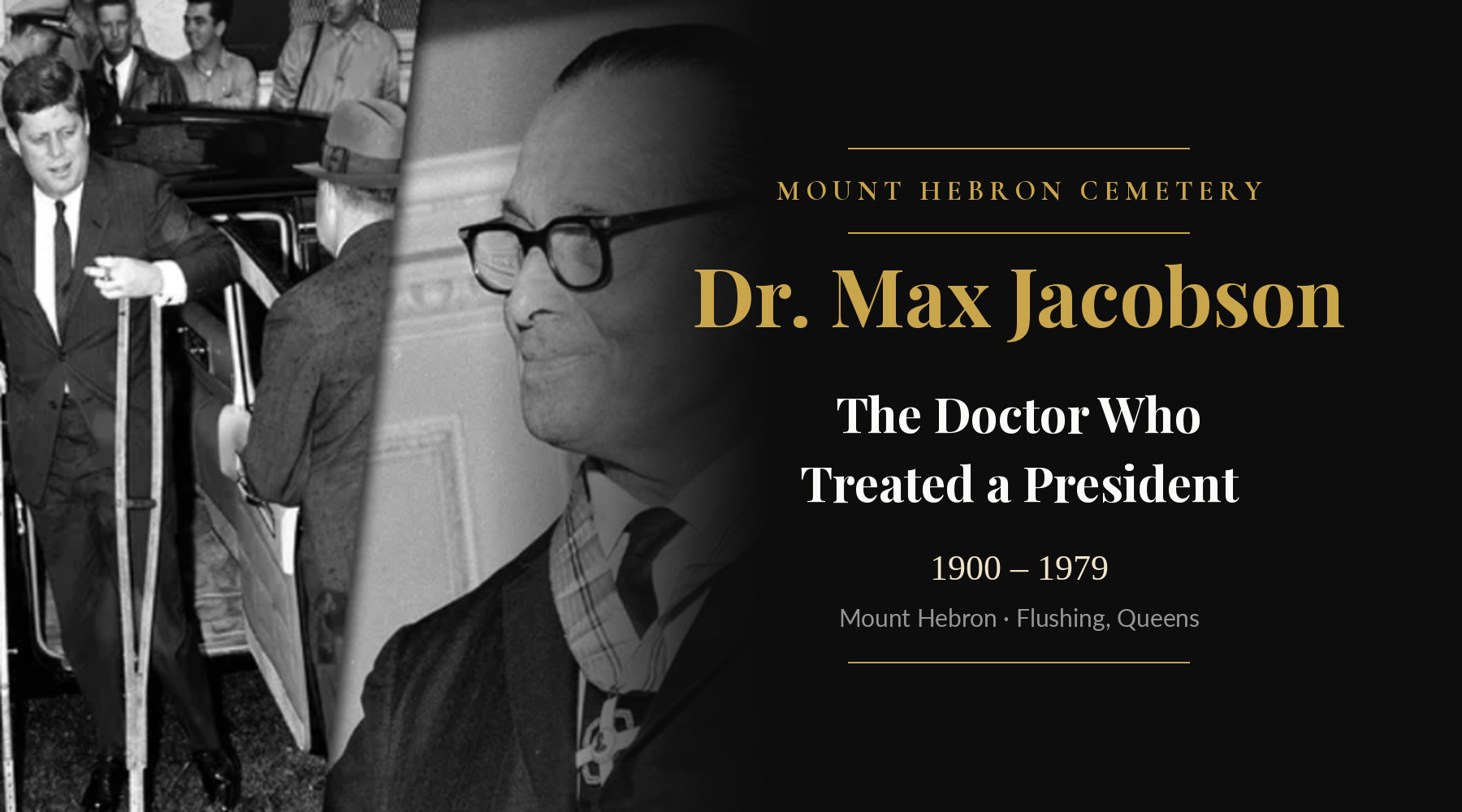
Max Jacobson was a German Refugee who moved to N.Y.C and established a practice on the Upper East Side of Manhattan. His practice catered to writers, musicians, politicians and entertainers. His popularity and his nicknames "Dr. Feelgood" and "Miracle Max" came from his vitamin injections which got their kick from 30-50 milligrams of amphetamines (speed) mix in with other things. Dr. Jacobson's most famous patients were JFK and his wife, Jackie. Some patients had bad reactions or died from these injections. Dr. Jacobson was investigated and charged with unprofessional conduct. His medical license was revoked. Dr. Jacobson applied to have his license reinstated a few years later. However, his application was denied and he died several months later.
Learn More
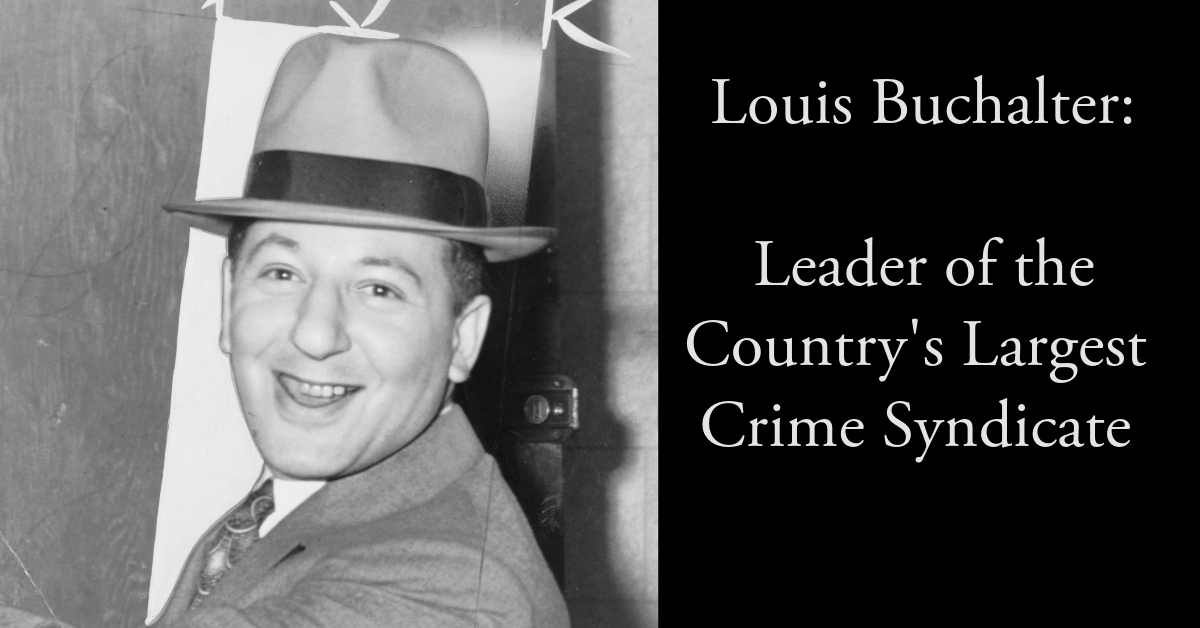
Louis "Lepke" Buchalter was an American Jewish Organized Crime figure and head of the Mafia hit squad and Murder Inc during the 1930s and one of the premier labor union racketeers. during that era. He paired up with the mobsters that would make his career. Buchalter together with Jacob "Gurrah".Shapiro infiltrated the unions that represented New York's garment industry workers. This scheme that would last Buchalter's entire career. The mob run unions would threaten strikes unless management paid the union bosses and the bosses would rob the unions. Buchalter eventually built up his labor scam into a small empire. He partnered with future Italian Mafia boss, Tony Lucchese to run the garment industry. This venture made him extremely wealthy.
~Blog by Renee Meyers
Learn More
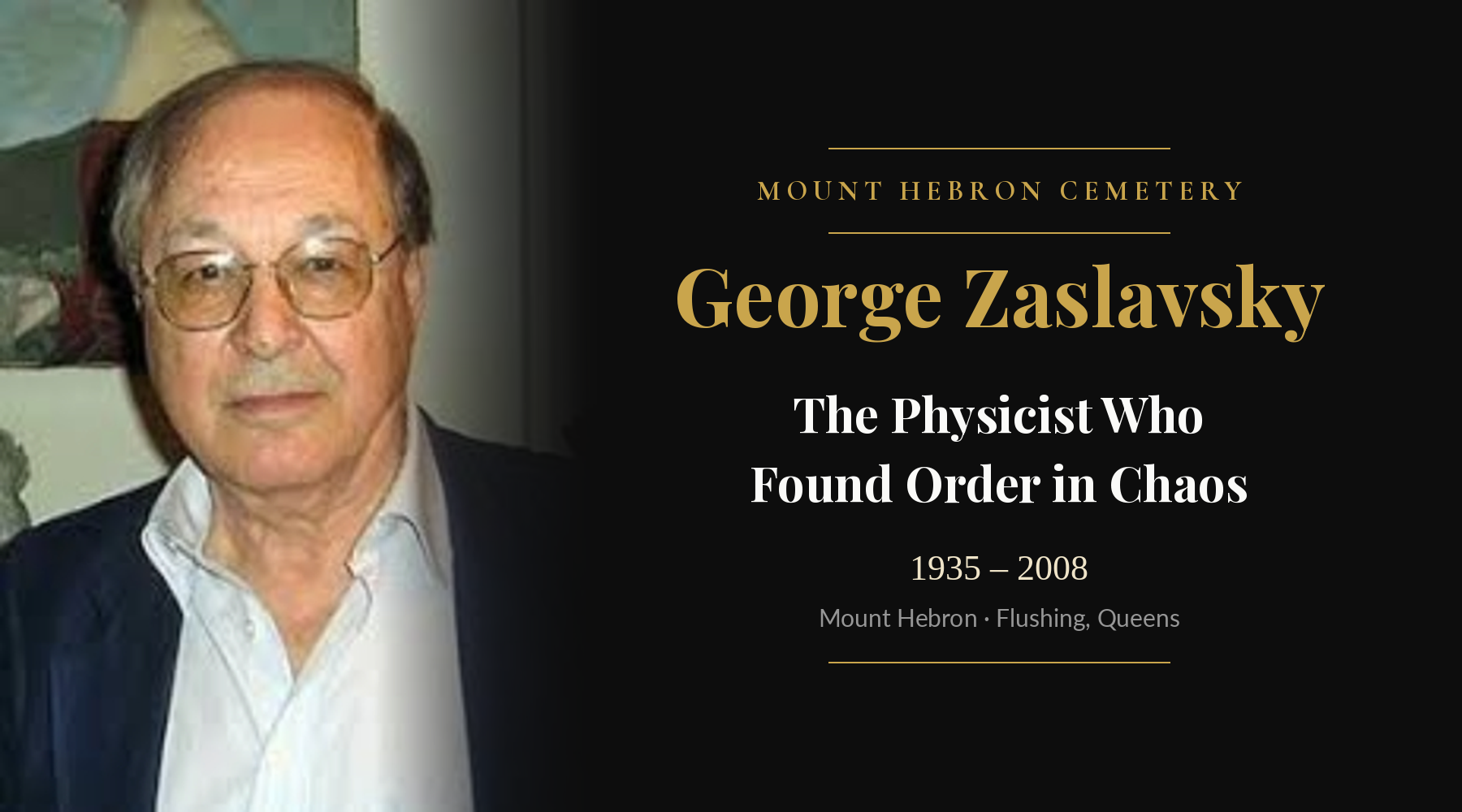
George Zaslavsky was born in Odessa in 1935, the son of an artillery officer who survived the Second World War. He studied at the University of Odessa and went to Siberia in 1957, just as physics there was coming alive. He became one of the founders of the physics of dynamical chaos. He was forced out of his post for signing letters in defense of Soviet dissidents, and he kept working anyway. He built a laboratory in Krasnoyarsk and helped discover the patterns now called Zaslavsky webs. In 1991 he came to New York to teach at NYU. He wrote nine books and more than 300 papers. He died in 2008. ~Blog by Renee Meyers
Learn More
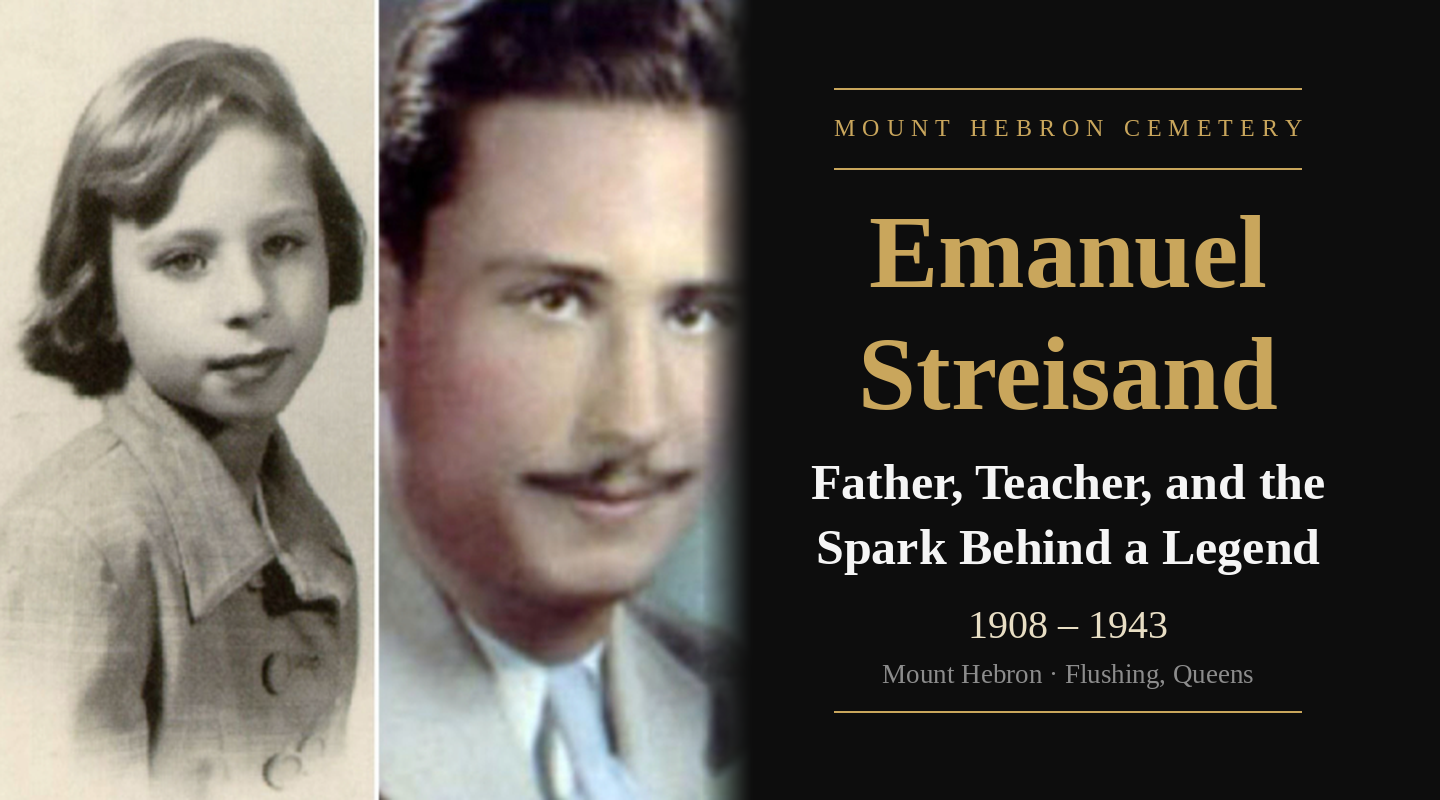
A toddler waits at a Brooklyn window for a father who never comes home. Emanuel Streisand, born in 1908, loved teaching. He worked his way through City College and brought Chekhov and Shakespeare to young men at Elmira Reformatory. He married Diana Rosen in 1930, raised two children, and studied at night for his doctorate. In August 1943 he died after a seizure at a summer camp, only thirty-five. His daughter Barbra was fifteen months old. She later honored him with a school, a building in Jerusalem, and her film Yentl. He rests at Mount Hebron beneath the words esteemed teacher and scholar. May his memory be a blessing. ~Blog by Rebecca Winn
Learn More
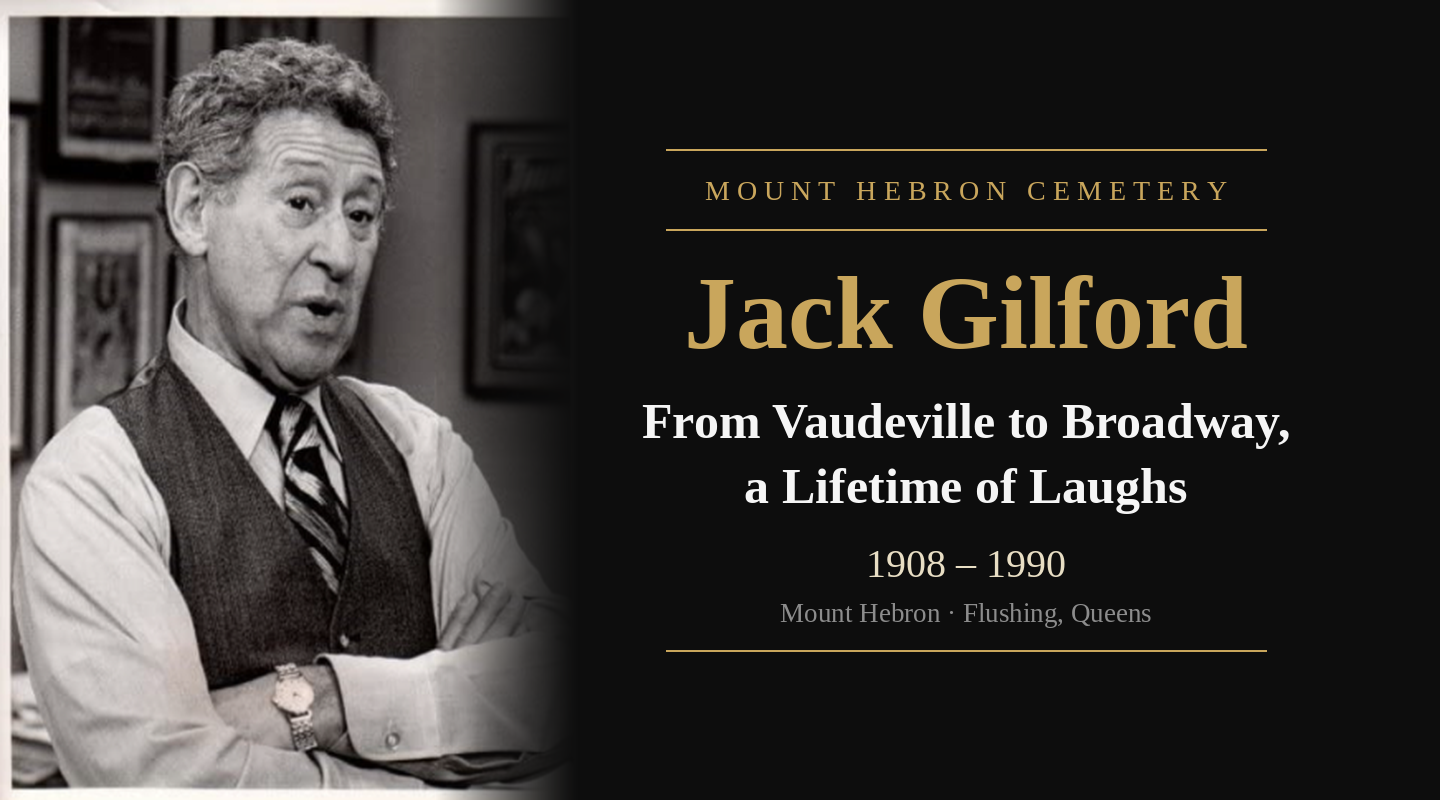
Jack Gilford was born Jacob Aaron Gellman on the Lower East Side in 1908. He grew up in Williamsburg, where his mother ran a restaurant and, by his own telling, sold bootleg liquor. Milton Berle discovered him working in a pharmacy. He became the master of ceremonies at Cafe Society, then a beloved Broadway comic. In 1953 Jerome Robbins named Jack and his wife, Madeline, before the House Un-American Activities Committee. The phone stopped ringing. He fought his way back as Hysterium in A Funny Thing Happened on the Way to the Forum. Later still came an Oscar nomination, Cocoon, and The Golden Girls. He died in 1990. ~Blog by Julian Christy
Learn More
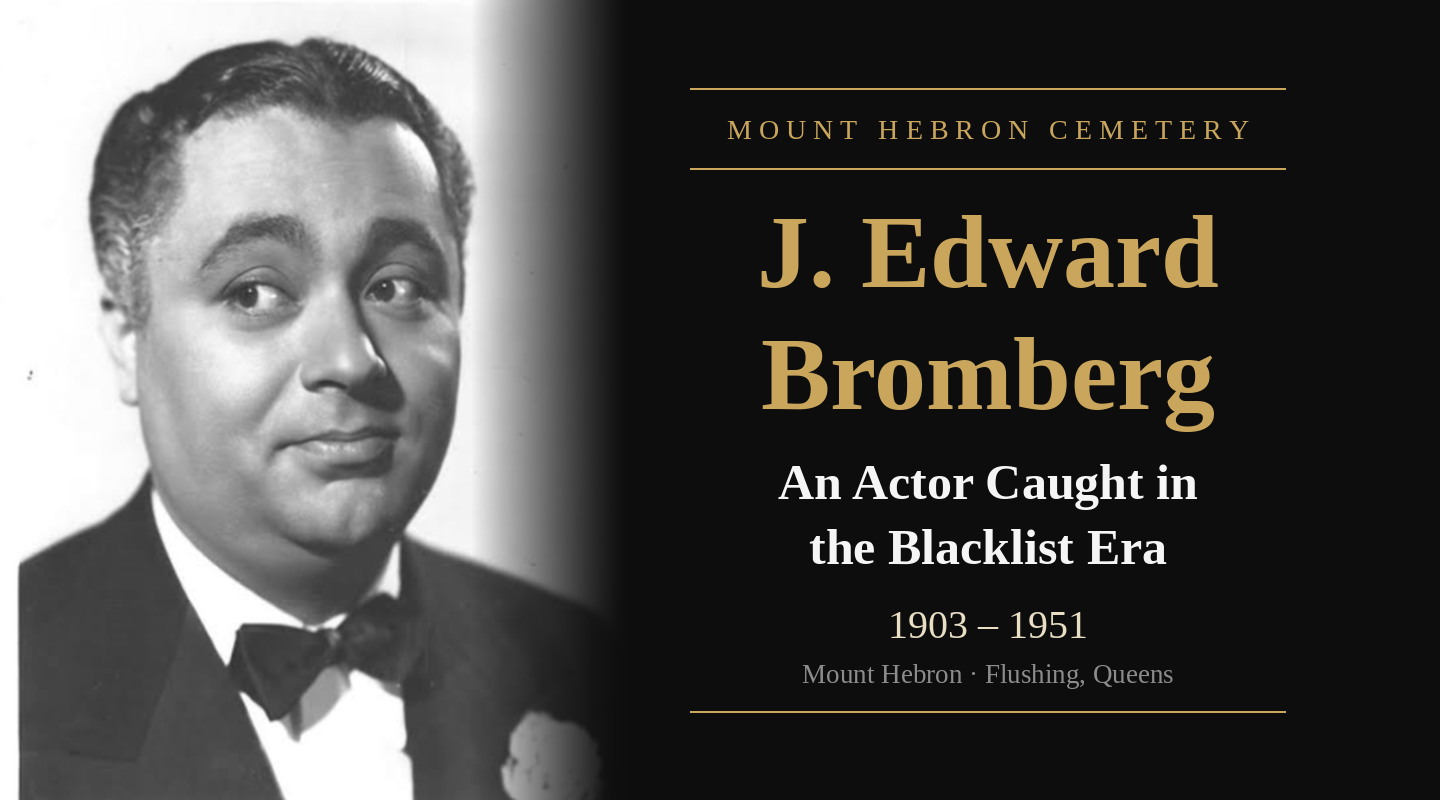
J. Edward Bromberg was born Josef Bromberger in Temesvar, Hungary, today Timisoara, Romania, on December 25, 1903. He came to New York as a baby in 1905. At Stuyvesant High School he played Jean Valjean. He became a founding member of the Group Theatre, then a Hollywood character actor in 53 films, from The Mark of Zorro to Son of Dracula. In June 1951, he refused to answer the House Committee on Un-American Activities. He was blacklisted. He went to London to find stage work. On December 6, 1951, he died of a heart attack at 47. At his memorial, Lee Grant said the committee had killed him. ~Blog by Julian Christy
Learn More
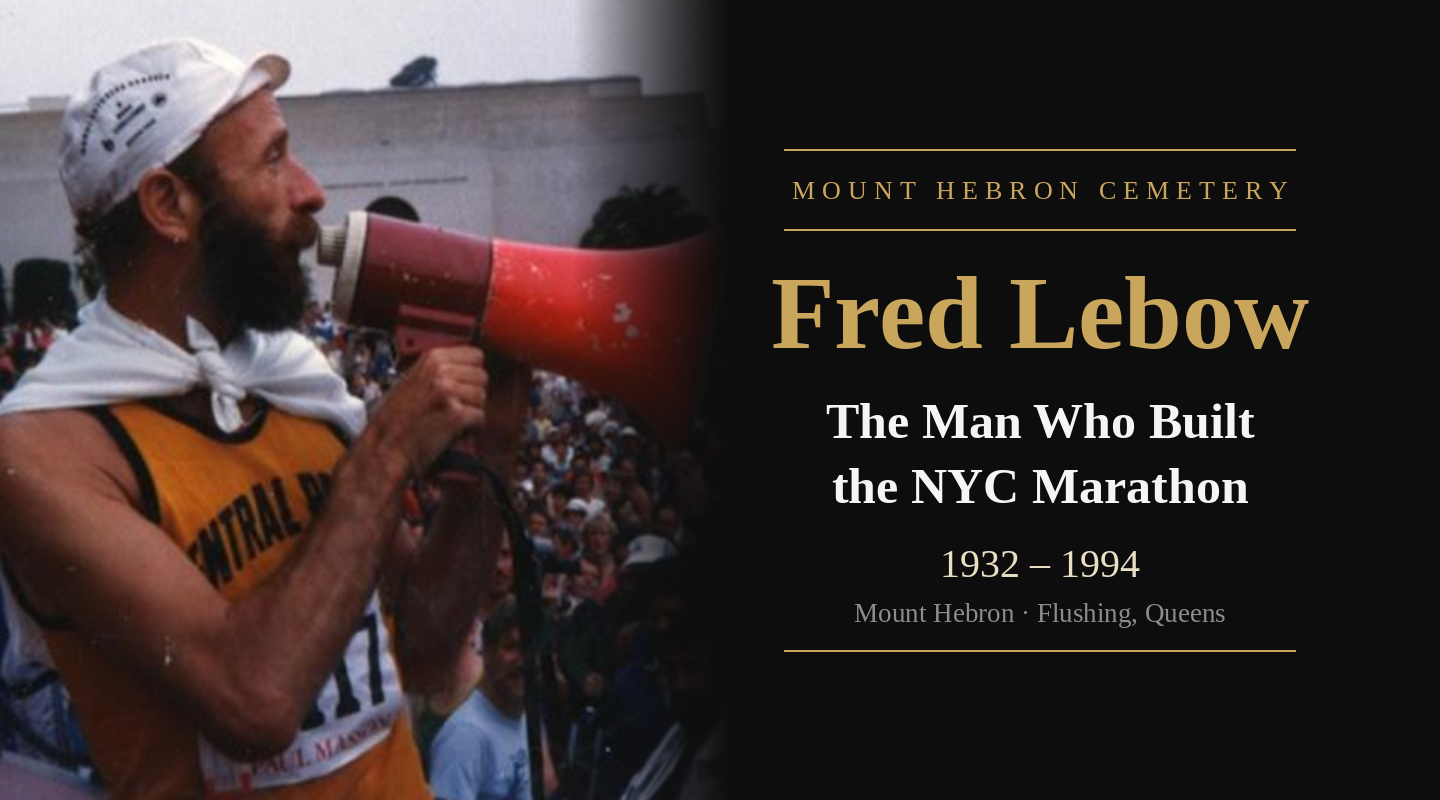
Fred Lebow was a runner, race director, and founder of the New York City Marathon. When the New York City Marathon began in 1970 it only had 55 finishers. Through his innovation and passion, it became one of the biggest marathons in the world, with a record 52,000 finishers in 2018.
He now rests with us at Mount Hebron.
Post Written by Rene Yaroshevsky
Learn More
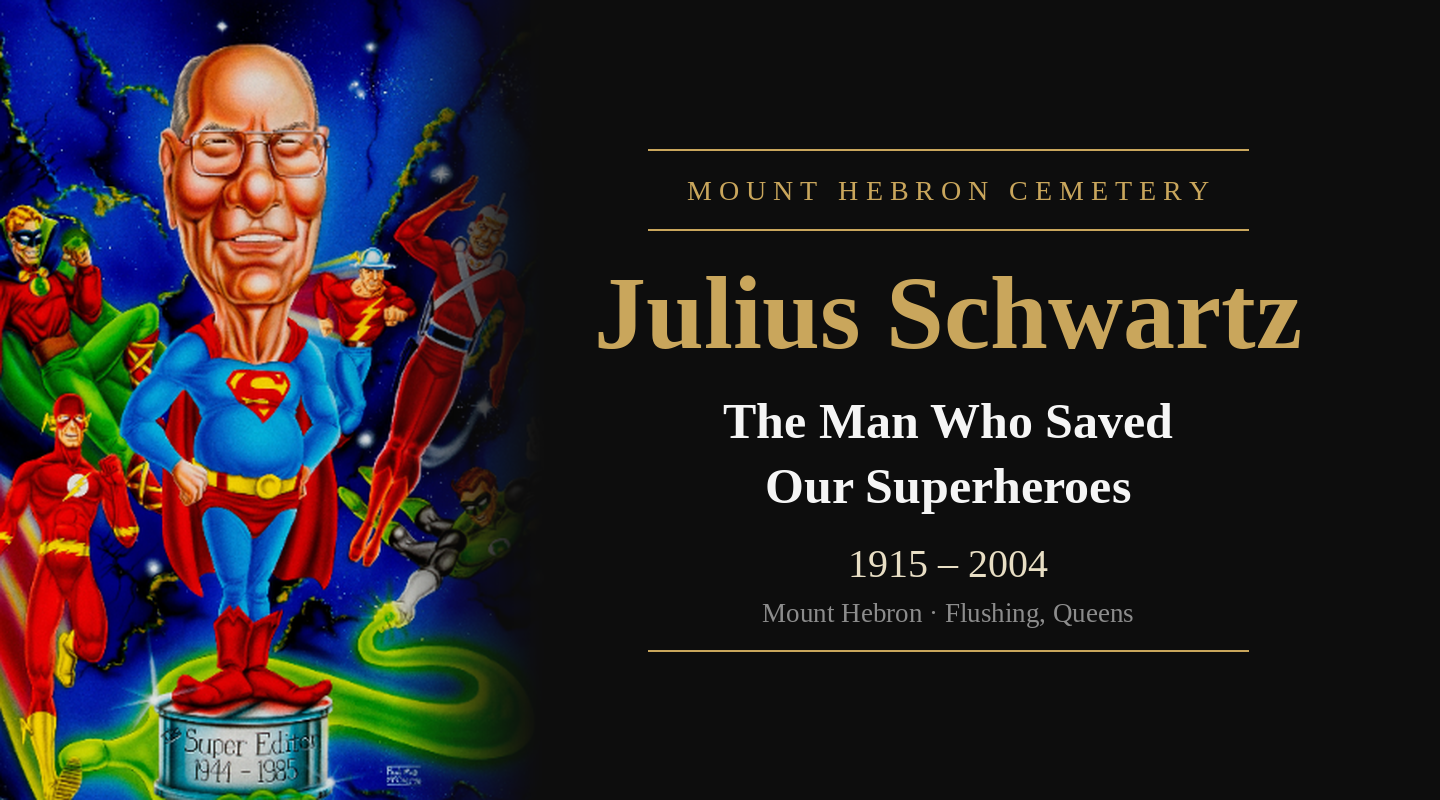
Julius Schwartz grew up in the Bronx, the son of Romanian Jewish immigrants, reading science fiction. As a teenager he started one of the first sci-fi fan magazines and became an agent for Ray Bradbury and H. P. Lovecraft. In 1944 he became a comic book editor. When superheroes nearly vanished after World War II, he brought them back, with a new Flash, a new Green Lantern, and the Justice League, and later rescued Batman and edited Superman. He helped bring the world the idea of parallel worlds. He wrote his own epitaph, and it is carved on his stone at Mount Hebron: "He met his last deadline." ~Blog by Elisheva Schuster
Learn More
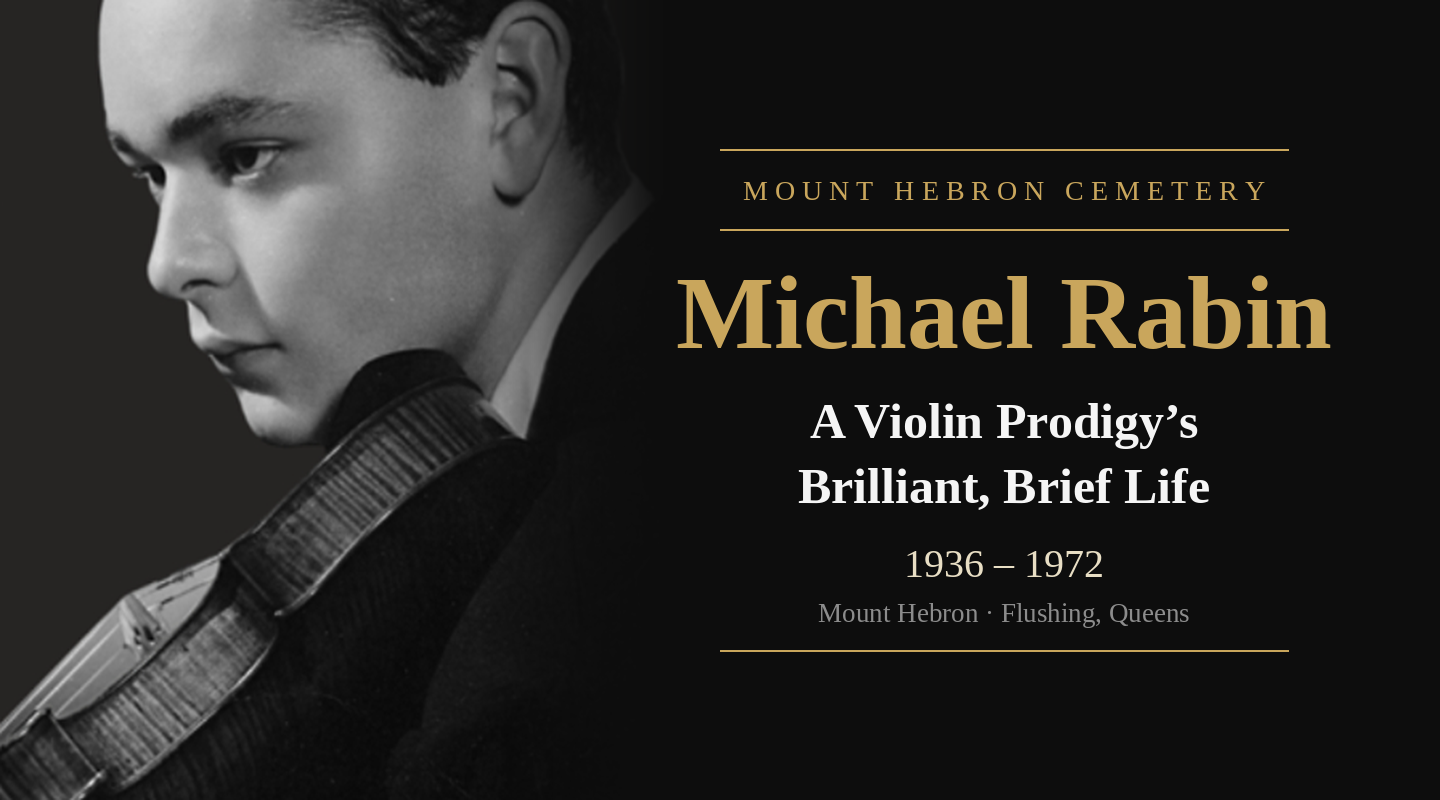
As a boy, Michael Rabin practiced with six marbles and an empty bowl, moving one marble each time he played a passage perfectly. At ten he made his debut with the Havana Philharmonic. At thirteen he played Carnegie Hall to a standing ovation, and conductors called him the genius violinist of tomorrow. He recorded the great Romantic concertos, played the soundtrack for an Elizabeth Taylor film, and traveled 700,000 miles. But the pressure of a stolen childhood caught up with him. He fought his way back and spoke openly about it. He died at 35, after a fall at home. At Mount Hebron, his stone reads Beloved Son. ~Blog by Brandon Castro
Read More
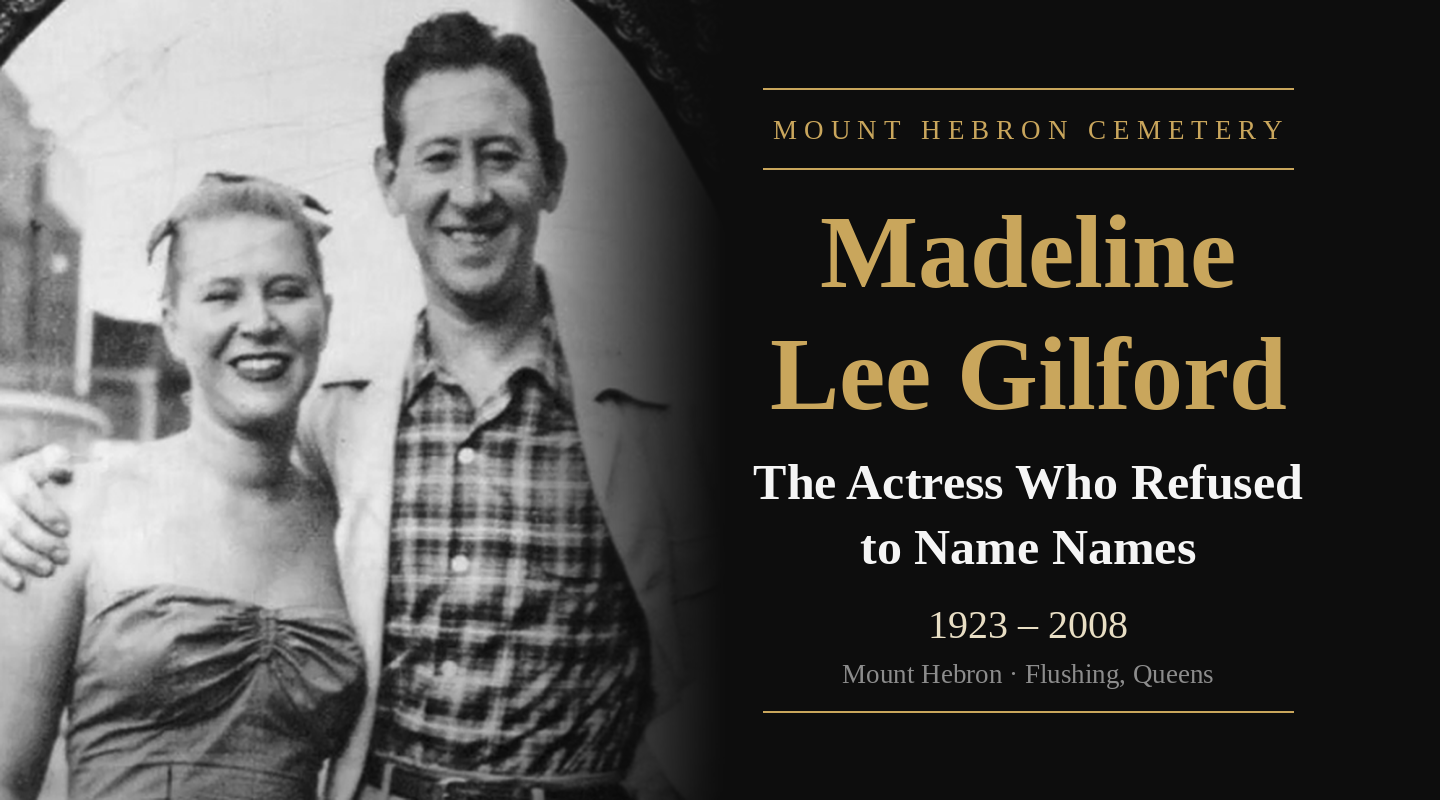
Madeline Lee Gilford was an American film and stage actress and social activist, who later enjoyed a career as a theatrical producer. Gilford was married, secondly, to actor Jack Gilford from 1949 until his death in 1990.
Learn More
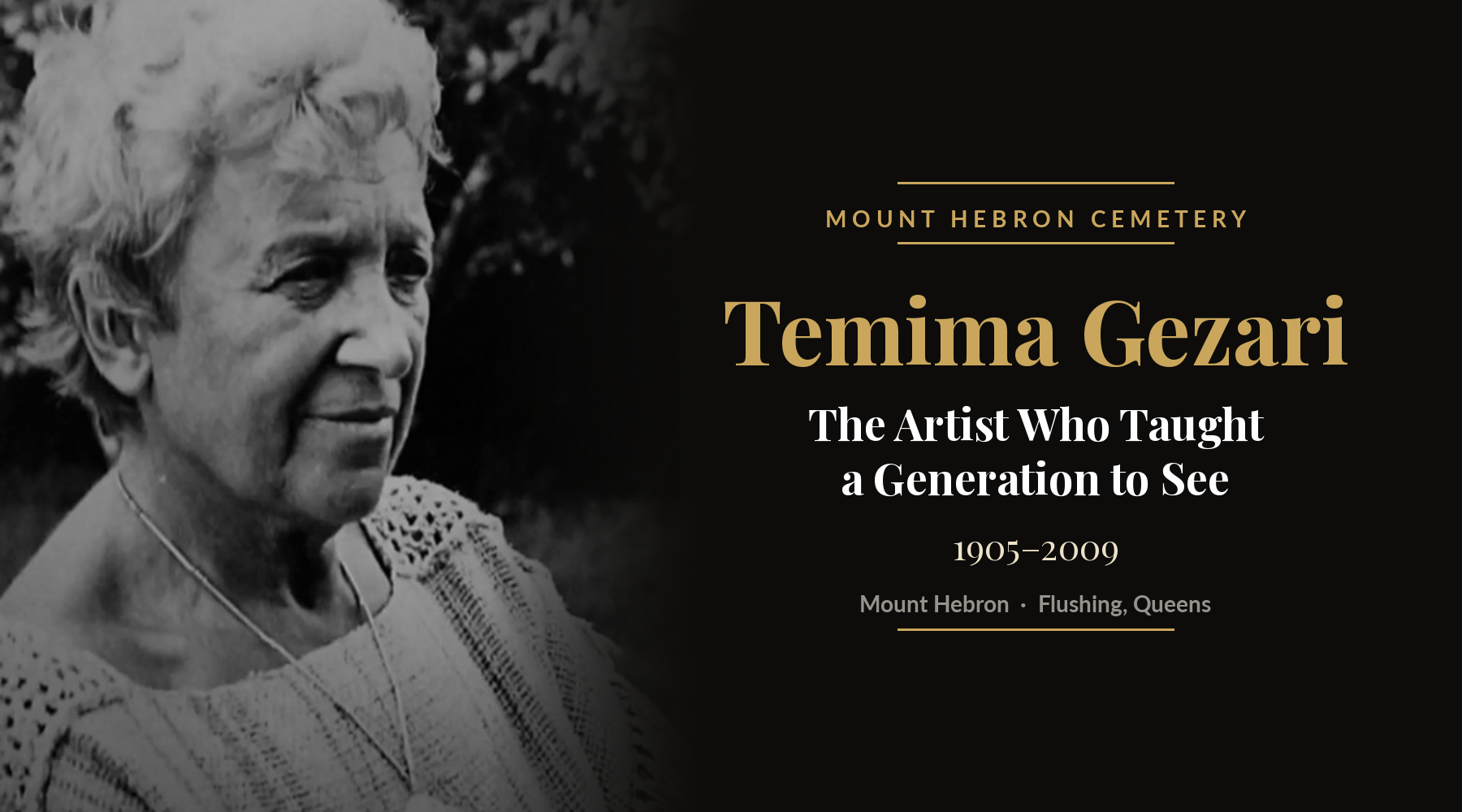
Temima Gezari was an American artist and art educator. Her life's work in painting and sculpture is presented in the photographic retrospective The Art of Temima Gezari, edited by her son, Daniel Gezari.
Learn More