Peter Wiernik: The Man Who Wrote Our History First
On a cold February morning in 1936, four hundred people filled Congregation Chovevey Torah on Eastern Parkway in Brooklyn. They came from the American Jewish Congress and the American Jewish Committee, from B'nai Brith and the Zionist Organization of America, from the Orthodox Rabbis of America and the Joint Distribution Committee. The president of Yeshiva College stood as an honorary pallbearer. The editors of rival newspapers came to mourn together. Practically every corner of Jewish life in America sent someone to that synagogue.
All of it for a newspaperman.
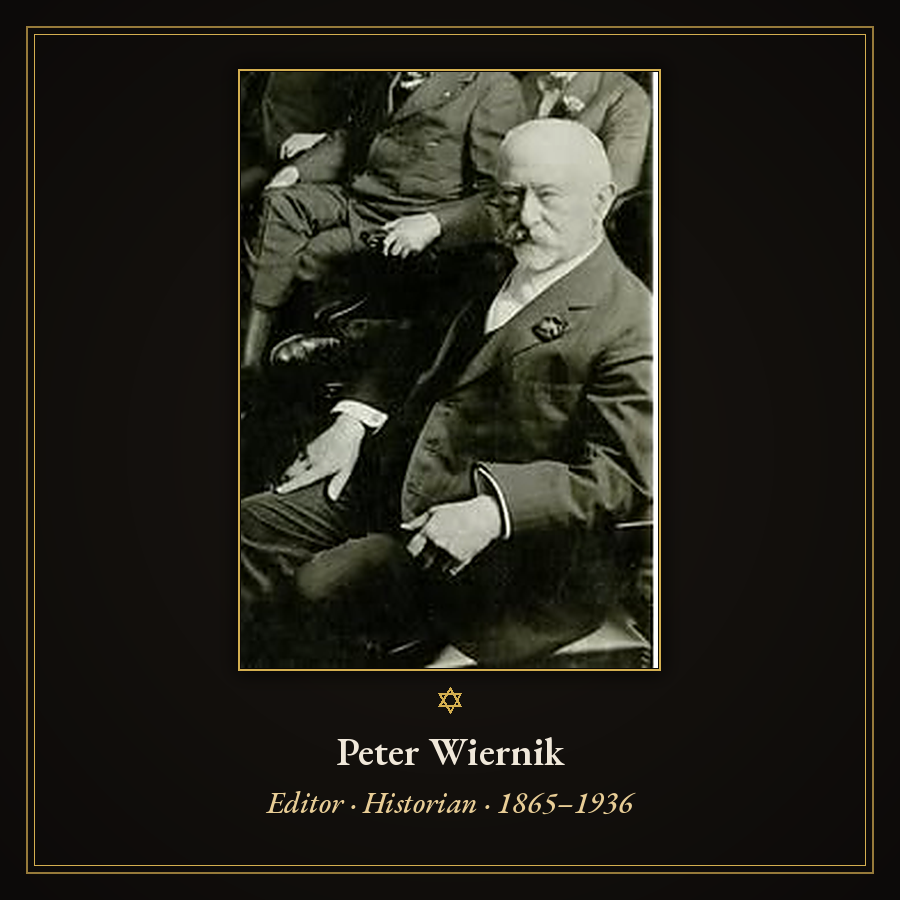
His name was Peter Wiernik, and if you have never heard of him, that is exactly why this story needs telling.
He was born Peretz Wiernik in Vilna in 1865, in the city Jews called the Jerusalem of Lithuania. The name was not flattery. For two centuries Vilna had been one of the great capitals of Jewish learning, the city of the Vilna Gaon, the eighteenth-century sage whose brilliance still shaped how half the Jewish world studied. It was a city of printers whose editions of the Talmud traveled to every corner of the map, of study halls that never went dark, of maskilim, the followers of the Jewish enlightenment, who believed a Jew could hold the whole of tradition in one hand and the modern world in the other. A boy raised in that city absorbed something particular: the conviction that books were not decoration but survival, that a people lives as long as its memory is written down. Peretz Wiernik absorbed it completely, and he never let it go.
In 1885, at about twenty years old, he did what his whole generation was beginning to do. He boarded a ship and sailed for America. Somewhere in the crossing, as happened to so many, Peretz became Peter, the name Americanized even as the man never was. He was early. The great migration was just gathering force. Between the pogroms and poverty of the 1880s and the closing of America's doors in 1924, more than two million Eastern European Jews would make the same crossing, packing into the tenements of the Lower East Side, into Brownsville and Williamsburg and Chicago's West Side, carrying almost nothing except their families, their faith, and their language.
And that language built an empire of newsprint. The American Yiddish press became one of the most remarkable institutions immigrant America ever produced. At its height, the Yiddish dailies of New York sold well over half a million copies a day, more than many of the great English papers. But circulation numbers miss what these papers actually were. For a generation of immigrants, the Yiddish paper was the university they never attended. It taught them how to vote, how to find work, how American courts and banks and schools worked. It printed their poets and serialized their novelists. It answered their letters about broken hearts and disobedient children. It fought their labor battles and argued their politics at full volume, paper against paper, on every newsstand in the Jewish quarter. To edit a Yiddish daily in those years was to hold one of the most influential positions in Jewish life.
Wiernik worked his way up inside that world the honest way, first in Chicago and then in New York, learning the trade from the type case up, writing on everything from politics to Jewish law. Then in 1901 a new daily appeared in New York, and it changed his life. It was called the Morgen Zhurnal, the Jewish Morning Journal, and it was built to be different. The giant of the Yiddish press, the Forverts, preached socialism to the sweatshop workers and looked with suspicion on the old religion. The Morgen Zhurnal turned the other way. It spoke for the traditional and the religious, for the shopkeepers and the shul-goers, for the immigrants who wanted desperately to become Americans without ceasing to be Jews. It was Orthodox in outlook, Republican in politics more often than not, and it was the only Yiddish morning paper in the city, read over coffee before the workday began. Where the Forverts told its readers to remake the world, the Morgen Zhurnal told its readers they were allowed to keep theirs.
Peter Wiernik became its editor and its intellectual soul. For more than three decades his editorials guided hundreds of thousands of readers through the questions of their new American lives. Could you keep Shabbos and keep your job? What did this election mean for the Jews? How should a parent raised in Vilna understand a child raised in Brooklyn? Day after day, in clear and learned Yiddish, Wiernik answered. He was that rare figure, a communal intellectual whose classroom arrived on the doorstep every morning.
But it is what he did beyond the editorial page that earns him a permanent place in our memory.
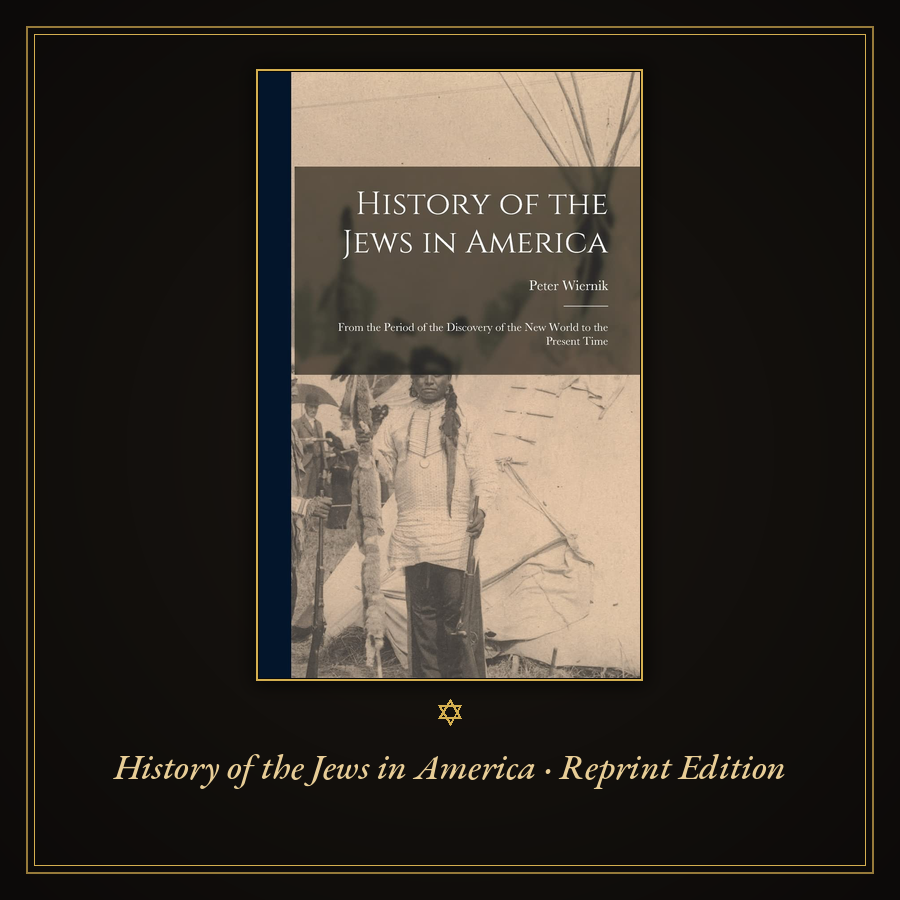
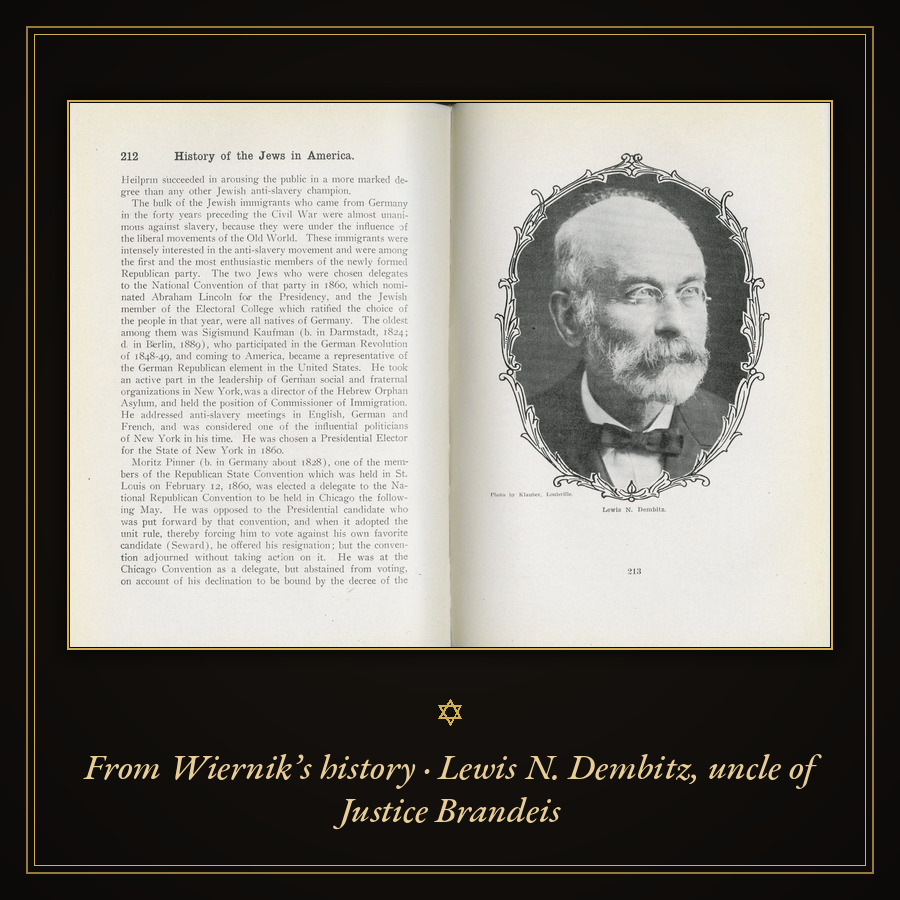
In 1912, Wiernik published a book called "History of the Jews in America." It does not sound revolutionary today. It was. Consider what did not exist in 1912. No university in America taught American Jewish history. No academic field, no journals, no professorships, no archives devoted to the subject. The American Jewish Historical Society was barely twenty years old and published scattered papers for a small circle. The story of Jews in America, stretching all the way back to the twenty-three refugees who sailed into New Amsterdam in 1654, had never been gathered by anyone into a single comprehensive volume. The greatest Jewish community in the history of the diaspora was assembling itself on American soil, and it had no written memory of how it got there.
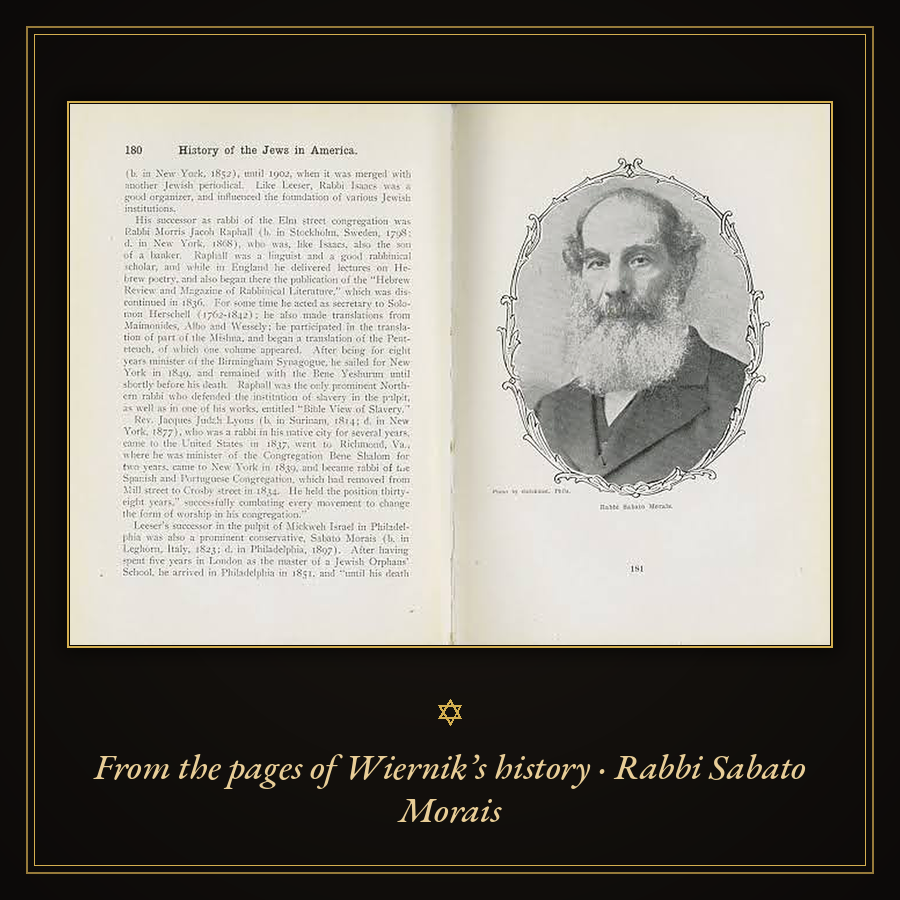
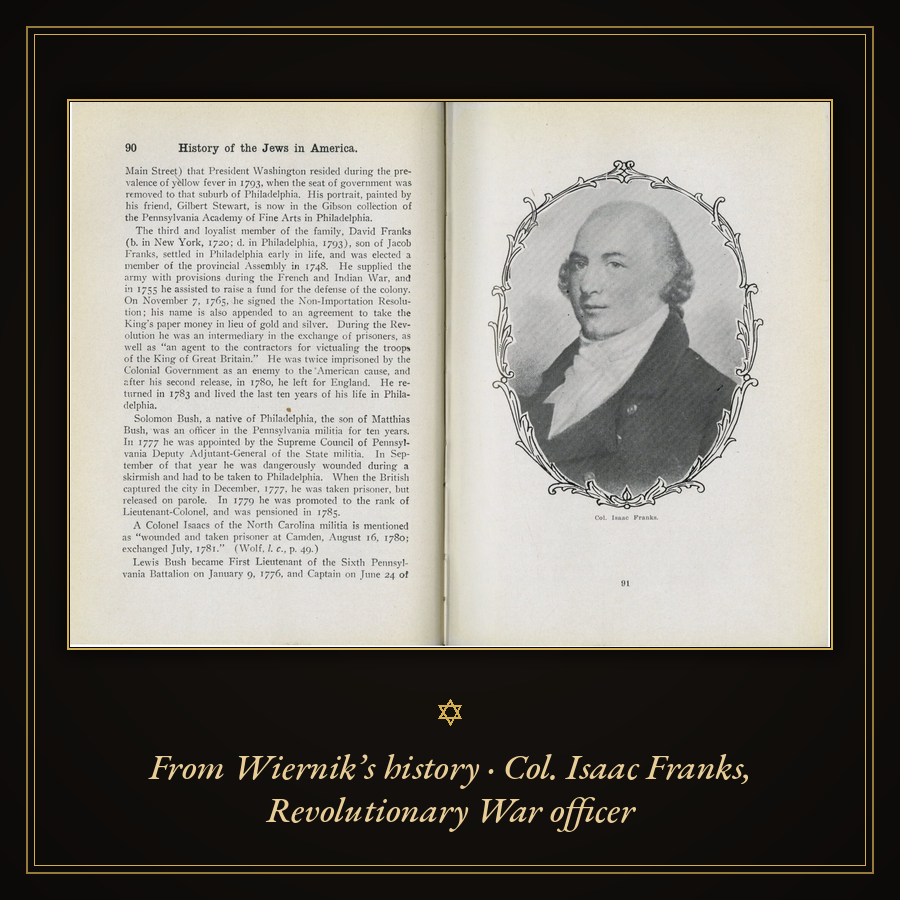
So a working newspaper editor, without a professorship, without a research grant, without so much as a graduate degree, sat down after his editorial duties and wrote our history first. He traced the whole sweep of it: the Sephardic merchants of the colonial ports, the German Jewish wave of the mid-1800s that built the great department stores and Reform temples, and the enormous Eastern European migration that he himself was part of and could describe from the inside. He wrote it in English, deliberately, so that the children of his Yiddish readers, and their American neighbors, could read it. And running underneath every chapter was a quiet insistence: Jews in America were not guests in someone else's story. They were authors of their own, and their story deserved the dignity of a history.
Scholars would follow him. Within a few decades the field he helped open would have its departments, its archives, its libraries. The book itself went through multiple editions and remained a standard reference for years. But somebody had to be first, and it was the editor from Vilna, working in the hours other men used for rest.
He gave that same devotion everywhere the record needed keeping. He contributed to the Jewish Encyclopedia, the monumental twelve-volume project completed in 1906 that attempted, for the first time in any language, to gather the whole of Jewish knowledge in one place. He wrote for Yiddish and English publications alike. He spent his life doing the essential, unglamorous work of explaining Jews to America and America to Jews, in daily installments, for over thirty years.
Peter Wiernik died on February 12, 1936, at his home at 922 Eastern Parkway, after a two-week illness. He was seventy years old. The four hundred mourners at his funeral were the visible measure of his reach, but the truest eulogy came from Dr. Samuel Margoshes, editor of The Day, a competitor by trade and an admirer by conviction. "He was a great Jewish historian who understood the past of the Jewish people and was thus able to understand the present of American Jewry. He was thoroughly American."
Understanding the past to understand the present. That is the whole work of memory in a single sentence. It is the work Wiernik did every morning of his life, and it is the work we carry on here.
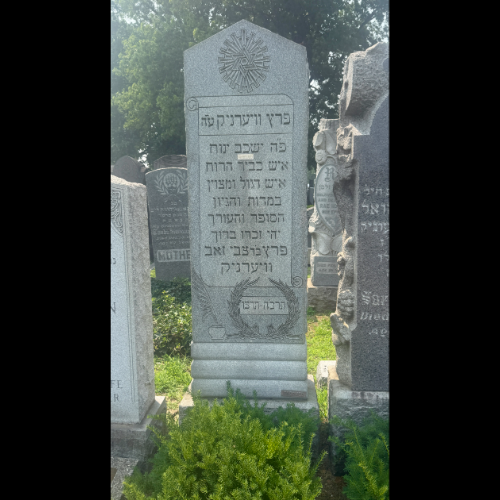
Peter Wiernik rests at Mount Hebron Cemetery in Flushing, Queens. The man who wrote our history first is now part of the history we keep.
May his memory be a blessing.
~Blog by Deirdre Mooney Poulos
Sources:
"400 Attend Service for Peter Wiernik," The New York Times, February 15, 1936. Peter Wiernik, History of the Jews in America (New York: Jewish Press Publishing Company, 1912). Background on Vilna, the American Yiddish press, the Morgen Zhurnal, and the Jewish Encyclopedia draws on the YIVO Encyclopedia of Jews in Eastern Europe and standard histories of the American Yiddish press.