The Man Who Wrote the Chase Scene
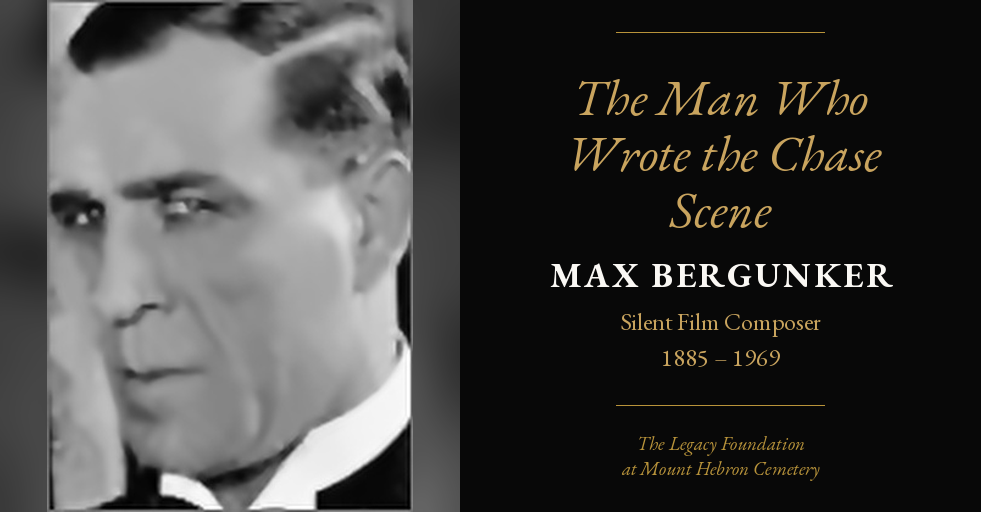
Max Bergunker was a pianist from Mykolaiv who reached New York in 1924 and went straight to work in the silent movie houses. In 1927 he composed a set of mood pieces for G. Schirmer's Photoplay Series, the stock cue music that theater orchestras across America played to accompany films. His music was performed thousands of times a night in towns that had never heard his name, and one of his pieces was called for on the cue sheet for Murnau's Sunrise, one of the greatest films ever made. Sound arrived within a year and put the entire profession out of work almost overnight. He lived in Brooklyn until his death in 1969 and rests at Mount Hebron.
Before movies could talk, someone had to play them.
Every silent film that ever screened in America came with music, and the music was live. A grand picture palace in Manhattan might carry a full orchestra of seventy players and a Wurlitzer organ besides. A neighborhood house in Brooklyn might have a piano and a violin. A small theater out west might have one person at an upright, playing three hours a night, six nights a week, watching the screen and inventing as they went.
By the mid twenties there were something on the order of twenty thousand movie theaters in the United States, and film had become the most popular entertainment the country had ever produced. Weekly attendance ran into the tens of millions. Music was not decoration in those rooms. It was the only sound in them, and the person making it was as responsible for the audience's experience as anyone on the screen.
They were not improvising as freely as you might imagine. There was a system, and Max Bergunker helped build it.
He was born on the third of March, 1885, in Mykolaiv, a shipbuilding city on the Black Sea in what was then the Russian Empire and is now Ukraine. It was an imperial naval town, laid out around its shipyards, and it held a substantial Jewish community that had grown through the nineteenth century into the tens of thousands. Mykolaiv had periods when it barred Jewish residence outright and periods when it flourished as a center of Jewish commerce, education, and music. Like every Jewish community inside the Pale of Settlement, it lived under restrictions on where its people could live, what they could study, and what work they could do.
Music was one of the few doors that stayed open. It required no university seat and no government license. It could be taught in a front room by an uncle. And when a family finally left, it was the rare profession that could be packed and carried.
Bergunker came to the United States in 1924 and was naturalized in 1929. He was thirty nine when he arrived, and that detail deserves a moment. He was not a child brought over by his parents. He was a grown man with a trade, who left behind whatever standing he had built and started over in a country whose language he did not yet own.
Consider what he had lived through before he boarded that ship. The pogroms that swept the Russian Empire after 1881. The 1905 revolution and the wave of anti-Jewish violence that followed it. The First World War fought across his own region. Then the Russian Civil War, which between 1918 and 1921 produced hundreds of pogroms across Ukraine and killed tens of thousands of Jews, with southern cities including Mykolaiv caught in the fighting as armies changed hands again and again. Then Soviet consolidation, then the famine of 1921 and 1922. A man who left Ukraine in 1924 at thirty nine had already survived four decades of it.
He also got out in the very last year it was possible. The Johnson-Reed Act of 1924 slammed the door on exactly the migration that had brought two million Eastern European Jews to America since the 1880s. It set national origin quotas designed to cut arrivals from Eastern and Southern Europe to a fraction of previous levels, and it worked. Jewish immigration from that region collapsed almost immediately and never recovered. Bergunker crossed in the final season before the gate closed. The relatives who did not are, in most families like his, simply absent from the American record.
The New York he landed in was the best possible city for a piano player. Hundreds of movie theaters needed music every single night. Vaudeville houses needed pit men. The Yiddish theaters along Second Avenue needed accompanists and rehearsal pianists. Dance halls, hotels, restaurants, silent film houses, and the young recording studios were all hiring. Local 802 of the American Federation of Musicians had been founded only in 1921 and had grown into one of the largest union locals in the country, its membership rolls thick with names that had crossed the Atlantic in steerage.
Those rolls read like a map of the Pale. Pianists from Odessa. Drummers from Pinsk. Trombonists from Orsha. Violinists from Kiev province. Cornetists from Minsk. Bergunker sits in that company, listed plainly as a pianist and silent film score composer, born in Mykolaiv.
Here is where his story becomes larger than one man.
Theaters could not afford to commission original music for every film, and no house pianist could compose three fresh hours a week. So the publishing industry solved the problem at scale by building libraries of what was called photoplay or mood music. These were short pieces written not for a particular movie but for a particular emotion. A hurry. A misterioso for stealth and creeping shadows. A furioso for storms and riots and mobs. An appassionato for love. A galop for a chase.
The instructions were printed right on the music. One Schirmer piece from the series is labeled as suitable for gruesome or infernal scenes and witches. Another promises extreme tension followed by riot, terrific storm, or volcanic eruption. Another is meant for pursuit and intense wrangling almost to blows. Reading those catalogues today is like reading the emotional vocabulary of an entire era written down in shorthand.
Studios and distributors then issued cue sheets telling theaters which piece to play at which moment of which film. The effect was extraordinary. A music director in Ohio and one in Queens could be playing the same eight bars at the same instant of the same movie on the same night, in front of audiences who had no idea the moment had been scripted for them.
In 1927, G. Schirmer published volume six of its Photoplay Series, and five of the pieces in it were Bergunker's. Appassionato Intenso. Misterioso No. 4. Furioso No. 4. Moto Perpetuo. Diabolical Allegro. William Strasser arranged them for theater orchestra, and each came with a piano conductor part so a single player could carry the whole thing alone if that was all the house could pay for.
He had been in the country three years.
That same year, F. W. Murnau released Sunrise, a film that has sat near the top of nearly every serious list of the greatest movies ever made since the week it opened. Its cue sheet calls for Bergunker's Diabolical Allegro at the moment one character stops another on the street. Somewhere in a darkened theater in 1927, an audience watched a masterpiece unfold while a musician played music written by a recent immigrant from Mykolaiv, and not one person in that room knew his name or ever would.
That was the nature of the work. His music reached more people than most concert composers reach in a lifetime, and it reached them anonymously.
Then it ended.
The Jazz Singer opened in October of 1927, the same year those pieces went to press. Within roughly three years sound film had swept the industry, and the theater orchestras were finished. Estimates from the period put the number of American musicians thrown out of work in the tens of thousands. The American Federation of Musicians fought back with a national advertising campaign against what it called canned music, taking out newspaper pages arguing that a machine could not replace a living player. They were right and it did not matter. They lost completely.
The timing could hardly have been crueler. The pit jobs vanished just as the stock market crashed in 1929, and the Depression closed theaters outright. A generation of immigrant musicians who had built entire livelihoods on live accompaniment found that the livelihood no longer existed, in the same season that the whole economy fell in. Some moved into radio orchestras and recording work, which is how a handful of them became famous. Most simply went quiet.
Bergunker's name does appear on a few feature films from those transition years, including The Patriot in 1928, Chinatown Nights in 1929, and Fighting Caravans in 1931. Those credits should be read carefully. Films of that era were frequently scored by compilation, meaning a studio assembled a soundtrack from existing library music rather than commissioning something new, so his name most likely travels with his Schirmer cues rather than representing scores he sat down and wrote for those pictures. That distinction is worth making honestly, and it costs him nothing. It places him where he actually stood, inside the machinery that made silent film sound like something.
He stayed in Brooklyn for the rest of his life. He died there on the eighth of July, 1969, at eighty four. He had lived long enough to see silent film become a curiosity, then a subject of serious scholarship, and long enough to watch the industry that discarded his profession grow into the largest cultural force on earth. He was alive when the first film preservationists began hunting down the cue sheets and the photoplay volumes, trying to reconstruct how these movies were meant to sound. Whether anyone ever told him that his work was being collected, we do not know.
He rests at Mount Hebron.
~Blog by Deirdre Mooney Poulos
It is fitting company. This cemetery holds the Yiddish theater performers who worked the Second Avenue houses, the union men who organized the trades, the landsmanshaft societies whose members bought burial ground a few dollars at a time so they could lie among people from their own town, and tens of thousands of immigrants who arrived the way he did, with a skill in their hands and no promise that anyone would need it.
His scores sit today in the Library of Congress, digitized and free for anyone to open, catalogued under his name with his dates printed beside it. You can download the parts and hear what a theater in 1927 heard.
Somebody wrote the chase music. It turns out we know who.
Work Cited:
Works Cited
"Max Bergunker." Wikipedia. https://en.wikipedia.org/wiki/Max_Bergunker
"Moto Perpetuo: (ceaseless, changeless, incessant)." Composed by Max Bergunker, arranged by William Strasser. New York: G. Schirmer, 1927. Schirmer's Photoplay Series, vol. VI, no. 59. Library of Congress, Music Division, Silent Film Scores and Arrangements. https://www.loc.gov/item/2020562319/
"Inventory of a Collection of Silent Film Music, ca. 1884-1931." New York Public Library, Music Division. https://www.nypl.org/sites/default/files/archivalcollections/pdf/mussilentmus.pdf
"Schirmer's Photoplay Series Vol. 1-6." Silent Film Sound and Music Archive. https://www.sfsma.org/schirmers-photoplay-series-vol-1-6/
"Sunrise." Cue sheet listing. Silent Film Sound and Music Archive. https://www.sfsma.org/sunrise/
"New York City." Old Klezmers / Alte Klezmorim. https://alte.klezmor.im/tag/new-york-city/
"Music to Imperil Pauline to." Houghton Library, Harvard University. https://sites.harvard.edu/houghton-library/2011/06/20/music-to-imperil-pauline-to
"The Alvin G. Layton Silent Film Music Collection, 1899-1987." American Music Research Center, University of Colorado Boulder. https://www.colorado.edu/amrc/sites/default/files/attached-files/AMRC-Layton.pdf
"Max Bergunker." Turner Classic Movies database. https://www.tcm.com/tcmdb/person/734734%7C110047/Max-Bergunker
"Max Bergunker." FilmAffinity. https://www.filmaffinity.com/en/name.php?name-id=727583812
Interment records. Mount Hebron Cemetery, Cedar Grove Cemetery Association. https://www.mounthebroncemetery.com