Story Summary:
Pruzhany sat in the Brest region of Belarus, home to Jewish life dating back to the 1450s. The town built synagogues, schools, and a free Jewish hospital, and by 1868 Jews made up more than half its population. The Nazis sealed 18,000 people into a ghetto here in 1941, and starvation and cold killed thousands before the deportations to Auschwitz even began. Only twenty Jewish survivors remained from Pruzhany when the war ended, and today a memorial stands in the old Jewish cemetery for those who were lost. ~Blog by Sophie Hunter
Pruziner Lodge: The Jews of Pruzhany, Belarus
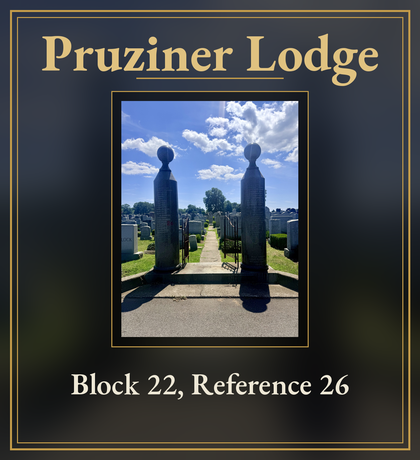
Pruziner Lodge is a landsmanshaftn that has a gated society burial plot at Mount Hebron. The Society’s name is a reference to Pruzhany, Belarus. Pruzhany is a city located in the Brest region of Belarus and was previously under Polish control until 1795. The area was then controlled by Russia, until 1919 after which it again came under Polish control until 1939. There are records of Jews living in Pruzhany dating back to the mid fifteenth century. In 1450 there was a ḥevra kaddisha, which recorded Jewish activities in the area. The first synagogue in the city was built in the Jewish quarter in 1463, although it was destroyed by a fire in 1863. In 1495 the Jews living in Pruzhany were displaced as part of the expulsion of Jews from Lithuania, but many returned in the following years. During this period, many of the Jewish people in the town earned their income from both agriculture and livestock, some also engaged in commerce or crafts. Later, the area would become known for its pottery. In 1644 Jewish people were given formal rights by Ladislaud IV. These rights included the right to reside in Pruzhany, to engage in occupations and to practice their religion. These rights were further expanded upon by later successors.
Towards the end of the 19th century, due to rapid economic development, migration was common and many people moved from rural areas to bigger cities. By 1868 around 61% of the people who lived in Pruzhany were Jewish, this amounted to around 2,575 people. There were many small businesses, county schools, and hospitals in the area. Alongside this, there were also different religious places of worship including two Orthodox churches, a Catholic church, a Synagogue and several Jewish prayer houses. Towards the end of the 1800s there were four Jewish Synagogues, a free Jewish hospital and a Jewish state school.
World War One had a significant impact on Belarus with widespread military violence. Many people suffered from hunger and disease, and Jewish people experienced antisemitism, pogroms, and deportations eastward. Whilst Pruzhany was not destroyed in the War, it did see an influx of refugees who were displaced from other cities. After the War, many people in Belarus suffered from economic hardship.
Pruzhany was also heavily impacted by the Second World War. Firstly, in September 1939 when it was seized by the Soviet Union army, then later on the 23rd of June 1941 it came under the control of German troops. Soon after the Germans’ arrival in Pruzhany, were arrested and Jewish people began to be killed. The Germans required that the city establish a Judenrat, which was initially formed of five members, but was soon increased to include twenty-four. Part of the Judenrat’s role was to collect money to meet the substantial ransom requirements, and to make arrangements to meet the forced labor demands of the Germans. The forced labor tasks included cutting down trees, clearing the roads and cleaning houses. Additionally, the Jews were also forced to give up many of their personal possessions including woolen and fur items, carpets and gramophones.
In the nearby towns of Hajnówka and Narewka Mala, the Jewish men were killed whilst the women and children were forcibly removed from their homes and brought to Pruzhany on foot.
On the 25th of September 1941, only a few months after the Germans had arrived in the town, a Ghetto was set up. The Judenrat were informed of its establishment and were required to put up the fences. Jews from nearby towns were forced into the Ghetto and by 1941 there were around 18,000 people living there. Both housing and food was scarce, and as a result, thousands of people died during the winter of 1941 due to the extreme cold, starvation and deprivation. The Nazis continued to require financial payments, and they stole from the Jewish synagogues, taking candlesticks, altars and silver cups. Additionally, requirements for forced manual labor were unrelenting and artisans such as shoemakers were forced to provide their services.
In the spring of 1942 underground groups began forming in the ghetto and they were able to establish contact with the partisans. A group of Jews began collecting weapons and started fixing broken German guns. Around twenty Jews from the ghetto were able to escape into the nearby forest with weapons.
On the 28th of January 1943 Nazis and auxiliary police surrounded the ghetto and the Jews were told that they would be transported to Silesia for forced labor. However, instead of this, around 10,000 Jews were forced onto railway wagons that took them to Auchwitz concentration camp. Whilst there were around 2000 Jews who were able to hide, many were later found and killed. The town was not liberated until the 17th of July 1944.
After World War Two, there were only around 20 Jewish survivors from Pruzhany. In 2005 a memorial was established in the old Jewish cemetery for the Jewish victims of the Holocaust.
~Blog by Sophie Hunter
Sources
https://jewishvirtuallibrary.org/pruzhany
https://www.facinghistory.org/resource-library/jewish-life-belarus-holocaust
https://shtetlroutes.eu/en/pruzhany-guidebook/
https://encyclopedia.1914-1918-online.net/article/belarus/
https://shtetlroutes.eu/en/pruzhany-cultural-heritage-card/
https://jgsny.org/searchable-databases/burial-society-databases/burialsoc-joodb/7475
https://www.jewishgen.org/yizkor/Pruzhany1/Pruzhany1.html