The Cornet Player From Port Said
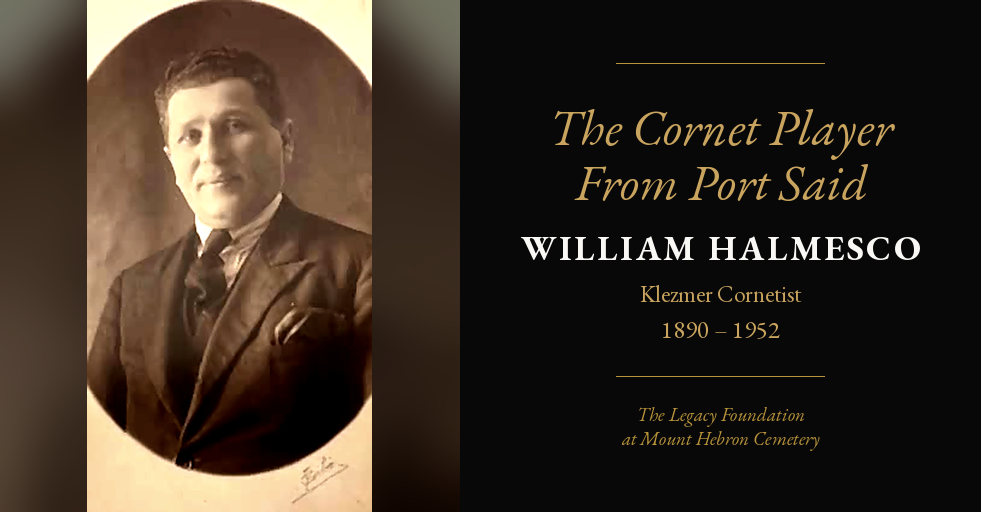
William Halmesco was born in Port Said, Egypt, in 1890, and he changed his own name to sound Italian because that was what the work required. He and his wife sailed from Alexandria in February of 1927 and reached New York the following month, and he joined the musicians' union and a klezmer burial society in the Bronx. His wife died four years later giving birth to their only child. He died in November of 1952 and rests at Mount Hebron in the plot of the Progressive Musical Benevolent Society.
Almost every immigrant story at this cemetery runs the same direction. A town in the Pale of Settlement, a ship, the Lower East Side. Poland, Ukraine, Lithuania, Belarus, Romania. The monuments say it plainly, in Hebrew and Yiddish, town after town after town.
William Halmesco came from Egypt.
He was born in Port Said in 1890, a city that existed only because of the Suez Canal. It had been built from nothing in the 1850s as the northern camp for the men digging the channel, and by the time he was a boy it had become one of the most polyglot places on earth. Ships from every nation stopped there to coal. The streets carried Greeks, Italians, Maltese, Armenians, Syrians, French administrators, British officers, Egyptians, and Jews. You could hear a dozen languages in one block. Business was conducted in French, in Italian, in whatever tongue got the deal done.
His family were European Jews of Austrian and Romanian ancestry who had settled in Egypt during the colonial era. That was not unusual. Through the nineteenth century, Jews came to Egypt from across the Ottoman world and from Europe, drawn by the canal, the cotton boom, and the relative freedoms of a place where the great powers had negotiated protections for foreign nationals. By the early twentieth century the Egyptian Jewish community numbered in the tens of thousands, concentrated in Cairo and Alexandria, and it was layered in a way few communities anywhere were. Ancient Arabic-speaking families, Sephardic families from the Ottoman lands, Ashkenazi families recently arrived from Europe, all living in the same cities and often in the same buildings.
The Halmesco brothers grew up in that world and grew up in music. According to the family, they played professionally. William took up the cornet and trumpet. His youngest brother Alexander played clarinet.
The family name was not Halmesco. It was Halm. He changed it himself while working in Egypt, in order to sound more Italian.
Stop and consider what that tells you. In colonial Egypt, Italian was a language of the opera house, the café orchestra, the touring troupe, and the music profession generally. Italian musicians had been working the eastern Mediterranean for generations. An Italian-sounding name opened doors that a German-sounding Jewish name did not. So a young Jewish cornet player from Port Said added a few letters to the end of his surname and went to work. It is the same instinct that led performers in New York to become someone else on a marquee, and it is a small window into exactly how much of himself a working musician had to negotiate.
Then came the war.
Family tradition holds that the brothers fought in the Ottoman army in the First World War and were interned in a camp in Malta. That detail is worth handling carefully, because it comes from family memory rather than a document, but it fits the period exactly. Egypt was legally still Ottoman territory at the start of the war even though Britain had occupied it since 1882. When the Ottoman Empire entered the war in late 1914, Britain formally severed Egypt from Istanbul and declared it a protectorate, and the Sinai front ran right through the region. Men from Ottoman lands were conscripted, and Britain held large numbers of captured Ottoman soldiers in Malta, which served as a major internment site throughout the war and after.
So a Jewish cornetist from Port Said may well have spent part of his twenties in a British prison camp on a Mediterranean island, having been conscripted into an army that was fighting the empire that governed his home city. That is the kind of biography the twentieth century handed out.
He came out of it and married Mathilda Meyer, from a German Jewish family long resident in Egypt.
By the mid twenties the family began leaving. His sister Sophia and her husband Charles Isaac Rosenberg, also a musician, had gone first, sailing from Alexandria to New York in the spring of 1915. William and Mathilda followed twelve years later, leaving Cairo and departing Alexandria in February of 1927, arriving in New York that March. They were not alone on the manifest. Other Egyptian Jewish musicians sailed with them.
The timing is remarkable. The Johnson-Reed Act of 1924 had just closed American immigration to a degree the country had never attempted before, setting national origin quotas designed specifically to shut down arrivals from Eastern and Southern Europe. Millions who wanted to come after 1924 simply could not. The Halmescos got through in 1927, which meant navigating a system built to keep people like them out.
They settled on Southern Boulevard in the Bronx. He joined the musicians' union as a cornetist and trumpeter, and he joined the Progressive Musical Benevolent Society.
That society is the reason he is at Mount Hebron, and it deserves its own explanation. The Progressive Musical Benevolent Society was a mutual aid and burial society for New York City klezmer musicians and their families. It was founded around 1913, peaked in the interwar and postwar years, declined through the 1970s, and was formally dissolved around 2010, by which point the surviving members had not held an official meeting in decades. Its records now sit at YIVO in two separate collections.
Mount Hebron holds hundreds of societies like it, and most were landsmanshaftn, organized around a hometown. This one was organized around a trade. These were men who played weddings, dance halls, Yiddish theaters, and pit orchestras, work that was seasonal and unreliable and offered no pension, no insurance, and no protection when a player got sick or a wife died young. So they built the protection themselves, a few dollars in dues at a time, and part of what they bought was ground to be buried in. Among strangers from a hundred different towns, the thing they held in common was the instrument in their hands.
For William Halmesco that turned out to matter very quickly.
In 1931, four years after they arrived, Mathilda died giving birth to their first child. The baby survived. He named her Mathilda in her mother's honor, and the family called her Matty. A widowed immigrant musician working unpredictable hours could not raise an infant alone, so she was sent to the Jewish Infants Home of Brooklyn and stayed there until she was five, when she came home to live with her father.
There is one more detail about the two of them, recorded years later in a profile of Matty in the Staten Island Advance in 2006. Her father tried for several years to get her to learn the violin. She never took to it. Eventually he gave up.
It is such a small thing and it says so much. Three generations of Halm men had made their living from music. He had changed his own name for it, been conscripted, interned, crossed an ocean because of it. And what he wanted, sitting in a Bronx apartment with the only family he had left, was for his daughter to play.
The rest of his story is the story of his profession. He had arrived in New York in 1927, which was the last good year. Silent film houses still had orchestras, the Yiddish theaters were full, and the klezmer recording boom was still audible. Within three years sound film had wiped out the theater orchestra jobs, the Depression had closed venues outright, and tens of thousands of American musicians were out of work. His World War Two draft registration card lists his occupation plainly. Unemployed cornetist.
He died in November of 1952 at sixty two and was buried in the Society's plot at Mount Hebron, in the same ground as his brother-in-law Charles Rosenberg, who had died of a burst appendix in 1929, and near Charles Braun, another musician from the same Egyptian circle.
There is one object that survives him. A handwritten klezmer tunebook in his hand is held today by the musician Dave Levitt, its cover and one of its dances photographed and shared publicly a few years ago. A cornet player born in Port Said, raised among the ships and the languages of the Suez Canal, wrote out Eastern European Jewish dance tunes by hand in a notebook and carried them to the Bronx.
That is the whole story in one artifact. He came from the wrong direction, from a city built for a canal, with an Italian name he gave himself, and he ended up in the same ground as everyone else here, because the music was the same music and the need for one another was the same need.
~ Blog by Deirdre Mooney Poulos
Works Cited:
Carkner, Daniel. "Rosenbergs, Halmescos and Brauns: 'Egyptian' families in the P.M.B.S." Old Klezmers / Alte Klezmorim, 13 January 2026, updated March 2026. https://alte.klezmor.im/2026/01/13/rosenbergs-halmescos-and-brauns-egyptian-families-in-the-p-m-b-s/
Carkner, Daniel. "My working list of Progressive Musical Benevolent Society musicians." Old Klezmers / Alte Klezmorim, 22 February 2026. https://alte.klezmor.im/2026/02/22/my-working-list-of-progressive-musical-benevolent-society-musicians/
Carkner, Daniel. "Some thoughts about the Progressive Musical Benevolent Society." Old Klezmers / Alte Klezmorim, 28 December 2025. https://alte.klezmor.im/2025/12/28/some-thoughts-about-the-progressive-musical-benevolent-society/
Old Klezmers / Alte Klezmorim, main index. https://alte.klezmor.im/
Records of the Progressive Musical Benevolent Society, RG 2110, and Progressive Musical Benevolent Society Records, RG 2330. YIVO Institute for Jewish Research, New York. https://yivo.org
Interment record for William Halmesco, block 62, reference 9. Mount Hebron Cemetery, Cedar Grove Cemetery Association. https://www.mounthebroncemetery.com/interments/
Staten Island Advance, 2006 profile of Mathilda Halmesco. Cited in Old Klezmers / Alte Klezmorim.
Ship manifest, Alexandria to New York, February 1927, and World War Two draft registration card for William Halmesco. Ancestry.com, reproduced in Old Klezmers / Alte Klezmorim.
Handwritten klezmer tunebook of William Halmesco, collection of Dave Levitt. Reproduced in Old Klezmers / Alte Klezmorim.