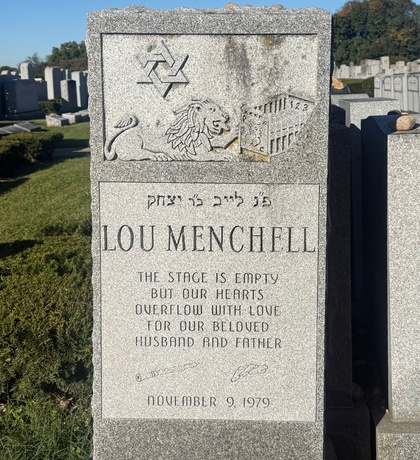
We'll Meet Again: Vicki Stuart and Lou Menchell
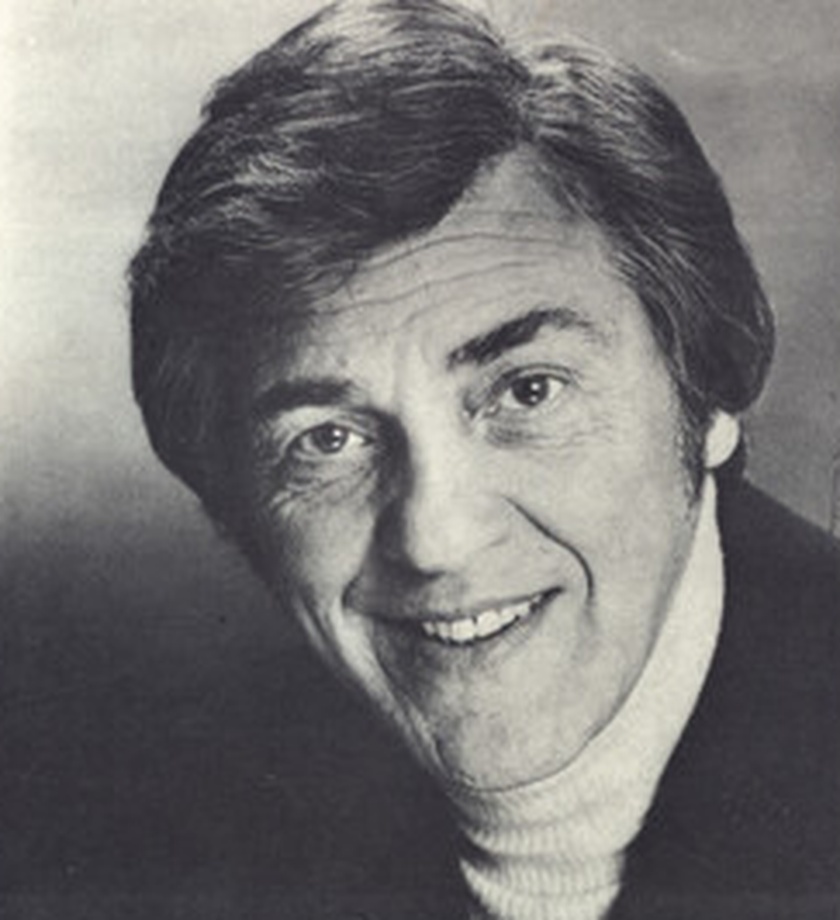
Before you read Vicki's story, you should meet Lou.
Lou Menchell was a comedian. He was an emcee, a singer of funny songs, and a master of impressions. His humor was Yiddish humor. It poked fun at himself, at his family, at his own Jewishness, and the audience laughed because they saw themselves in every line.
He learned his trade where so many Jewish comics did. The Catskills. The Borscht Belt. Summer after summer, families from New York City packed the mountain hotels, and every night someone had to make them laugh. Lou was one of the men who did. It was the same stage that launched Buddy Hackett, Sid Caesar, and Jerry Lewis.
He made records, too. In 1954 he released a comic song called "All I Want for Chanukah Is Marilyn Monroe." The next year, Billboard gave it a nod, calling it cleverly written and neatly performed. He recorded a playful mambo parody. He sang a number called "Love Is Great," in which he made fun of himself for being a married man. That joke would come true soon enough.
One night in the late 1950s, Lou saw a young English singer on television. Her name was Vicki Stuart. He decided right then that he had to meet her. Then fate stepped in, in the form of an aunt. Vicki's Aunt Rose happened to catch Lou's act at a Long Island beach club. She went backstage and mentioned that she had a niece in show business. Lou had exactly one question. "Is she married?"
She was not. Not for long.
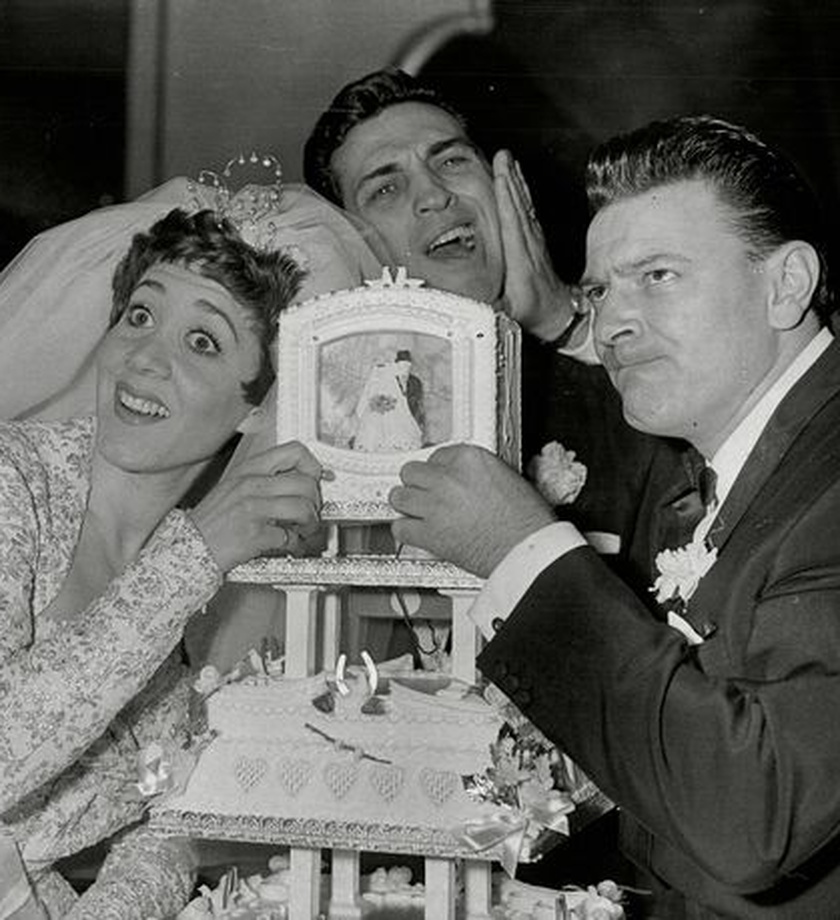
They married in London in February 1960. When Vicki's father called to size up the American comedian, he asked what Lou did in the winter. Lou had the perfect answer. He wore an overcoat. That was Lou. Quick, warm, and impossible not to like.
For twenty summers, Lou and Vicki performed together in the Catskills. They bought a house on the bank of a lake. They raised their sons, Ivan and Roland, there. Some nights they did three shows, then laughed all the way home in the car. They also knew the deepest grief two parents can know. Together they turned it into work that helped families across the country.
Lou died in 1979. Vicki stopped singing. For years, when she opened her mouth, nothing would come out but tears. It took their son Ivan, writing shows just for her, to bring her voice back.
That is the measure of the man. When Lou was gone, the music went with him.
What follows is Vicki's story, in her own words, just as her family shared it with us.
A Life in Full
by Vicki Stuart Menchell, in her own words
I was born in London in 1935. Four years later, Hitler decided to redecorate.
I was four years old when the Blitz began and the sky above London turned orange. I remember running through the park with my father, pulling his hand and saying: "Daddy, the sky is all bright — look at it, look at it." He didn't stop running. I was nine when I was evacuated alone to Lancashire, where I lived with strangers and attended a Catholic convent school as the only Jewish girl in the district. My mother had asked the nuns not to indoctrinate me. Three years later I could recite the catechism from memory. My grandmother opened the door on Ash Wednesday, looked at the cross on my forehead, and said: "Oh. They made her a shiksa." There was fun, even during the war.
My father was in the electronics business — which is relevant only in that what he invented had nothing to do with electronics. He put magnets on the shop windows to stop them shattering in the blasts. He called them schlumpers. The next morning, all the windows were shattered. The schlumpers were still in place. So much for schlumpers.
My career began quite by accident. I was at a party, a friend dared me to get up and sing, and the pianist leaned over when I finished and asked if I'd like to do this professionally. I said okay. That okay lasted a lifetime. But none of it would have happened without my father, who believed in me before I believed in myself. It was his idea to send me to theatrical school, and as with most of his ideas — the schlumpers aside — he was absolutely right.
Before the nightclubs and television shows, I did USO tours — performing for American servicemen across Germany and North Africa. I performed for two thousand sailors on an outdoor stage in Tripoli.
One of our stops was Entebbe. We all had to fill out forms to disembark. One of the questions was: what is your religion? I wrote Jewish. An official came aboard and told me I could not set foot in Entebbe. Everyone got off the plane. Then another official came through with a spray called Flit — a common insecticide — and sprayed it throughout the entire aircraft while I sat in my seat. I suppose that to them, Jewish meant contagious.
I made my television debut on The Dave King Show in London, appeared on The Kraft Music Hall, and when Dave King brought me to America, I drew more fan mail than any other guest on his NBC series. From there came The Tonight Show with Johnny Carson.
I went on to perform alongside Milton Berle, Don Rickles, Sammy Davis Jr., Alan King, Jackie Mason, Jim Dale, and many others. I made my Las Vegas debut at the Sahara opening for Don Rickles, and later spent a year in Hollywood on Days of Our Lives playing Violet Crumb, the owner of a pub.
In 1959 I met Lou Menchell. He had seen me on television and was determined to meet me. My aunt Rose happened to see him performing at a Long Island beach club, went backstage, mentioned she had a niece in show business. He asked immediately: "Is she married?" We were introduced and from the moment we met, the attraction almost exploded. We married in London in February 1960 — Dave King was best man, Vidal Sassoon did my hair — and from that day on we were never apart.
When my father called from London to speak with Lou before the wedding, he asked: "I understand you want to marry my daughter. I know you perform in the Catskills in the summer. What do you do in the winter?" Lou said: "I wear an overcoat." After that, they became great friends.
Lou and I spent twenty summers performing in the Catskill Mountains, where we bought a house on the bank of a lake and raised our sons Ivan and Roland. We could do three shows in a single night and still find things to laugh about on the drive home. It was a wonderful life. All our friends were entertainers. The evenings were long and full and loud, the way the best evenings always are.
In December 1966, our infant son Andrew William died suddenly at seventy days old. When I first spoke to the Chief Medical Examiner of New York I said: "This happened to Lou and me for some kind of reason. There must be a reason. What can we do to help?" That question drove ten years of work. The Andrew Menchell Infant Survival Foundation grew from six members to nearly five hundred, changed how sudden infant death was classified on death certificates across the country, and I counseled parents who called me in the middle of the night. Our work was central to what the world now knows as Sudden Infant Death Syndrome.
When Lou died in 1979, I stopped performing. I would open my mouth and nothing would come out, or if it did, I would cry.
Years later, I was at a cabaret club in New York City, and a friend pushed me on stage to sing. My son Ivan was in the audience. Afterward he said: "If you're really going to sing, I'll write you a show." Ivan wrote two Off-Broadway shows for me. The first, Smiling Through, told the story of an English entertainer who carried London through the Blitz with music and an unshakeable refusal to stop. The second, We'll Meet Again, was built around the songs that kept people going during the war — thirty of them, from the shelters and the pubs and the music halls. In 1995 I stood in Times Square on the fiftieth anniversary of Victory over Japan and sang We'll Meet Again to twenty thousand people.
Recently I moved with my family to Westport, Connecticut. I have two sons, Ivan and Roland, who are caring and thoughtful and wonderful — and two daughters-in-law, Karen and Danita, whom I have always called my daughters. I always wanted daughters. I have three granddaughters: Olivia, Lou, and Darla — who I love more than words could ever possibly say. I believe grandchildren are the dividends of life.
On my ninetieth birthday I sang for a room full of veterans. All these years later, and the war is still part of my life. I suppose it always will be. It made me who I am.
I believe that in life you have to give back somehow. I know some people agree and some people don't. I just feel that if I can give back a little — I should.
Sources
- Vicki Stuart Menchell, "A Life in Full," shared with The Legacy Foundation by the Menchell family.
- "Lou Menchell." Wikipedia. Cites Billboard, "Reviews of New Pop Records," 1955.
- "Lou Menchell." The Borscht Belt Tattler podcast, conversation with Ivan Menchell.