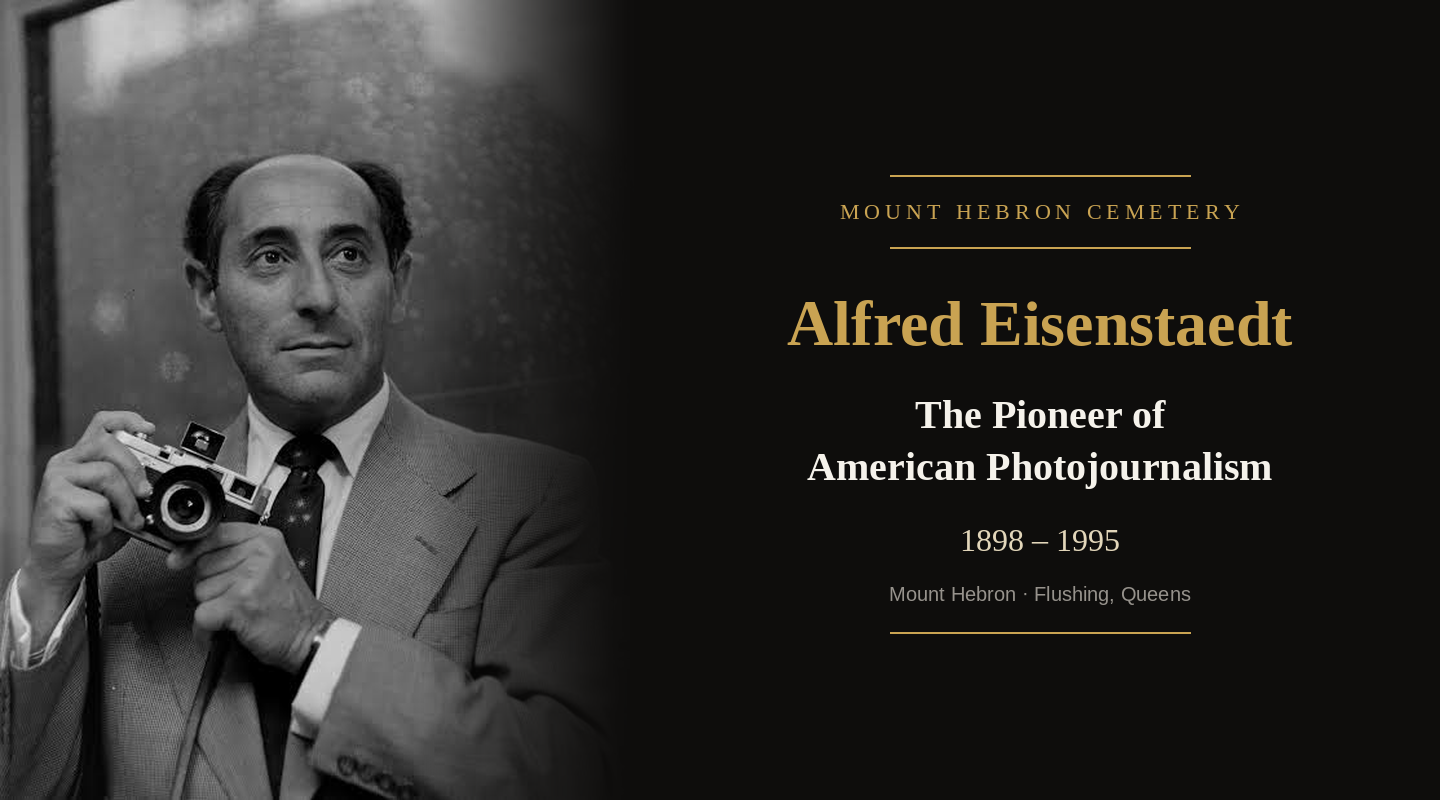
Alfred Eisenstaedt – The Pioneer of American Photojournalism
EARLY LIFE
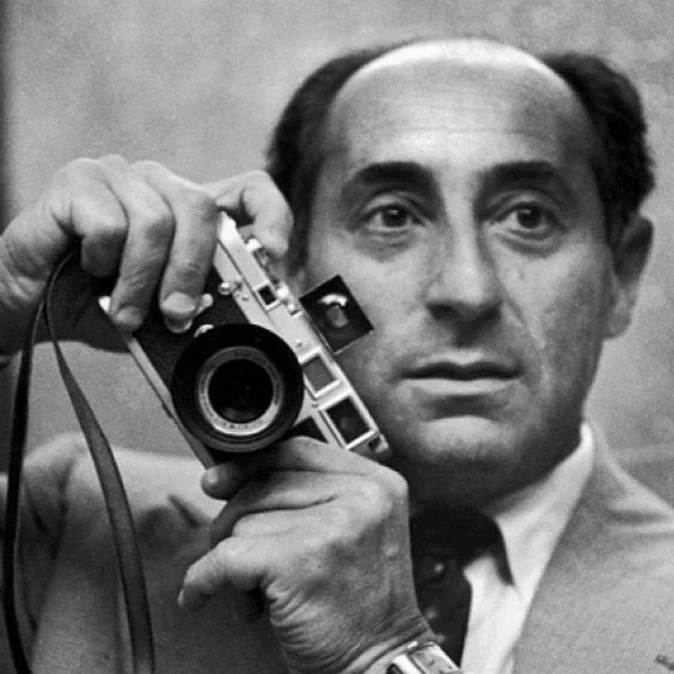
Alfred Eisenstaedt, the famed and internationally recognized photojournalist best known for his immortal “V-J Day in Times Square,” was born in the town of Dirschau, German Empire (now Tczew, Poland), in 1898, to Joseph Eisenstaedt, who was a retailer in Dirschau, and Regina Schoen. He grew up in an affluent environment. Together with his two brothers, Eisenstaedt attended school in Germany and moved with his family to Berlin in 1906, where he would discover his love for photography – one that would follow him for his entire life. At fourteen years of age, he received a gift from his uncle, an Eastman Kodak camera, after which he picked up photography as a hobby. He had received no formal training throughout his childhood and early adult life, and his unrelated university studies were abruptly interrupted by World War I. Eisenstaedt served in the German Army until April 1918, when he was discharged after suffering shrapnel wounds in both of his legs. After recovering from his wounds and having to use crutches and a cane for one year, he worked for some time in Germany as a belt and button salesman while living at the family home in Berlin. Eventually, Eisenstaedt returned to his old hobby, photography, and he began learning more about film and development on his own. He was particularly inspired by the photography of Erich Salomon, who was well-known at the time for using small, handheld cameras to take shots of politicians and dignitaries, often with the camera hidden from view. He famously took one of only two existing photos of the United States Supreme Court in session, by faking a broken arm and carrying the small camera in his cast. Eisenstaedt even managed to collaborate with Salomon on several of his assignments throughout the 1930s in Europe. Unfortunately, Salomon was murdered at the Auschwitz concentration camp during World War II, on July 7, 1944, and the war would soon impact Eisenstaedt and his career path as well.
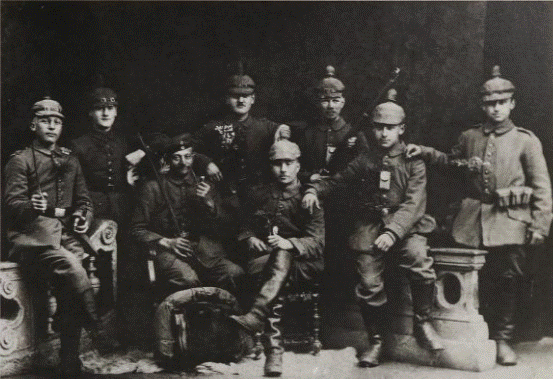
“In 1916 I was drafted into the army. I was seventeen years old. Here is a picture of me with my comrades. I was the only one who was not killed. I was shot in the legs, which saved my life.” – Alfred Eisenstaedt, Eisenstaedt on Eisenstaedt: A Self-Portrait
WORK IN EUROPE
While Eisenstaedt had started as an amateur photographer, he quickly picked up freelance jobs and got to work as a photojournalist. His first true assignment came in 1929, when he worked for the Berlin office of Pacific and Atlantic Photos (which would later be absorbed by the Associated Press) and covered the Nobel Prize ceremony in Stockholm that year. His work, both during and after this first assignment, highlighted aspects of his work that would go on to define his career – Eisenstaedt’s dedication to natural lighting would follow him throughout his life. He had, from the start of his career, been using handheld cameras (such as the Leica model) instead of the more popular large press cameras, and favored using the available light instead of relying on flash photography, which gave him a unique opportunity to capture candid photos instead of the common posed shots. That flexibility would later earn him the title “the dean of today’s miniature-camera experts,” as he was described by Life magazine in 1944. It was this combination that allowed him to rise quickly among the ranks of the new and unrefined profession, and armed with his miniature 35-millimeter Leica camera, which allowed him to capture shots undetected, Eisenstaedt began covering major political events across Europe, as well as photographing celebrities across the continent. One of his legendary early photos has next to nothing to do with the fame of the person in the image, rather speaking to his professionalism in framing and capturing shots “in the moment” – while at the Grand Hotel in Switzerland in 1932, Eisenstaedt captured a breathtaking image of an ice-skating waiter, with a lone chair in the foreground (staged by Eisenstaedt for purposes of focusing) and with the incredible Swiss Alps in the background.
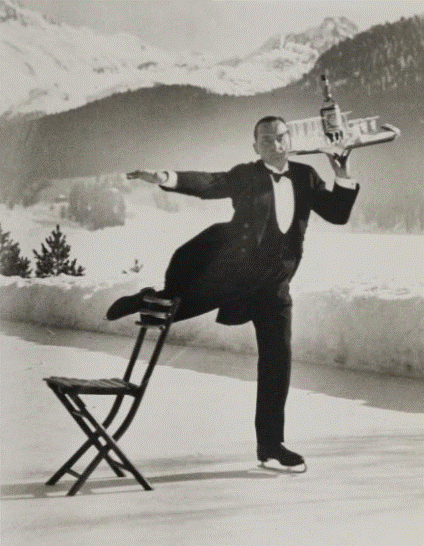
“At the ice rink of the Grand Hotel was a waiters school where young apprentices learned how to serve drinks to the mostly English guests who used to have lunch and cocktails there. The waiters were all on skates. I did one smashing picture of the skating headwaiter. To be sure the picture was sharp, I put a chair on the ice and asked the waiter to skate by it. I had a Miroflex camera and focused on the chair.” – Alfred Eisenstaedt, Eisenstaedt on Eisenstaedt: A Self-Portrait
As a more established photographer in the 1930s, Eisenstaedt put his skills to use in regard to political events across the world. One of the most impactful moments of his career came during a League of Nations meeting in Geneva in 1933, where Eisenstaedt captured an off-guard Joseph Goebbels, Nazi Germany’s propaganda minister, in a pleasant mood. However, when Eisenstaedt returned for another portrait, the malevolence of the German was captured in an infamous image that would, after the war, come to personify Goebbels and his Nazi propaganda machine as a whole. Eisenstaedt reflected on this moment in particular in his 1985 book, Eisenstaedt on Eisenstaedt: A Self-Portrait.
Later I found him at the same table surrounded by aides and bodyguards. Goebbels seemed so small, while his bodyguards were huge. I walked up close and photographed Goebbels. It was horrible… He looked up at me with an expression full of hate. The result, however, was a much stronger photograph. There is no substitute for close personal contact and involvement with a subject, no matter how unpleasant it may be.
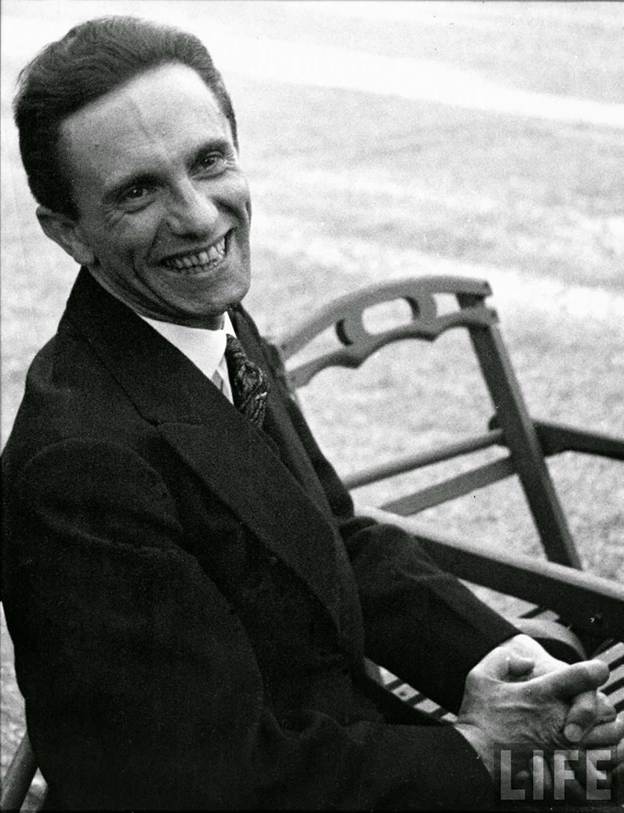
Eisenstaedt’s first encounter with the Nazi Propaganda Minister: “I found him sitting alone at a folding table on the lawn of the hotel. I photographed him from a distance without him being aware of it. As documentary reportage, the picture may have some value: it suggests his aloofness.” – Alfred Eisenstaedt, Eisenstaedt on Eisenstaedt: A Self-Portrait
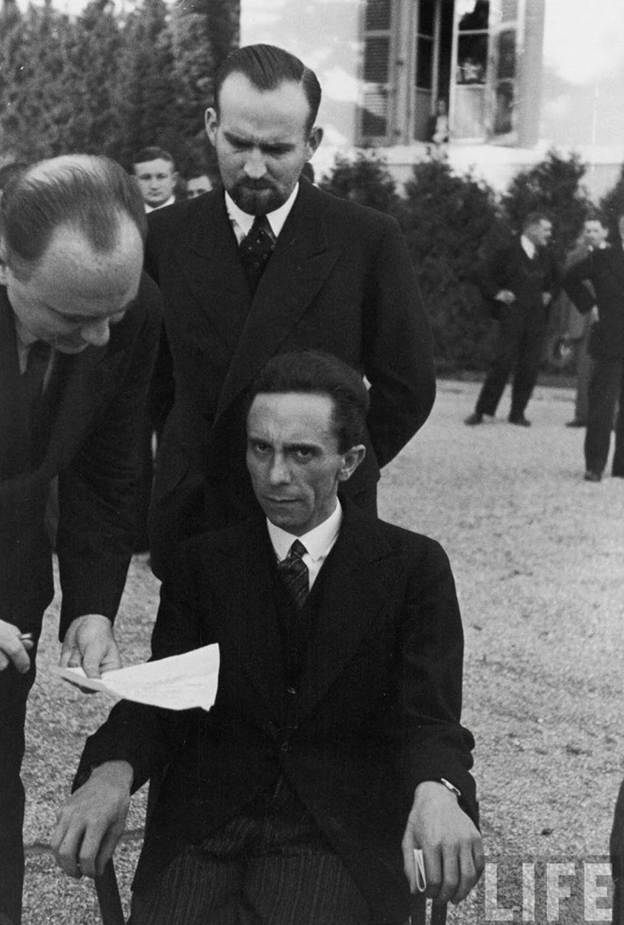
“This picture could be titled, ‘From Goebbels With Love.’ When I went up to him in the garden of the hotel, he looked at me with hateful eyes and waited for me to wither. But I didn’t wither.” – Alfred Eisenstaedt, Eisenstaedt on Eisenstaedt: A Self-Portrait
As anti-Semitic rhetoric continued spreading throughout Germany, the implications for Eisenstaedt were clear. In 1933, the Editor’s Law came into effect under Hitler’s rule, mandating that all journalists and other editorial workers must be of the Aryan race. The director of the Associated Press, Louis Lochner, refused to follow this ruling, stating that the staff “are efficient, they are honest, they are splendid characters, they are well educated and speak three and four languages. There is no reason in the world outside of the accident of their having been born Jews why I should fire them . . . I simply refused.” Meanwhile, Eisenstaedt continued working in defiance of Nazi ideology – he went on to photograph Hitler’s first meeting with Benito Mussolini in Venice, Italy, weeks before Hitler was named Führer of Nazi Germany, and was away from Europe in 1935, covering the invasion of Ethiopia by Mussolini’s army, documenting the poor shape of the Ethiopian armed forces, lacking basic shoes and weapons, and capturing Ethiopians from all walks of life – from politicians to soldiers to civilians, becoming the gold standard for photojournalism across the world. However, Eisenstaedt’s employment in Germany continued to face growing risks – during 1935, an SS newspaper exposed the employment of Eisenstaedt’s boss, Leon Daniel, and his assistant, Cecile Kutschuk, both Jews. After his return to Europe from Ethiopia, this aggressive anti-Semitic stance in Germany forced Eisenstaedt from his homeland, and in that same year, he sailed on the S.S. Ile de France, departing Le Havre, France, and arriving in New York City on November 27.
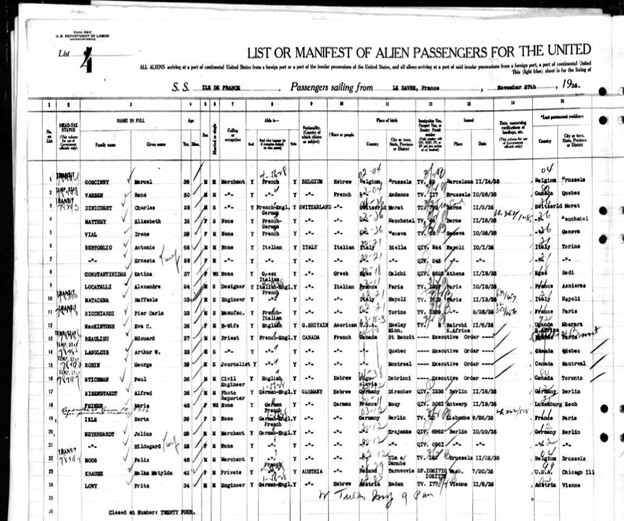
Eisenstaedt’s name on a manifest of foreign passengers arriving in the United States. The 36-year-old photojournalist is listed 17th on the manifest. Eisenstaedt immediately petitioned for US citizenship and was naturalized in 1944.
IMMIGRATION TO THE UNITED STATES
Upon his arrival in New York City, Eisenstaedt immediately got to work as a freelance photojournalist. Both of his previously mentioned supervisors, Daniel and Kutschuk, managed to escape Nazi Germany, and they both founded Pix Publishing, a photo agency that provided visual materials to well-known magazines such as Life and Sports Illustrated, which employed Eisenstaedt. Additionally, Eisenstaedt worked as a freelance photographer for Harper’s Bazaar, a fashion and art publication that exists to this day, as well as Vogue, and Town and Country, working with leading designers and Art Deco artists of the time. These lifestyle magazines helped Eisenstaedt find his place in New York City, and in 1936, he finally got his domestic breakthrough – Henry Luce, the founder of Time magazine, had bought Life, and invited Eisenstaedt to join him as one of the publication’s four original photojournalists. This was a prestigious post that Eisenstaedt would maintain until Life ceased its weekly publications, and he would continue working with the people he had met there for the rest of his career. Eisenstaedt petitioned for citizenship shortly after arrival, in 1936, and would not receive citizenship until 1944. As a result, his newly developed and refined art of the candid photograph grew in domestic publications, especially in photographing celebrities, artists, philosophers, and politicians. However, as World War II came to the United States, Eisenstaedt’s photos turned to wartime topics, culminating in his famous “V-J Day in Times Square”.
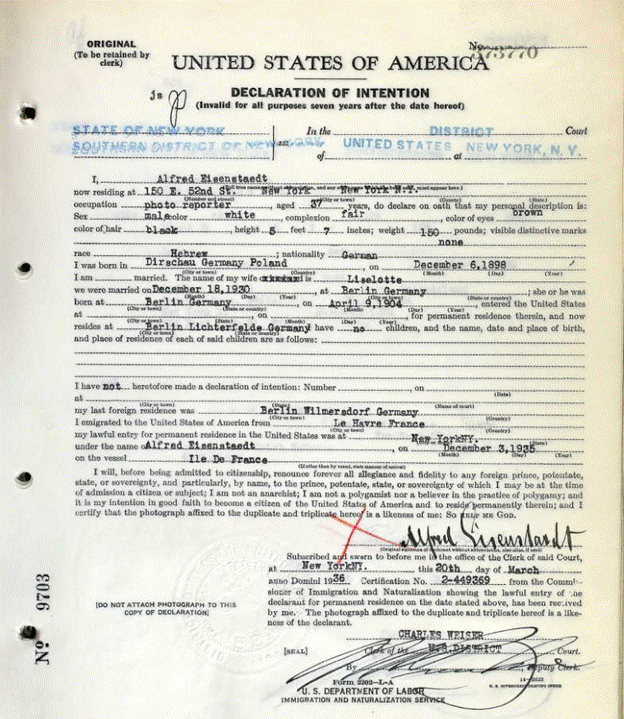
Eisenstaedt’s Declaration of Intention for citizenship, which he submitted less than half a year after his arrival in the United States. The long waiting period to receive his American citizenship resulted in him covering domestic issues, specifically in lifestyle magazines, bringing his candid style of photography to the United States.
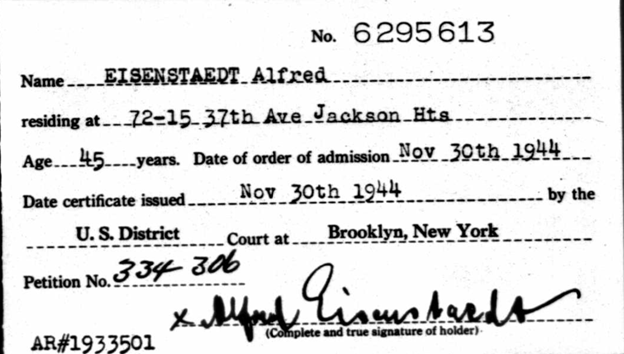
Eisenstaedt received his American citizenship in 1944, but still preferred to work domestically, capturing images of the homefront throughout World War II.
My style hasn’t changed much in all these sixty years. I still use, most of the time, existing light and try not to push people around. I have to be as much a diplomat as a photographer. People often don’t take me seriously because I carry so little equipment and make so little fuss. When I married in 1949, my wife asked me, “But where are your real cameras?” I never carried a lot of equipment. My motto has always been, “Keep it simple.” – Alfred Eisenstaedt, Eisenstaedt on Eisenstaedt: A Self-Portrait
EISENSTAEDT’S WORK DURING WORLD WAR II
As with all citizens and residents of the nation, the declaration of war on Japan and Germany by the United States came with a sharp change for Eisenstaedt. Known for his photos of celebrities and other well-known individuals, his wartime assignments now focused on the regular people – the soldiers coming back on furlough from combat, the wives, mothers, and children who would see new draftees off at the train station – and it was in these notably regular moments, reproduced and felt thousands of times across America, that Eisenstaedt’s work shifted from that of another staff photographer to that of one who had recorded formative moments for the nation’s history. For the years preceding the famous “V-J Day” photo, Eisenstaedt had captured soldiers returning and leaving for the war, capturing as much of them as of the teary-eyed civilians seeing them off. His small 35-millimeter camera, along with his use of exclusively natural light, allowed these images to capture natural moments of raw emotion, often capturing the entire gamut in one shot, instead of posed photos for bulky and hardly subtle press cameras. “Each goodbye is a drama complete in itself, which Eisenstaedt’s pictures movingly tell” was how Life described Eisenstaedt’s wartime photos in 1944. Appearing in the February 14, 1944, edition of Life, on Valentine’s Day, this simple photo series captured the emotions of draftees, veterans, and civilians alike, at once both documenting a day’s events at New York’s Penn Station and bringing to light the deeper emotional aspect of the homefront during a conflict that claimed tens of millions of lives.
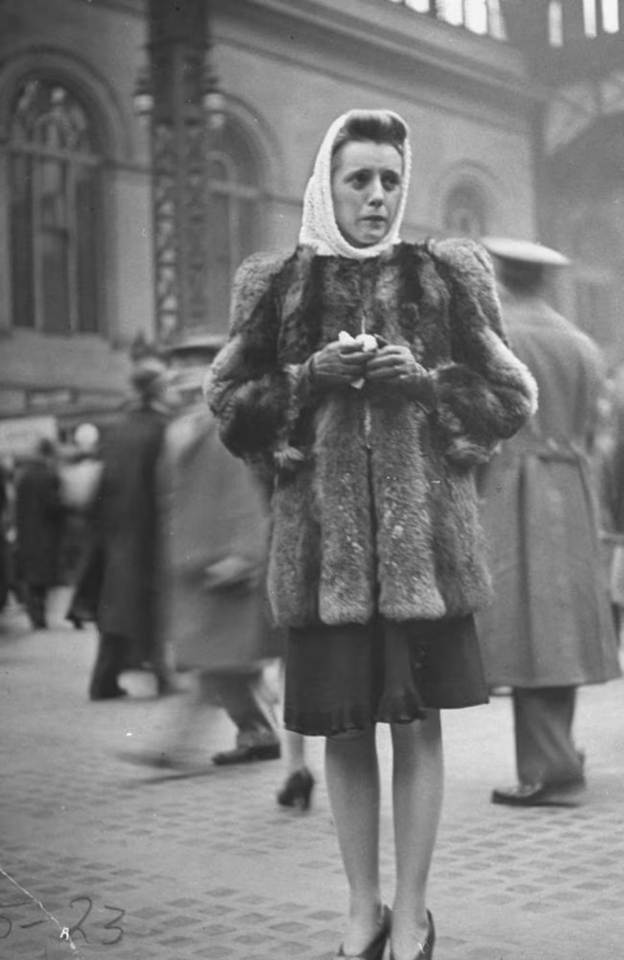
Distraught woman clutching tear-sodden handkerchief as she looks blindly after her soldier boyfriend who has just walked away after saying goodbye in Pennsylvania Station as he returns to active duty after a short furlough during WWII. – Eisenstaedt/Life Magazine.
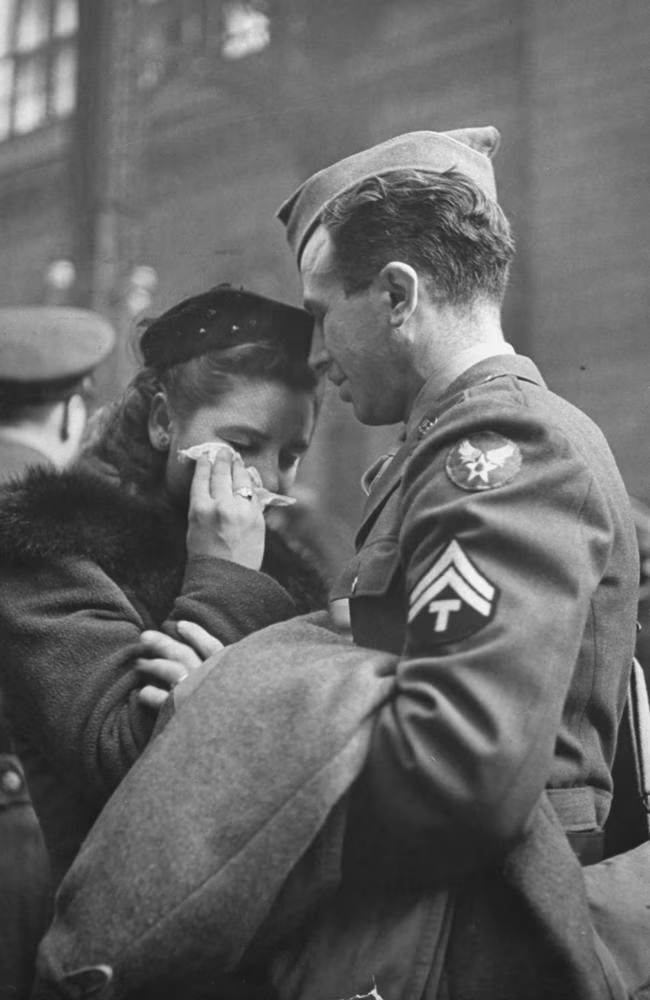
Soldier consoling his weeping wife as he says goodbye at Pennsylvania Station before returning to duty after brief furlough during WWII. – Eisenstaedt/Life Magazine.
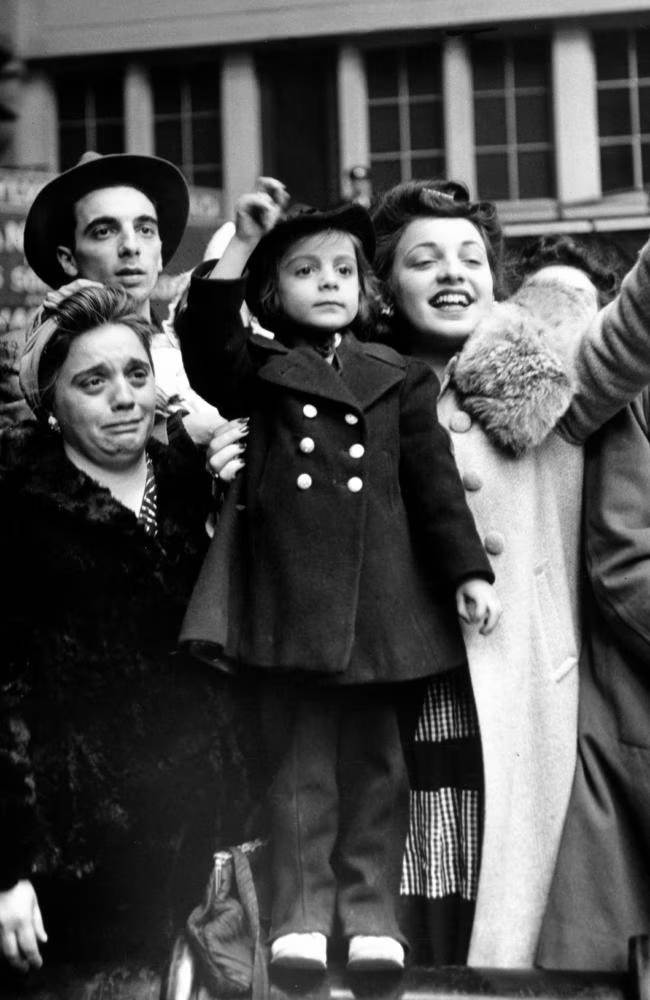
Women, men and children in Pennsylvania Station bidding farewell to unseen servicemen during WWII. – Eisenstaedt/Life Magazine.
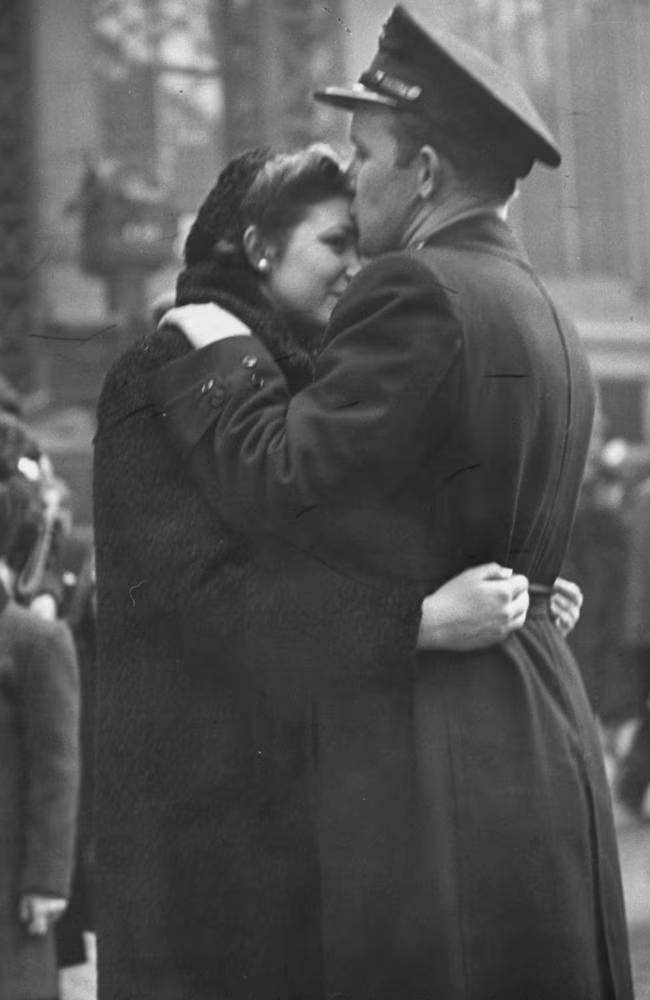
“You can hold a Rolleiflex without raising it to your eye; so they didn’t see me taking the pictures. I just kept motionless like a statue. They never saw me clicking away. For the kind of photography I do, one has to be very unobtrusive and to blend in with the crowd.” – Alfred Eisenstaedt, Eisenstaedt on Eisenstaedt: A Self-Portrait
As the war with Japan drew to a close, ending four years of U.S. involvement in the worldwide conflict, August 14, 1945 became a day of jubilation – Japan had announced its intention to surrender and stop fighting, with US President Harry Truman delivering the news to the American public that same day. V-J (Victory in Japan) Day, as August 14th would be known, kicked off a series of celebrations across the country, bringing active service members, soldiers on furlough, family and friends, and the everyday civilians together. Naturally, arguably the largest celebration in the nation took place minutes from Eisenstaedt’s office at the Time & Life Building on 1 Rockefeller Plaza, in Times Square. Eisenstaedt, armed with his handheld Leica IIIa camera, snapped the spontaneous “V-J Day in Times Square” of an unidentified U.S. Navy sailor kissing a stranger, seemingly a nurse, as per Eisenstaedt’s own accounts. Standing on 45th Street and facing north, from the convergence of Broadway and 7th Avenue, Eisenstaedt photographed a multitude of people and celebrations throughout the day. Eisenstaedt had no time to record the names of the two people in the photo. To this day, they have not been positively identified. Eisenstaedt’s photo was published in Life Magazine on August 27th, and spread throughout the United States, serving as a perfect depiction of the jubilation and relief of the end of the war. In Eisenstaedt on Eisenstaedt, the photojournalist’s celebrated autobiography, he explained the spontaneity of the photograph.
In Times Square on V.J. Day I saw a sailor running along the street grabbing any and every girl in sight. Whether she was a grandmother, stout, thin, old, didn't make a difference. I was running ahead of him with my Leica looking back over my shoulder but none of the pictures that were possible pleased me. Then suddenly, in a flash, I saw something white being grabbed. I turned around and clicked the moment the sailor kissed the nurse. If she had been dressed in a dark dress I would never have taken the picture. If the sailor had worn a white uniform, the same. I took exactly four pictures. It was done within a few seconds. Only one is right, on account of the balance. In the others the emphasis is wrong—the sailor on the left side is either too small or too tall. People tell me that when I am in heaven they will remember this picture.
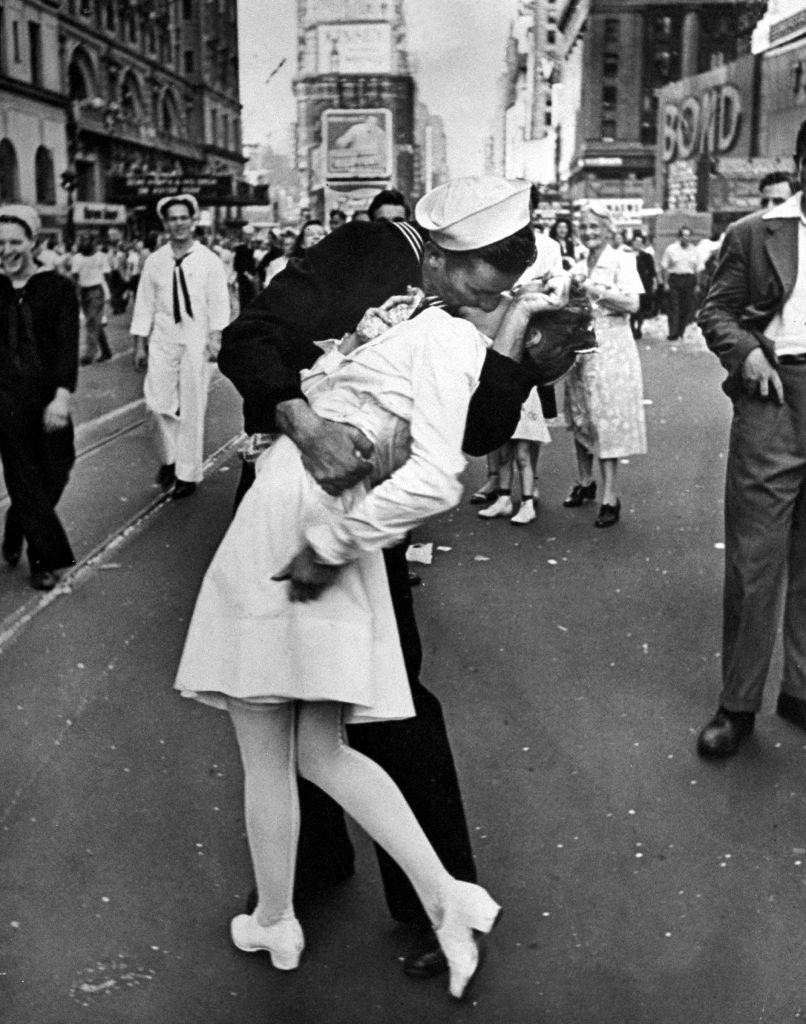
"In New York's Times Square a white-clad girl clutches her purse and skirt as an uninhibited sailor plants his lips squarely on hers" – Original caption from Life Magazine on Eisenstaedt’s photo.
As the celebrations of the day continued, Eisenstaedt was not the only photojournalist from Life in Times Square. William Shrout was another photojournalist who had descended on the site, having previously covered combat zones in Guadalcanal in the Pacific Theater of the war, before being forced out by illness and injuries sustained in the combat zone. While none of Shrout’s individual images matched Eisenstaedt’s in fame, Shrout managed to capture Eisenstaedt himself, walking with reporters amid the euphoric crowd. Two of Shrout’s images showed the photojournalist behind the photo that would create the international story of the day, showing him as just as much a part of the exuberance as he was an impartial photographer, even capturing Eisenstaedt’s own celebratory kiss, shared with another reporter. These images, along with Eisenstaedt’s own famous shot, captured the raucous, joyous mood of the country at large – four years of US fighting had come to a close on both fronts, and the twentieth century could continue as normal. These first few chaotic hours after President Truman’s announcement were captured here perfectly, the cathartic relief and joy destroying the prior sorrows, fears, and losses of the war – Midtown Manhattan, where Eisenstaedt had only two or three years earlier captured poignant images of soldiers leaving their families for the war in Europe or the Pacific, now hummed with the excitement of a nationwide celebration. As the newspapers stopped printing stories of death and losses overnight, with the headlines gloriously proclaiming the war’s end, it would be hard to imagine the heart of New York City in any way other than through what Eisenstaedt captured.
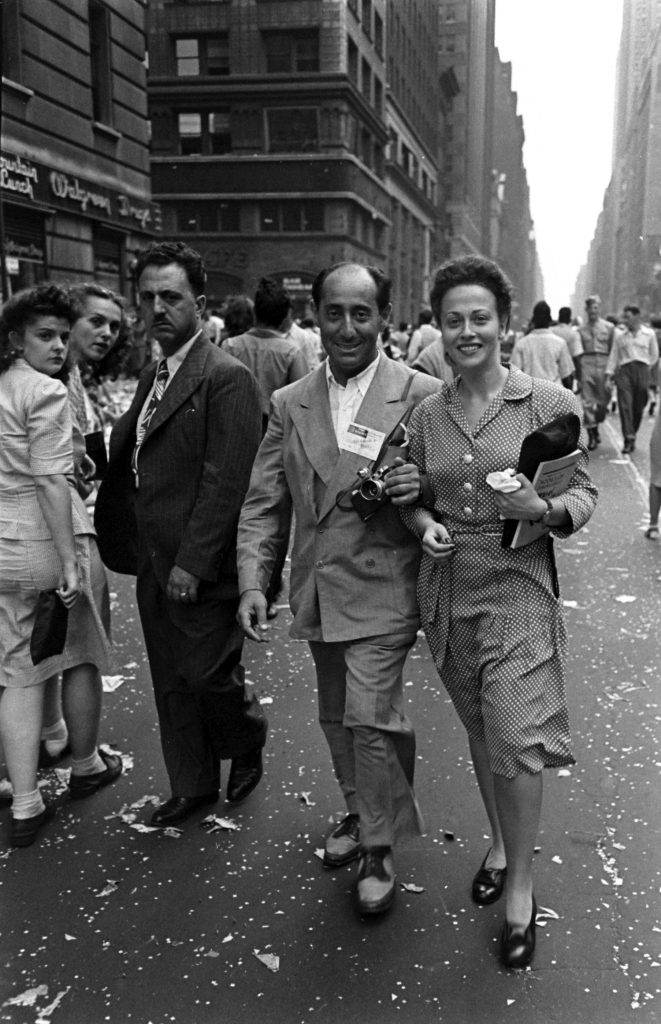
Eisenstaedt, center, walking through the crowd in Times Square with another reporter (photo by William Shrout)
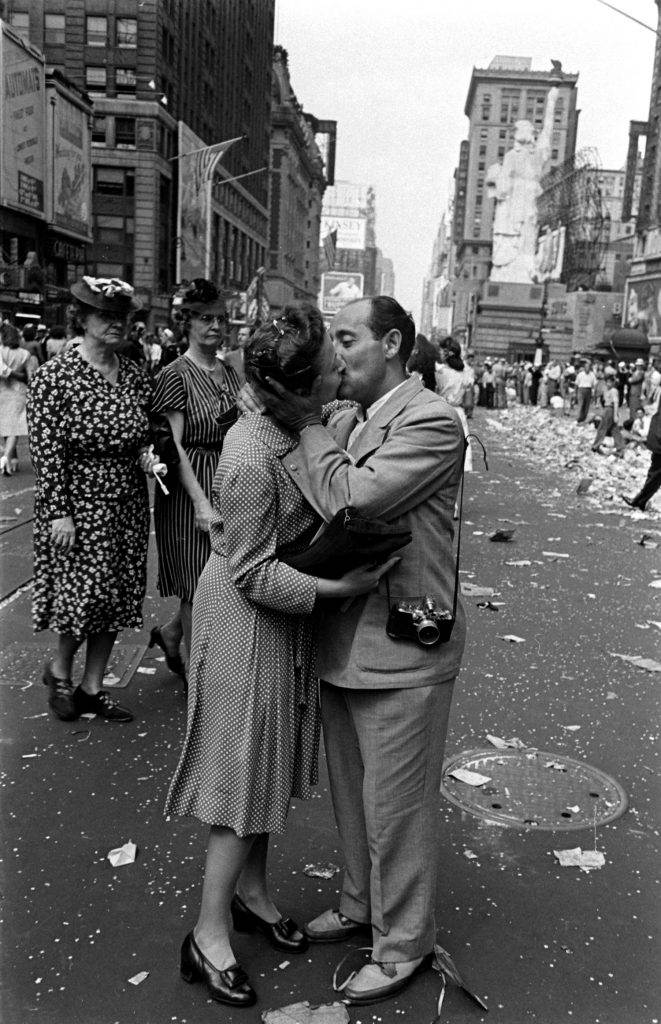
Shrout’s photo of Eisenstaedt’s own kiss on V-J Day, shared with a reporter on the streets of Midtown, not far from where Eisenstaedt captured the anonymous sailor and nurse.
If Eisenstaedt was a well-known photojournalist prior to the events of V-J Day, this photo propelled him to even greater fame, setting him up for extremely prestigious assignments later in life, after the war. Additionally, Eisenstaedt’s newly minted citizenship, received just one year prior, allowed him to leave the United States on an assignment from Life, facilitating an equally monumental, if not as famous, series of photos, documenting the destroyed nation of Japan and its civilians. During this trip, which began in December 1945 and stretched into 1946, Eisenstaedt’s most famous and captivating photo of the series came as a portrait of a lone mother with her child, amidst the backdrop of the ruined Hiroshima, the city having been leveled by an atomic bomb half a year earlier. The long-term effects of radiation poisoning and exposure were not known to the general public, neither in the United States nor in Japan, keeping media, including Eisenstaedt’s own Life magazine, guessing just as much as the subjects in his somber photo.
Japanese doctors said that those who had been killed by the blast itself died instantly. But presently, according to these doctors, those who had suffered only small burns found their appetite failing, their hair falling out, their gums bleeding. They developed temperatures of 104, vomited blood, and died. . . . Last week the Japanese announced that the count of Hiroshima’s dead had risen to 125,000. – “What Ended the War”, Life Magazine, September 17, 1945.
Eisenstaedt’s photo largely predates the moral, ideological, and political discourse on the use of the atomic bomb on Hiroshima and Nagasaki – information about the true effects of the bomb was non-existent, especially for members of the public in any nation – but it does set a backdrop for both the moment and the decades to come. While the nuclear weapons dropped on the two cities would set the stage for the modern world throughout the Cold War, the myriad of conflicts throughout the 20th century, and into the present day, Eisenstaedt’s simple portrait shows the human element of the war – the story, repeated millions of times, of civilians losing their homes and their families, with the barren trees and rubble in the background underscoring the intensity of loss. During this trip, Eisenstaedt would continue to photograph several sites in Japan, traveling with the now ceremonial Emperor Hirohito, documenting the devastation of civilian life in cities including Tokyo and Yokohama, and proceeding to photograph exchanges of Japanese prisoners of war, as well as the Japanese war criminal trials held that same year.
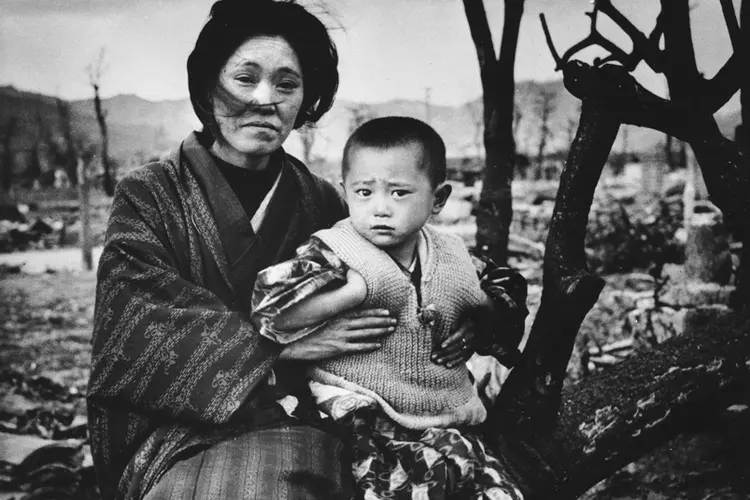
“A mother and child were looking at some green vegetables they had raised from seeds and planted in the ruins. When I asked the woman if I could take her picture, she bowed deeply and posed for me. Her expression was one of bewilderment, anguish and resignation ... all I could do, after I had taken her picture, was to bow very deeply before her.” – Alfred Eisenstaedt, Eisenstaedt on Eisenstaedt: A Self-Portrait.
POST-WAR CAREER
Following his post-war assignments, Eisenstaedt returned to New York and spent a large portion of his career working with the celebrities of the mid-twentieth century. One of these exchanges was in Princeton, New Jersey, where Eisenstaedt captured an image of the two great scientists, Albert Einstein and Robert Oppenheimer, working together at the Institute for Advanced Study. While he was rarely awestruck thanks to the volume of celebrities he had met, Einstein and Oppenheimer’s presence was one Eisenstaedt remembered well. He recalled that, in the excitement of the moment, he had prepared to shoot, but realized that he had forgotten to load the film into his camera. Feeling ashamed, Eisenstaedt quickly sneaked out of the room, pretending that something was wrong with his camera, before returning and capturing the scientists, hard at work discussing the theory of matter. Two years later, Eisenstaedt returned to Princeton and shot a portrait of Einstein, sitting in his chair with notes in hand, that would become the definitive image of the famous scientist for many years to come.
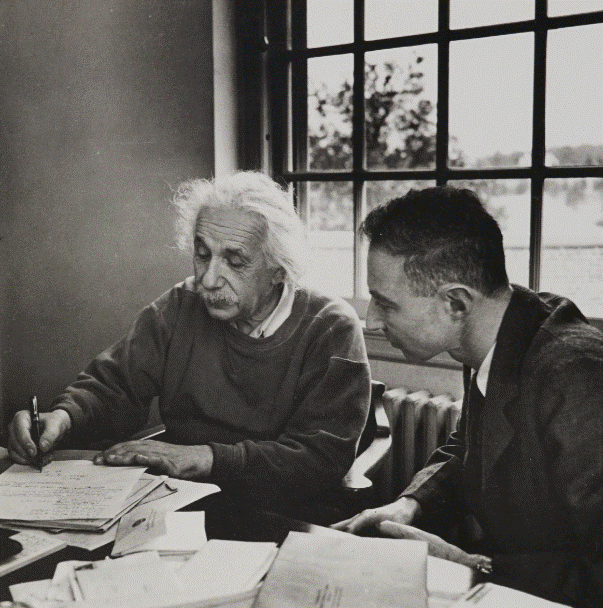
Einstein with Oppenheimer, in Princeton, New Jersey, shot just after Eisenstaedt’s mishap with the missing film.
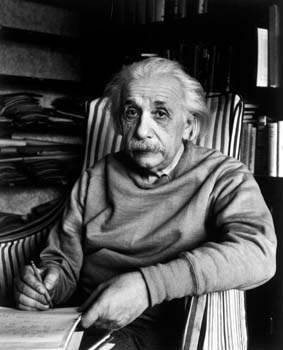
Eisenstaedt’s famous portrait of Albert Einstein, taken at Princeton two years after their first encounter.
Throughout the 1950s and 1960s, Eisenstaedt worked with many popular figures, both in the United States and abroad, with many receiving dedicated photo series – the actress Marilyn Monroe, whom he photographed in her Hollywood home in 1953, and Sophia Loren, whom he first met in 1961. He worked with Loren for over twenty years and became a close family friend, photographing her on film sets, traveling, and at home with her husband and children, with his unobtrusive style yielding remarkable results – Loren appeared on the cover of Life seven times over Eisenstaedt’s career, accompanied by detailed photo essays shot by Eisenstaedt, capturing unique, intimate images at the height of her worldwide fame. In his memoirs, Eisenstaedt referred to Loren as a great friend, noting “I am always surrounded by her pictures”. Other famous writers and film stars Eisenstaedt had the pleasure of working with included Charlie Chaplin, who at that point in his career had been directing films with incredibly famous actors in their own right, including Marlon Brando (whom Eisenstaedt captured alongside Chaplin), and Ernest Hemingway, both of whom he referred to as being incredibly difficult subjects to photograph. To capture Chaplin, Eisenstaedt had traveled to a London film set, where he took photos of him directing and instructing Marlon Brando on the set of A Countess from Hong Kong – Sophia Loren was also on set, and this star-studded film would become famous for being the last directed by Chaplin, as well as being his only color production. Even though Chaplin was not the easiest subject to work with, he would not be the hardest – that honor belonged to Ernest Hemingway, as Eisenstaedt traveled to his home in Cojímar, Cuba, to capture images that would accompany Hemingway’s “The Old Man and the Sea”, which, first published in the Life edition alongside Eisenstaedt’s photos, would sell over five million copies in two days. However, Hemingway was an uncooperative subject at first, requiring prodding from his wife to put on a shirt for the shoot, and more work from Eisenstaedt, Hemingway’s wife, and a drink to agree to a portrait. Nevertheless, Hemingway and Eisenstaedt would part on good terms, with the photographer returning a year later to capture Hemingway’s participation in a deep-sea fishing contest in Hemingway’s own boat, just off the coast of Havana.
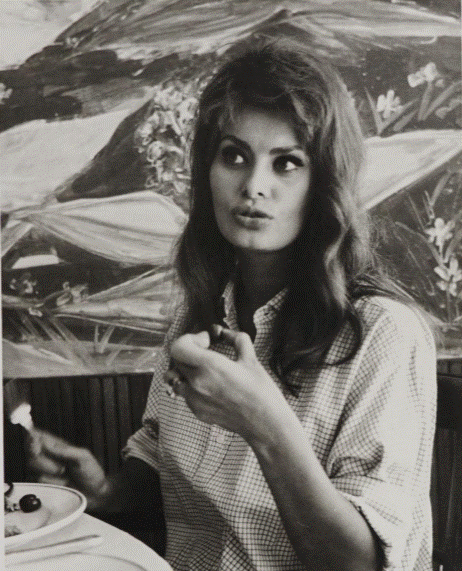
One of Eisenstaedt’s many images of the famous Sophia Loren – he would become a close friend of hers, capturing images of her on sets, in travel, and at home with her family.
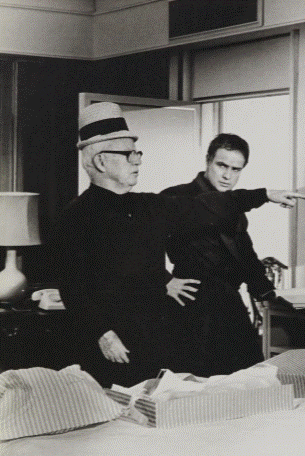
“During the filming of The Countess from Hong Kong, Chaplin was a most difficult man to photograph. You had to be as quiet as a mouse and actually whisper all the time.” – Alfred Eisenstaedt, Eisenstaedt on Eisenstaedt: A Self-Portrait
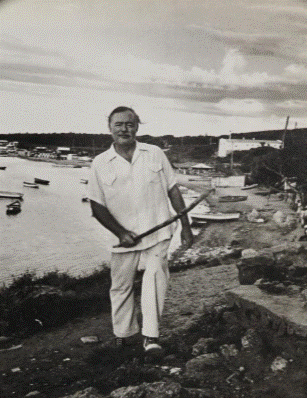
“My most difficult subject was Ernest Hemingway. He was very excitable, but in the end we got on fine… He went almost berserk because, while I was photographing, he overheard a little boy ask his father, ‘Who is that actor?’” – Alfred Eisenstaedt, Eisenstaedt on Eisenstaedt: A Self-Portrait
Throughout the 1950s and early 1960s, Eisenstaedt continued working inside and outside of the US, having his first solo exhibition in Rochester, NY, as well as documenting state visits and trips, including the Duke of Edinburgh’s trip to the Arctic Circle, Vice President Nixon’s trip to Central America, Soviet General Secretary Nikita Khrushchev’s visit to New York City, and the Bolshoi Ballet’s performance for the occasion, and NY Governor Rockefeller’s trip to Venezuela, as well as photographing President Kennedy before and after his election to the presidency – he took many photos of Kennedy and his family, including his wife, Jacqueline, and his daughter, Caroline. Another one of his most famous works came during a trip to Paris, and as usual, it was a shot that came to be in the moment, capturing the ecstatic reaction of the spectating children to a puppet show in the Tuileries Garden. He had been working in France for some time on a photo series he titled “The Parisians”, focusing on capturing everyday life in Paris, from embracing couples to miniature painters in and around the Louvre, to an everyday family enjoying their Sunday off. Another notable photo from that series was his “Low Angle of the Eiffel Tower”, where he shot the intricate lattice structure of the Eiffel Tower from a dramatic, low perspective. While unrelated to the lives of everyday Parisians captured in the rest of the series, it produced a view in stunning black and white that brings a newfound beauty to the famous structure, and created a perspective that millions of tourists try to replicate under the tower to this day. He had been taking photos at the puppet show, looking for the most effective angles, until the perfect opportunity presented itself – the climax of the show, the moment when the dragon is slain arrived, and the pure, unscripted emotion of the children spectating was brought out. It was in this moment that Eisenstaedt captured the photo, and it soon became the highlight of his trip to France, capturing the entire spectrum of emotions in one image – from triumph to shock to disbelief, this image captured Eisenstaedt’s innate talent to capture a moment in time, with emotions that could be expressed only through childhood wonder and excitement.
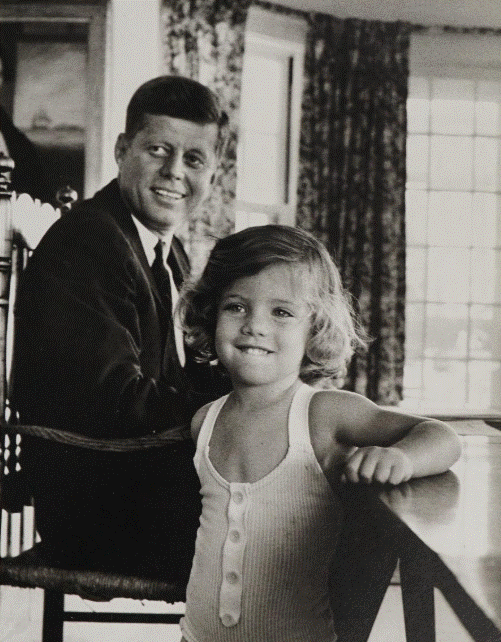
“This was the first of many times I photographed JFK – just after he had been chosen the Democratic candidate for president. He and Caroline pose happily, even though she had just stuck chewing gum on his freshly pressed pants.” – Alfred Eisenstaedt, Eisenstaedt on Eisenstaedt: A Self-Portrait
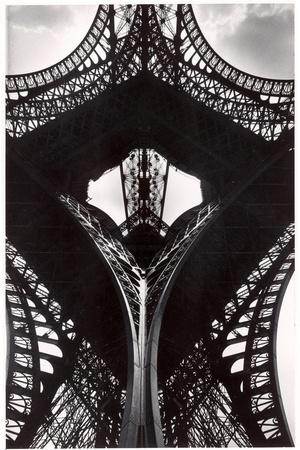
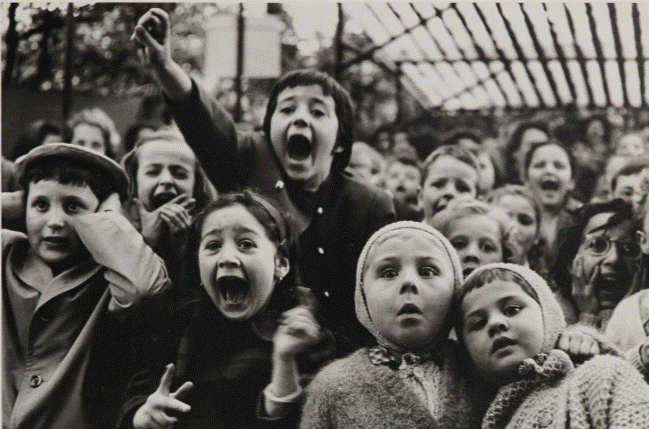
“Very often this sort of thing is only a momentary vision, my brain and vision does not register, only my eyes and my finger react. Click.” – Alfred Eisenstaedt, Eisenstaedt on Eisenstaedt
LATER LIFE AND LEGACY
Throughout this time, Eisenstaedt lived his personal life in his Jackson Heights apartment, commuting daily to the nearby Time-Life building. He married Kathy Kaye, a woman from South Africa, and the two lived together until her death in 1972, after which his sister-in-law (Lucy Kaye) became his constant companion, helping him get to work even with ailing health towards the end of life. In 1979, Eisenstaedt started work on what would become one of his most famous independent photo series, Eisenstaedt: Germany, which was published in a separate book, as Life had stopped its weekly publications in 1972. In this series, Eisenstaedt traveled back to his old home in Berlin, taking photos that could be juxtaposed against those taken at the very start of his career, before he was forced to flee the country. One of the most important photos for Eisenstaedt himself was that of Beethoven’s bust in Bonn, in the room where the great composer was born. While Eisenstaedt had attempted to photograph the bust while he was still in Germany, he recalled that “as I was putting up my tripod some Nazis came in and put a wreath there that read, ‘On the Führer’s birthday – the S.S. Sturmgruppenführer, Bonn.’” Over 40 years later, in 1979, Eisenstaedt photographed the room and bust without the uninvited Nazi emblems, placing the two images side by side in his memoir. Eisenstaedt also photographed the places he had known as a child, including the yard near his home, with children playing marbles just as he had many years before, noting that regardless of the destruction and changes that had occurred in Berlin during his forty years of absence, his childhood home, yard, and school remained just as they were in the years before his emigration. He also noted a scene he found to be strange: the old statues that used to line the Alley of Victory in Berlin. As symbols of the Prussian Empire, with figures of Frederick the Great and Barbarossa, these imperial monuments were removed by the Nazis so as to not risk destruction. While many of them were dismantled and remained buried under Allied rule out of fear that they would inspire German militarization, by 1979 they had been excavated, and Eisenstaedt found them in this strange position, referring to both the imperial leaders and their monuments as “tumbled”.
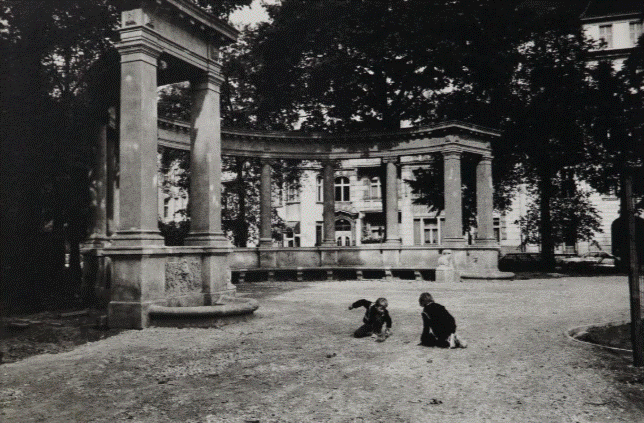
The Berlin yard where Eisenstaedt had played as a child, finding children occupying themselves in the same way he had – by playing marbles.
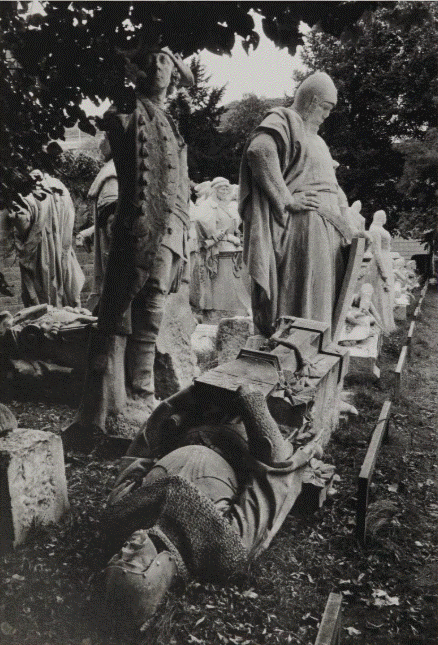
The garden where the old imperial statues of Prussia were excavated and replaced shortly before Eisenstaedt’s return.
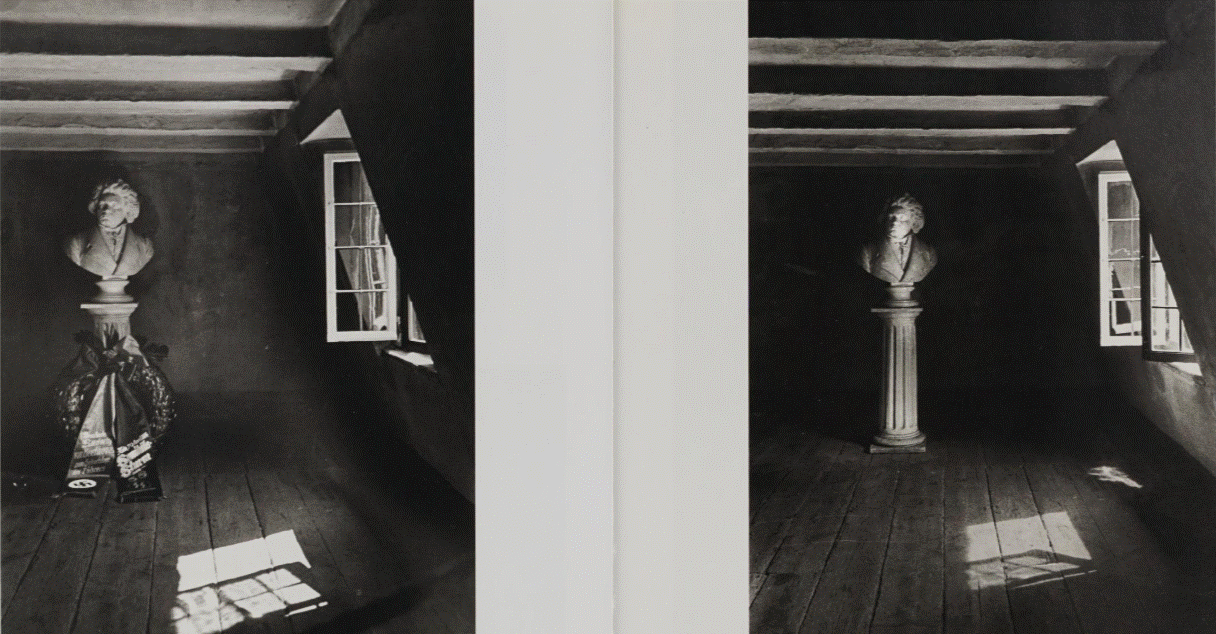
The room in the house where Beethoven was born, with his bust at the end. The image on the left was taken by Eisenstaedt in 1934, with the wreath that had been placed there by Nazis for Hitler’s birthday. 45 years later, Eisenstaedt shot the image on the right, noting, “Well, I did it without the wreath when they were gone”.
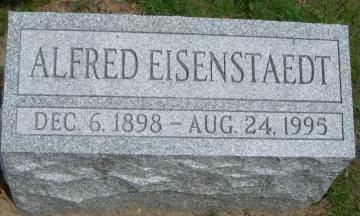
After his trip to Germany, as he continued compiling books and independent photos in New York, Eisenstaedt’s health began to decline. He began to suffer from arthritis, which greatly limited his mobility and ability to shoot as effectively as before, relying on assistance in shooting and in walking, especially from his sister-in-law, Lucy Kaye, and later using a wheelchair into the 1990s. Since the 1930s, he had taken his summers on Martha’s Vineyard in his vacation cottage, which he particularly enjoyed for his ability to experiment with different elements of his photography, isolating lighting, lenses, filters, and prisms. While he had spent his entire career working with small, handheld cameras, and had rejected the use of artificial lighting, Martha’s Vineyard proved to be the perfect sandbox to perfect his craft. One of his most famous photos there was of a majestic oak tree on the island, with equal use of shadow and light creating the breathtaking image. Later on, he famously photographed the Clinton family at Martha’s Vineyard, taking portraits of sitting president Bill Clinton, First Lady Hillary Clinton, and their daughter, Chelsea. This 1993 meeting was one of his last presidential sittings, and one of his last photographs taken in his life – he was 94 years old. Two years later, Eisenstaedt passed away at his vacation cottage on Martha’s Vineyard, at the age of 96 after suffering a heart attack, and now rests at Mount Hebron Cemetery in Flushing, NY.
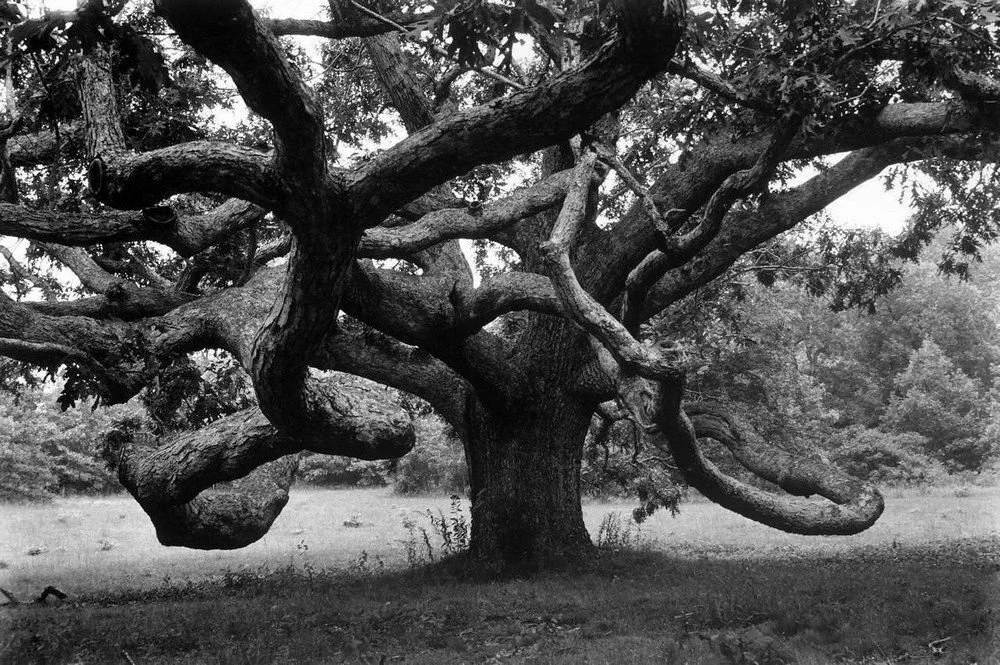
“For many summers, I drove past this giant oak on Martha's Vineyard. But, I always said to myself 'Next time!' Then one day I took heart, found a hole in the fence and photographed. Tragically, just a few months later, disease claimed half the tree.” – Alfred Eisenstaedt
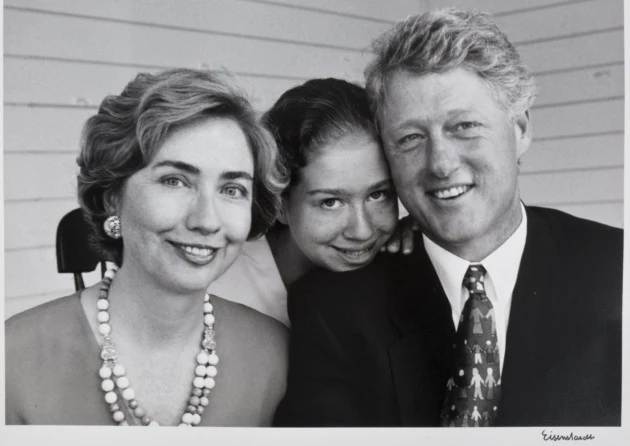
An image from Eisenstaedt’s 1993 sitting with President Clinton and his family at their cottage on Martha’s Vineyard.
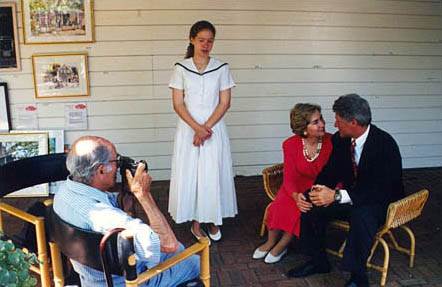
A photo of Eisenstaedt photographing the Clintons on Martha’s Vineyard in 1993, taken by a close friend, photographer William E. Marks.
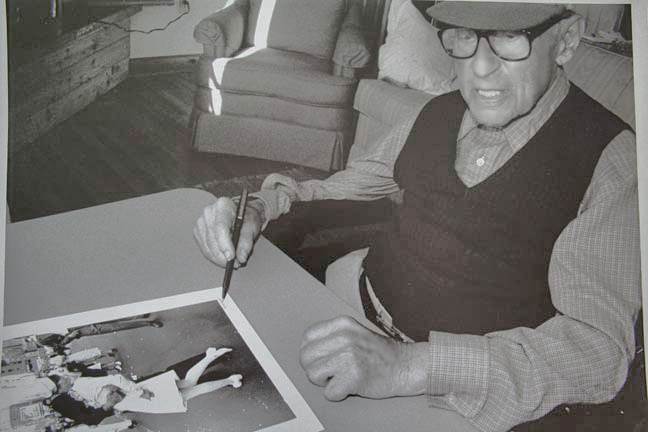
Eisenstaedt signing a print of his famous “V-J Day in Times Square” photo on Martha’s Vineyard on August 23, 1995, in his cottage. He passed away just a few hours later due to a heart attack.
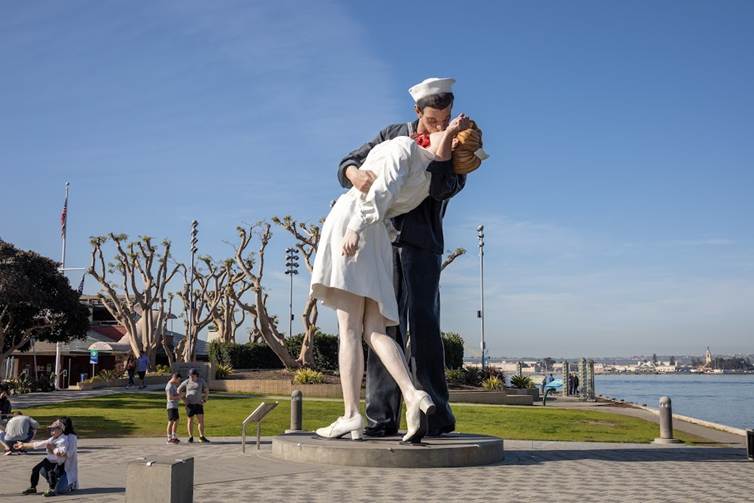
Eisenstaedt’s legacy as a world-famous photojournalist was honored in many ways, before and after his death in 1995, being a testament to his life’s work. He received the Joseph A. Sprague Memorial Award from the National Press Photographers Association in 1971, as well as the Achievement award of the Photographic Society of America and the Lifetime Achievement Award of the American Society of Magazine Photographers in 1978. In 1981, he received the Art Directors Club 60th Annual Merit Award for his work on Eisenstaedt – Germany, and later that year, became the first photographer to capture President Reagan’s famous ranch. In 1983, he was awarded an Honorary Doctorate of Fine Arts from Miami University in Oxford, Ohio. In 1987, he received the Progress Medal from the Photographic Society of America and the Leica Medal of Excellence, as he had used Leica’s handheld cameras for his signature candid portraits throughout his career. The next year, he was awarded the Master of Photography Award from the International Center of Photography, as well as the Mayor’s Award in Arts and Culture in New York City, followed by his 1989 National Medal of Arts, awarded by President George H.W. Bush in a White House ceremony. Eisenstaedt continues to have permanent exhibitions across the United States, including in San Diego and in the Martha’s Vineyard Museum, where so many of his famous photos and experiments were shot and conducted. American sculptor Seward Johnson modeled a replica of the “V-J Day in Times Square” photo titled Unconditional Surrender, and installed several identical sculptures of the event, standing 25 feet tall. They are now permanently featured in San Diego, California, near the USS Midway Museum; Sarasota, Florida, on the waterfront; Hamilton, New Jersey, in an installation that contains a park and a museum founded by Johnson; as well as in Normandy, France, outside the Caen Memorial Museum. These memorials and awards serve to highlight the life’s work conducted by Eisenstaedt, one of the pioneers in photojournalism and the master of the candid photo, through his professional and personal journey from Germany, the forced relocation as a result of Nazi rule, and his incredible work in the United States, setting the standard for generations of photographers and photojournalists to come, a testament to his character, work, and professionalism in his craft.
Alfred Eisenstaedt now rests at Mount Hebron Cemetery, together with his wife, Kathy. The Legacy Foundation is honored to be able to tell his story.
Sources:
Eisenstaedt on Eisenstaedt: A Self-Portrait
http://rarehistoricalphotos.com/goebbels-eisenstaedt-1933/
https://www.ebsco.com/research-starters/history/alfred-eisenstaedt/
https://en.wikipedia.org/wiki/Alfred_Eisenstaedt
https://time.com/3880669/goebbels-in-geneva-1933-behind-a-classic-alfred-eisenstaedt-photo/
https://kcstudio.org/revelations-in-a-suitcase-alfred-eisenstaedt/
https://www.newspapers.com/image/318666610/?article=7e4090b7-07cd-4511-9659-e92b138390c9&focus=0.20004784,0.21582027,0.3761613,0.29689646&xid=3355
https://www.qchron.com/qboro/i_have_often_walked/eisenstaedt-did-life-in-jackson-heights-apartment/article_033459fd-9e62-5bff-bfd7-c02bd752018c.html
https://www.news.com.au/lifestyle/real-life/photographer-alfred-eisenstaedt-captured-emotional-war-farewells/news-story/9817fc1983544db771c2f23927b47815
https://time.com/3517476/v-j-day-1945-a-nation-lets-loose/
https://time.com/3881060/wasteland-mother-and-child-hiroshima-1945/
https://www.npr.org/sections/pictureshow/2009/09/hemingway.html