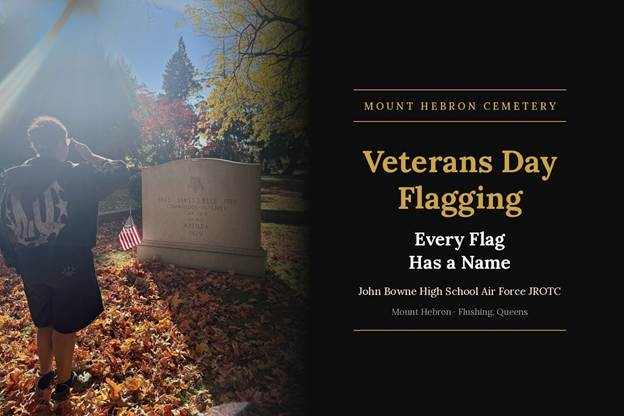
Every Flag Has a Name
Veterans Day Flagging with the John Bowne High School Air Force JROTC
They came from right across the street.
John Bowne High School sits just across the road from Mount Hebron. On a bright November afternoon, a long line of cadets crossed over and came down the sidewalk along the cemetery fence. They passed the parked trucks. They passed the oak trees, their leaves turning brown and red and drifting down onto the grass. Some of the cadets wore hoodies. Some wore headphones around their necks. One wore his uniform. They talked and laughed the way teenagers do when they are out of the classroom for the afternoon.
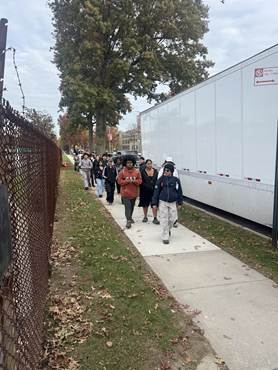
The cadets cross over from John Bowne High School.
Major Panton walked with them. So did Chief Lopez. They are the instructors of the John Bowne High School Air Force JROTC, and every year before Veterans Day, they bring their cadets to Mount Hebron to do something that matters.
They come to flag the graves of our veterans.
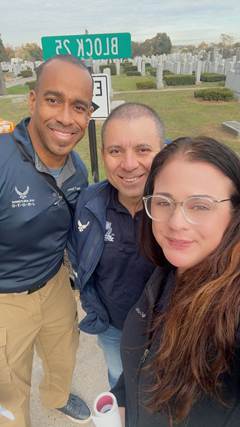
Major Panton and Chief Lopez with Deirdre Mooney Poulos of The Legacy Foundation.
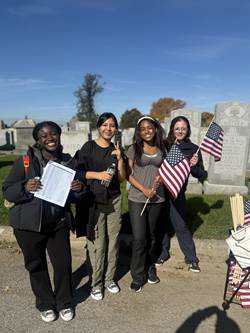
By the time the whole line reached the gates, there were enough cadets to fill a row of headstones in a single photograph. We gathered them at the edge of the road. We handed out the maps. We handed out the lists. Every list was organized by section of the cemetery, and every name on every list belonged to someone who served.
Then we handed out the flags.
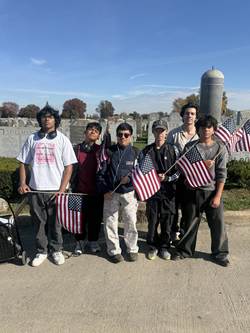
There were hundreds of them. Small American flags on thin wooden sticks, each one tipped with a gold point. Some cadets carried them rolled tight in bundles under their arms. Some carried them in armfuls, so many that the flags covered their faces in the photographs. One group pushed a wire shopping cart so stuffed with flags that the sticks poked out in every direction. It looked like it might tip over at any moment. It never did.
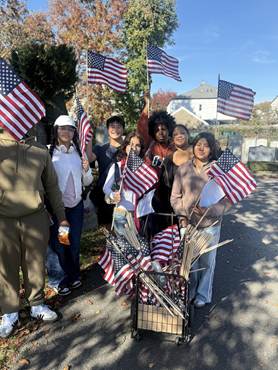
A cart full of flags, and a team ready to place every one.
The cadets split into small teams and set off down the cemetery roads. They would keep going for five hours, all of it on foot, across 225 acres.
Flagging a cemetery is slow work. It is supposed to be. You cannot do it from a distance. You have to walk up to each stone. You have to read the name. Sometimes the name is carved in English. Sometimes it is in Hebrew. Sometimes it is worn so smooth by a hundred years of rain that you have to lean in close and trace the letters with your eyes. You check the name against the list. You find the right grave. Then you kneel, press the flag into the ground, and stand it up straight.
Then you do it again. And again. And again.
Major Panton gave them one more instruction. Every flag ends with a salute. So at each grave, after the flag was standing straight, a cadet stepped back and raised a hand.
The cadets moved block by block. Block 19. Block 25. Block 28. They read names they had never heard before. Names of men who were born in New York and Brooklyn and in small towns in Poland and Russia and Romania. Names of men who served in the First World War, the Second World War, Korea, and Vietnam. Men who came home and men who did not.
Block by block, the cadets found every name on their lists.
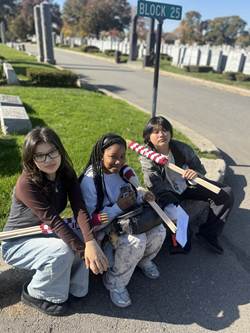
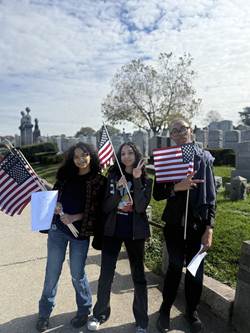
Somewhere in the middle of the afternoon, they took a break. They sat on the curb at Block 19 with their flags across their laps and Gatorades in their hands. They squinted into the sun and made peace signs for the camera. Then they stood up, brushed off their jeans, and went back to the rows.
That is the thing about these cadets. They never once acted like this was a chore.
Lists in hand, flags at the ready.
At one grave, a cadet stopped.
The stone was part of a family row, a line of matching markers with bronze plaques gone green with age. The plaque in front of her read Isidor Eckert, M.D. Born in New York City, January 19, 1887. First Lieutenant, Medical Corps, United States Army, World War I.
A doctor. A man who went to war not to fight but to heal. In the First World War, Army doctors worked in field hospitals and aid stations behind the trenches, treating wounds and gas burns and the flu that swept through the camps. Dr. Eckert came home from that war. He lived to be 58.
The cadet placed his flag beside the stone. Then she stood back, faced him, and raised her hand in a salute.
Major Panton had taught them that each flag ends with a salute. Dr. Eckert got his.
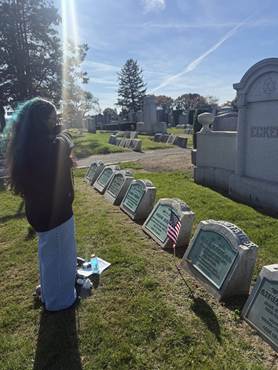
A salute for Dr. Isidor Eckert, First Lieutenant, Medical Corps, World War I.
A little later, it happened again.
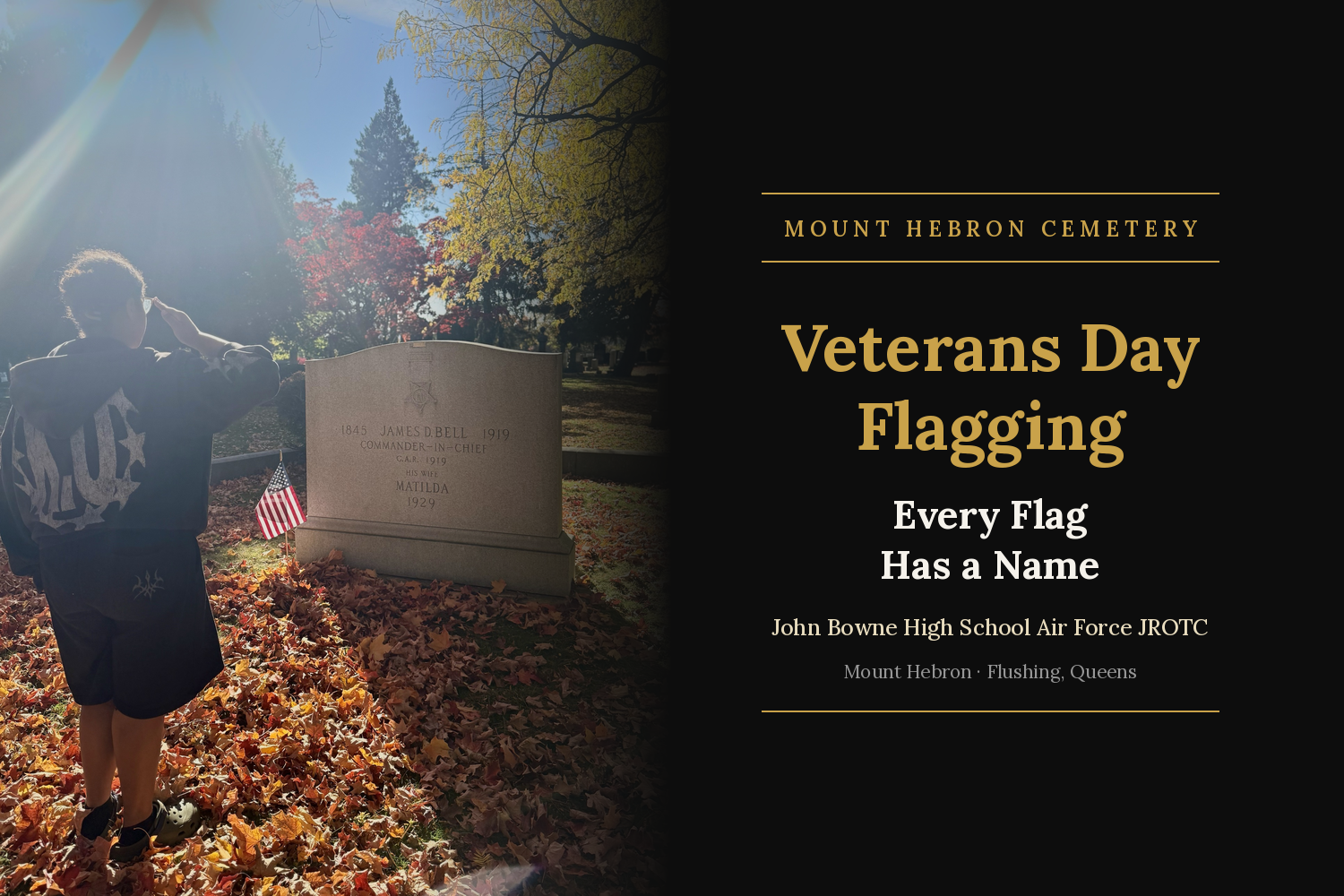
This time the stone was larger, standing alone in a carpet of fallen leaves, red and orange and gold. The sun came through the trees behind it so brightly that it lit up the whole scene. The stone read James D. Bell, 1845 to 1919. Commander-in-Chief, G.A.R. 1919. His wife, Matilda, 1929.
Most people walk past a stone like that without knowing what those three letters mean. G.A.R. stands for the Grand Army of the Republic. It was the great organization of Union veterans of the Civil War. At its height it had hundreds of thousands of members. And James D. Bell was once its leader.
James was born in New York City in 1845. He was still a teenager when the country went to war with itself. He served with the 1st New York Mounted Rifles as a regimental commissary sergeant, keeping his fellow soldiers fed and supplied, and he stayed until the war was over in 1865.
Then he came home and built a life. He became a lawyer in Brooklyn. In 1888 he was appointed Police and Excise Commissioner. Later he was appointed United States Attorney for the Eastern District of New York. But he never stopped being a soldier. For thirteen years he led the Abel Smith Post, the first Grand Army post on Long Island. In 1914 he became commander of the Grand Army for all of New York State.
In September 1919, the Union veterans of the entire nation elected him Commander-in-Chief.
He held the office for only a few weeks. James D. Bell died at his home in Brooklyn on November 1, 1919. He was 74 years old.
The cadets placed his flag on November 3. Two days after the anniversary of his death.
There is something else about James D. Bell that made this moment feel like it was meant to be. In 1868, the leader of the Grand Army of the Republic issued an order asking Americans to decorate the graves of the soldiers who died in the Civil War with flowers and flags. They called it Decoration Day. Today we call it Memorial Day. The tradition of placing flags on veterans' graves, the very thing these cadets came to do, began with the organization James D. Bell would one day lead.
More than 150 years later, a high school cadet stood in the leaves in front of his stone and saluted him.
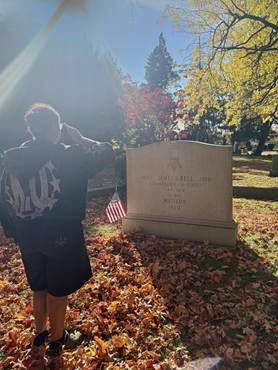
A salute for James D. Bell, Civil War veteran and Commander-in-Chief of the Grand Army of the Republic.
He would have understood exactly what he was seeing.
This year, one flag carried something more.
Near the fence along the road, there is now a sign standing in the grass. In front of it, on the curb, rests a bouquet of white roses tied with a ribbon of stars and stripes. Beside it, a flag. The face on the sign is a young man in his Air Force dress blues, standing in front of an American flag. Above his photograph are the words In Memoriam. Below it, his name.
Captain Charles A. Ransom, United States Air Force.
He was a fellow serviceman. He gave his life in service to his country.
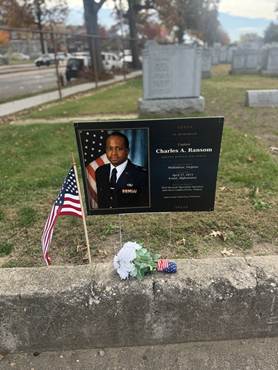
In memory of Captain Charles A. Ransom, United States Air Force.
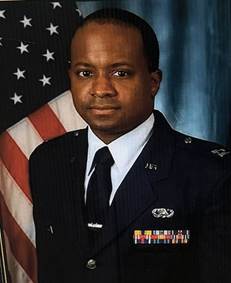
Captain Charles A. Ransom, 83rd Network Operations Squadron.
Charles grew up in Midlothian, Virginia. He was a runner. He loved to play golf with his dad. He went to the Virginia Military Institute, and after his first year there, he earned an Air Force ROTC scholarship. His classmates said he knew even then that the Air Force would be his life. He graduated in 2001.
Think about that for a moment. Charles Ransom started his own journey in an ROTC program. The cadets standing in front of his sign are at the very beginning of that same road.
He became a cyberspace officer, one of the Airmen who protect the military's communication networks. He served with the 83rd Network Operations Squadron at Langley Air Force Base in Virginia. His commanders called him an outstanding officer. He was a leader. He was someone people trusted.
In 2011, Charles deployed to Kabul, Afghanistan, to serve as a senior advisor to the Afghan Air Force. His job was to help build something. To train and support the men who would one day defend their own country.
On April 27, 2011, during a meeting at the Kabul airport, an Afghan military pilot opened fire. Nine Americans were killed. Eight of them were Airmen. One of them was Charles.
He was 31 years old.
Charles received the Bronze Star and the Purple Heart. After his death, he was promoted to Major. Back home in Midlothian, an American Legion post now carries his name. And every year on April 27, a formation of nine runners sets out at Langley and runs 2.7 miles together. One runner for each life lost. Four, two, seven. The date he died, carried in their steps.
When his squadron mourned him, they turned to the words of the Airman's Creed, the promise every Airman makes. Charles answered his nation's call. He defended his country with his life. And now, they said, it was up to them to never leave him behind. They closed with a simple request.
Tell people about Captain Ransom.
So we are.
Before the cadets went back across the street, we gathered them around his sign for one last photograph. They held our banner in front of them. Major Panton knelt on one side. Chief Lopez knelt on the other. The cadets stood behind them in a crowd, some smiling, some serious, one still in his uniform. Behind them, the headstones stretched back in long gray rows, and somewhere among them were hundreds of small flags they had placed with their own hands.
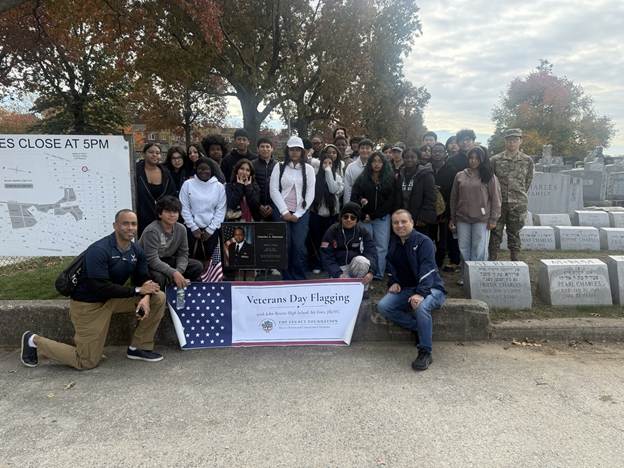
The John Bowne High School Air Force JROTC with Major Panton and Chief Lopez, gathered around Captain Ransom's memorial.
Air Force cadets, standing beside an Air Force officer they never got to meet.
Most of them were not yet born when Charles graduated from VMI. Many of them were small children when he died. They did not know his name this morning. They did not know Isidor Eckert's name, or James D. Bell's, or the hundreds of other names on those lists.
Now they do.
That is what this day is really about. Not just the flags, though the flags are beautiful. When Veterans Day comes, people driving past Mount Hebron will see a sea of red, white, and blue rising out of the grass, and they will know that someone remembered. But the flags are only the outside of it. The inside of it is the names. Every one of these men had a mother who said his name. Had friends who shouted it across a field. Had a family that waited for him to come home. A name is the last thing a person leaves behind. Saying it out loud is the simplest way to keep someone in the world.
His squadron asked us to tell people about Captain Ransom. Today, a group of teenagers from across the street did.
They did not leave him behind.
They did not leave any of them behind.
None of this happens on its own. Flags cost money, and someone has to believe they matter.
This year, that someone was Frank Wurzel of the Bnei Rapp Anshe Dombrowa society.
Anshe Dombrowa means the people of Dombrowa. It is the name of a town in the old country, carried across an ocean by the immigrants who founded the society. They built new lives here. They looked after one another. And they bought ground at Mount Hebron so that, in the end, they could rest together. Some of the men who rest on those grounds served this country in uniform.
Frank did not want them forgotten. So this year he made a generous donation to the flagging, in honor of the veterans of his own society. When the cadets reached his grounds, they planted his flags, read those names, and saluted those men.
Thank you, Frank. You honored your own, and you helped us honor so many more.
To Major Panton, to Chief Lopez, and to every single cadet of the John Bowne High School Air Force JROTC: thank you. Thank you for the walk across the street. Thank you for five long hours of walking and kneeling and reading and standing flags up straight. Thank you for every single salute.
You came here as students. You left as keepers of their memory.
We will see you next year.
~Blog by Deirdre Mooney Poulos