Young Anthropologists Decode the Past at Mount Hebron
Blog by Deirdre Mooney Poulos
The sun came up bright over Mount Hebron. The sky was that deep, clear fall blue you only get a handful of times a year. Oak leaves lay scattered across the grass in reds and browns and golds. They crunched underfoot on the paths. It was the kind of morning that makes a cemetery feel less like a place of endings and more like an open book.
And on this morning, the readers were the fifth graders of PS 889.
A yellow school bus pulled in, and out came a class full of energy. Hoodies in every color. Sneakers ready for walking. Faces full of questions. Their teacher, Andrew Portnoy, led the way, joined by Ms. Markin and Ms. Serrano. Together they had prepared these students well, and it showed from the first minute. They listened. They were curious. They were ready to work.
Behind them came the parents. So many parents. Chaperone after chaperone stepped off that bus, and we could not have been happier to see them. Their presence changed the whole day. Every corner of our field site had a grown-up nearby. They knelt in the grass beside their kids. They held clipboards steady. They pointed out a carving here and a letter there. More than once, they got just as curious as the children and started hunting symbols on their own.
We were also glad to welcome Adam Ginsberg, president of the Legacy Foundation board, and his wife, Jess. They spent the morning walking the rows alongside the students, admiring rubbings and cheering on every discovery. It meant a great deal to have them there. The Foundation exists for mornings exactly like this one.
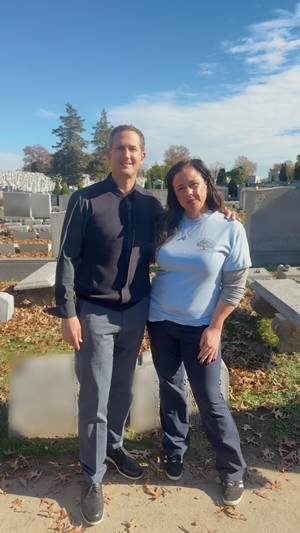
Deirdre Mooney Poulos with Adam Ginsberg, president of the Legacy Foundation board, among the stones of Mount Hebron.Photo courtesy of The Legacy Foundation.
Every student wore a bright green Legacy Foundation drawstring bag. Against the gray stone and the green lawn, those bags made the whole class easy to spot from anywhere on the grounds. The students carried clipboards, pencils, sheets of paper, and a worksheet called the Symbol Hunt. And each pair had one more tool. It was small, fuzzy, and bright yellow.
A tennis ball.
More on that soon.
The program is called Decoding the Past. Before anyone picked up a pencil, we talked about what that means.
Anthropologists study people. How they lived. What they loved. What mattered to them. Sometimes the people they study lived a very long time ago. They cannot be interviewed. They cannot tell their own stories. So anthropologists learn to read what those people left behind. Pottery. Tools. Paintings on cave walls. Carvings in stone.
For one morning, these students were not visitors. They were anthropologists. Mount Hebron was their field site.
It is a beautiful field site. The section we visited is made up of family plots. Tall, upright monuments stand in neat rows, each with a family name carved across the top in strong, square letters. In front of them sit smaller footstones, low to the ground, each one marking a single person. Some are worn soft by a century of rain and snow. Some are still sharp enough to cast a shadow. Low hedges frame the plots. Stone benches wait for visitors who come to sit a while. Tall evergreens stand at the edges like guards.
We started with the basics. How a cemetery like Mount Hebron came to be. Who rests here. Why families chose to carve what they carved. Then we turned to the language hidden in the stones.
People have always spoken in symbols. The ancient Egyptians carved pictures into temple walls to tell stories that would last for thousands of years. A bird could mean a word. An eye could mean protection. A single shape could hold a whole idea.
Then we asked the students a question. Do you ever talk in pictures?
They knew the answer right away. Of course they do. Every day. A heart. A thumbs up. A little flame. A face with tears of laughter. Emojis are symbols too. They carry feelings and ideas in a single small picture, the same way those Egyptian carvings did, and the same way the stones of Mount Hebron do.
Our signs showed each symbol three ways, side by side. On the stone. In Egyptian form. As an emoji. That was the moment the lesson clicked. You could see it on their faces. The old stones suddenly did not seem so old or so far away. The people who carved them were saying something. And these fifth graders realized they could learn to read it.
Then came the rubbing. And here is where the tennis ball comes in.
A stone rubbing is one of the oldest tricks in the field. You lay a sheet of paper flat against a carving. You hold it steady with one hand so it does not slip. Then you press and roll the tennis ball across the paper. Slowly. Gently. Back and forth, over and over. The ball is soft enough to protect the stone and firm enough to pick up every edge. Little by little, the carving rises up out of the blank page in soft blue.
There is something about watching history appear under your own hand. The students leaned in close. Some held their breath. One boy pressed his palm flat against the paper, his glasses sliding down his nose, rolling that yellow ball in careful circles until a shape began to bloom. Fallen leaves stuck to his knees. He did not notice. He was too busy watching.
Then the hunt began.
The students set out in pairs across the section, Symbol Hunt sheets clipped to their clipboards. Each sheet had a grid of boxes to check. Ivy, its leafy vines climbing up the stone. A torch, its tall flame rising from a bowl. A daisy with petals all the way around. A lily, shaped like a trumpet. There were bonus symbols, too, for the sharpest eyes in the class.
The pairs moved from plot to plot. They crouched down by the footstones. They walked slowly along the big family monuments, tracing the carvings with their eyes. A pair would stop, point, check the sheet, and talk it over. Is that a flame or a leaf? Is that ivy or a vine? Then they would decide together, check the box, and kneel down to make a rubbing. Then off to the next one.
The discoveries came fast. Soon the students were holding up their pages for anyone who would look.
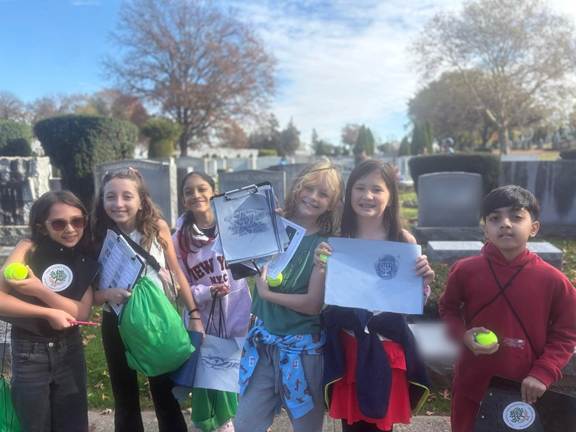
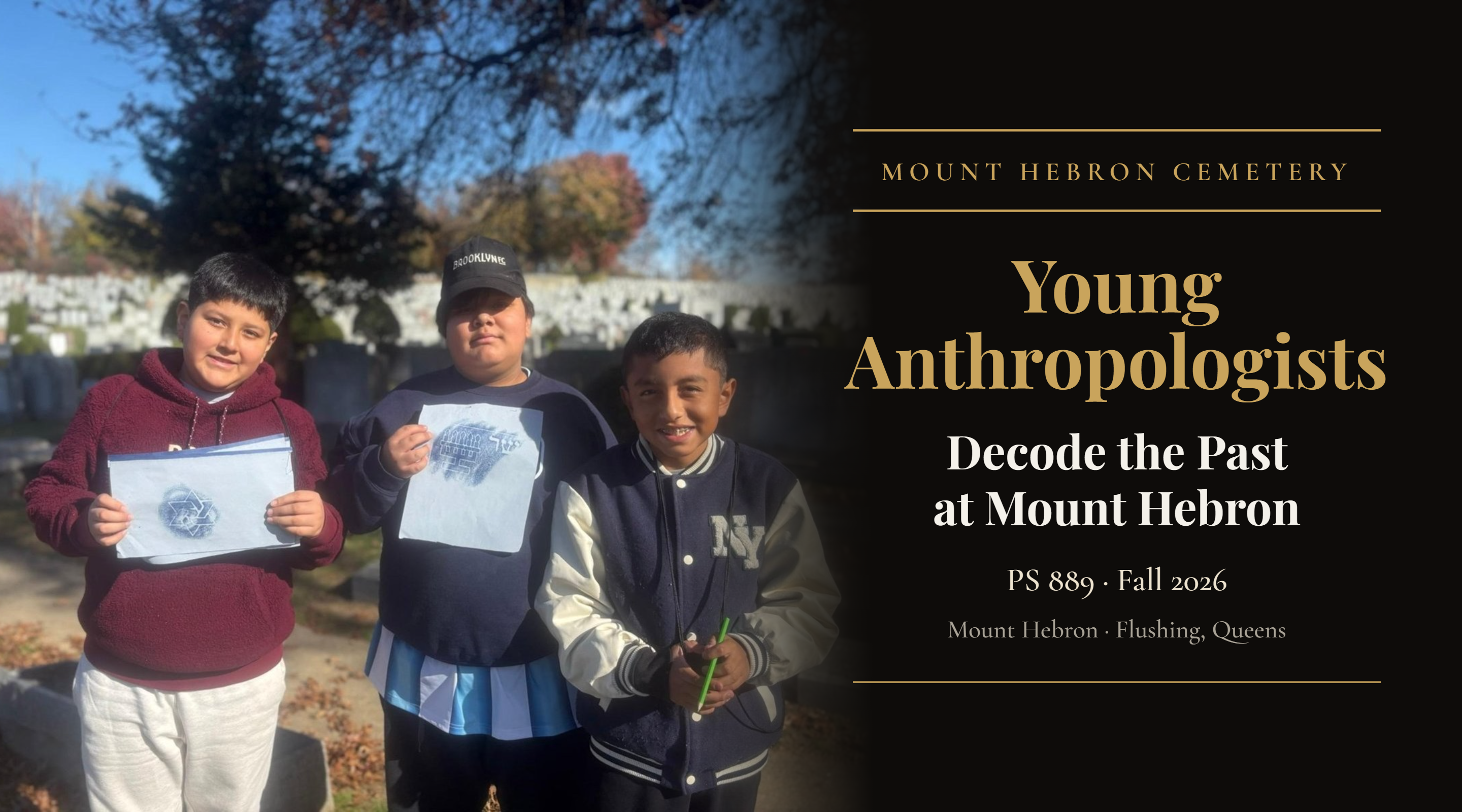
Six proud anthropologists show off their rubbings, including a star and a candelabra.Photo courtesy of Andrew Portnoy, PS 889.
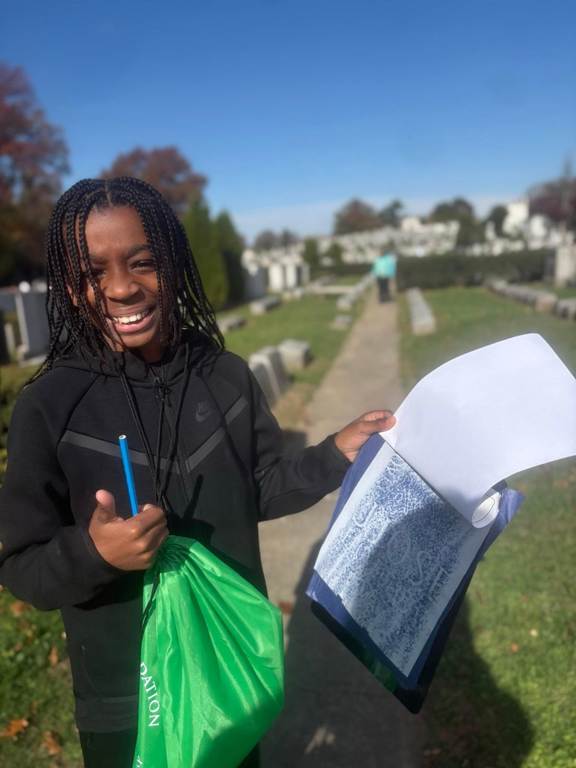
A big grin and a thumbs up for a freshly made rubbing.Photo courtesy of Andrew Portnoy, PS 889.
One boy in a black jacket held up a rubbing of a torch, its flame curling upward in long blue strokes, with two carved letters faintly showing beside it. He could not stop smiling.
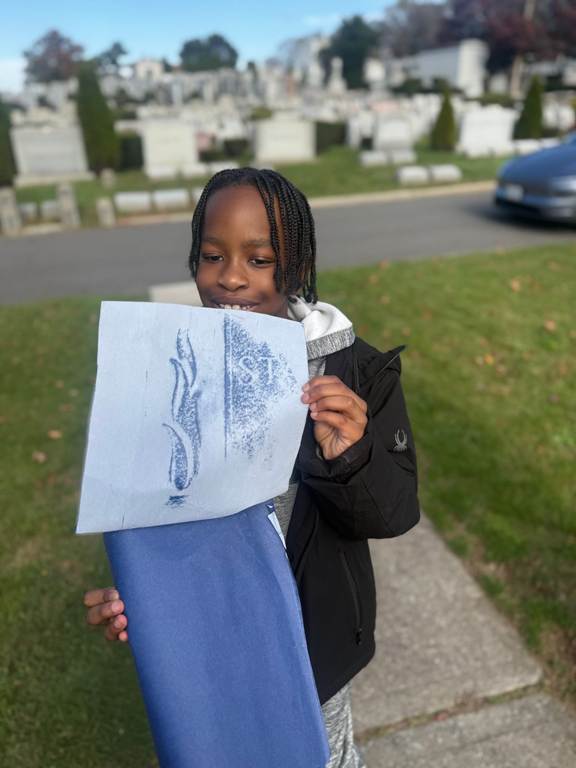
A student smiles behind his rubbing of a torch, its flame curling up the page.Photo courtesy of The Legacy Foundation.
Two girls stood side by side on the path, each proudly showing off a page with a six-pointed star pulled straight from the stone.
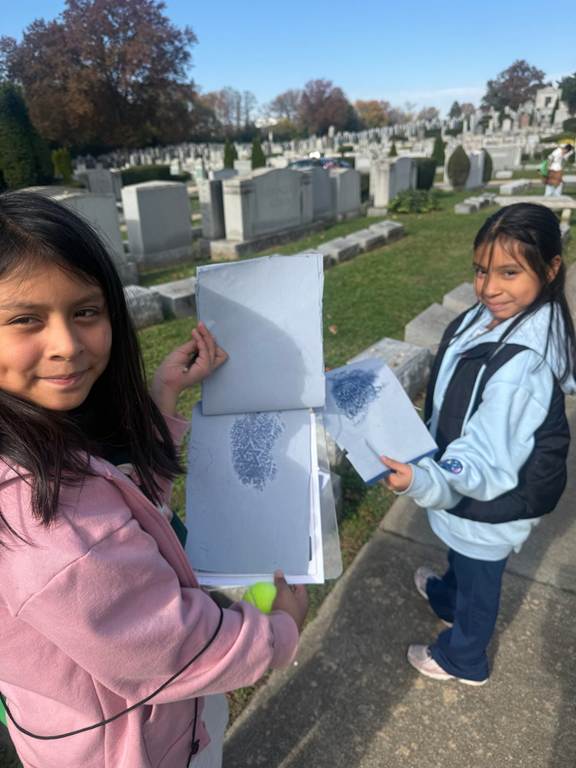
Two girls hold up the six-pointed stars they pulled from the stone.Photo courtesy of The Legacy Foundation.
Another student flipped through a whole stack of rubbings clipped to her clipboard, a bold star on top, a grin spreading across her face.
One girl, a tennis ball tucked in her hand, held up a perfect rubbing of a candelabra. She had found it on a footstone right at her feet.
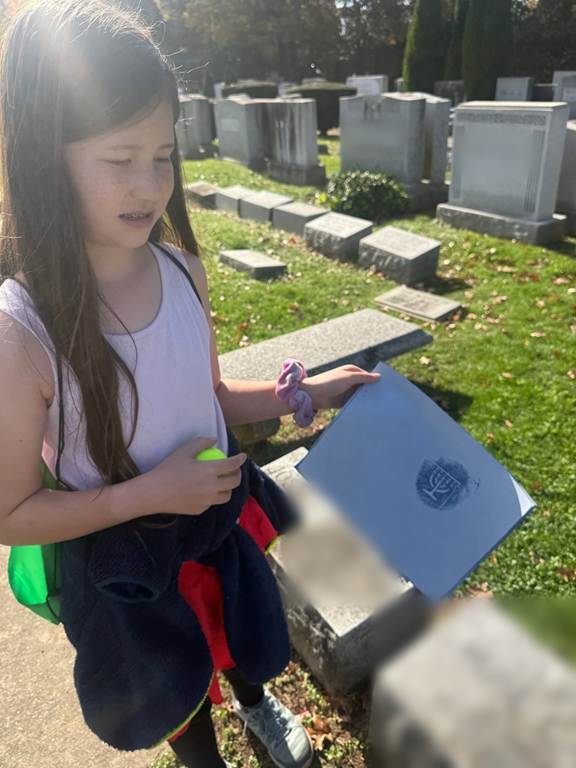
A perfect candelabra, found on a footstone right at her feet.Photo courtesy of The Legacy Foundation.
Every symbol was a small discovery. Every discovery was a little piece of someone's story, told in stone and carried home on paper.
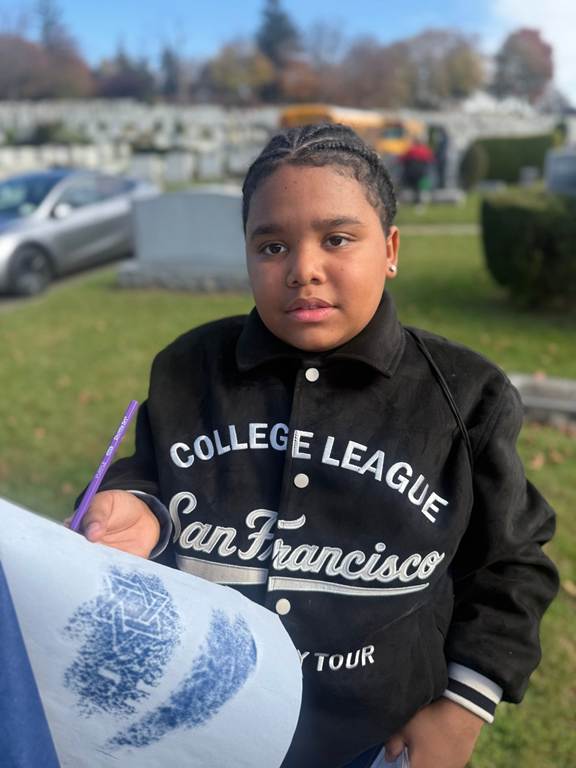
A young anthropologist pauses with his pencil and a star rubbing.Photo courtesy of The Legacy Foundation.
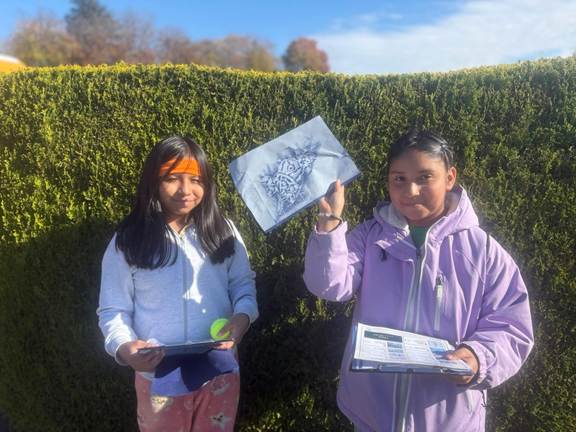
Two partners hold up a flower rubbing in front of a tall green hedge.Photo courtesy of Andrew Portnoy, PS 889.
The kids were amazing. Truly. They were curious, careful, and respectful of the place they were standing in. They walked the paths. They were gentle with the stones. They asked thoughtful questions and listened to the answers. They worked like real field researchers, because that morning, that is exactly what they were.
Respect mattered most of all. Every stone belongs to a family, and these students treated each one that way. They handled the stones with care, kept to the paths, and honored the people whose stories they had come to read.
By the end of the morning, the clipboards were heavy with paper. Pencils were worn down. Tennis balls had picked up a little dust and a lot of blue. The green bags were fuller than when they arrived. And the hunt sheets were covered in checkmarks.
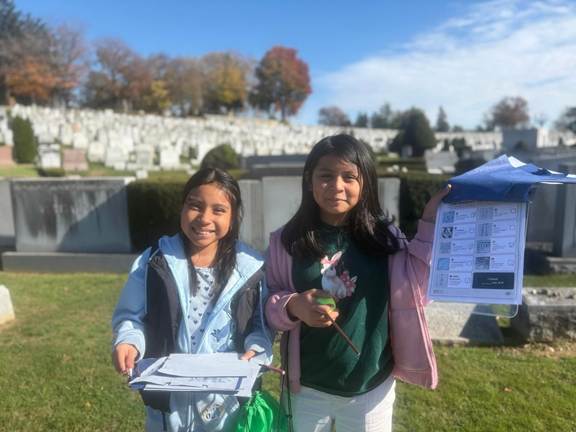
Two partners show off their finds and a Symbol Hunt sheet full of checkmarks.Photo courtesy of Andrew Portnoy, PS 889.
But the best thing those students took home was not on paper. It was a new way of seeing. A cemetery is not just a quiet place full of names and dates. It is a library. Every stone is a page. Every symbol is a word chosen with love by someone who wanted to say something that would last. A flame for a life that burned bright. A star. A candelabra. A flower for someone who was cherished. These students learned that if you slow down and look closely, the stones will talk to you.
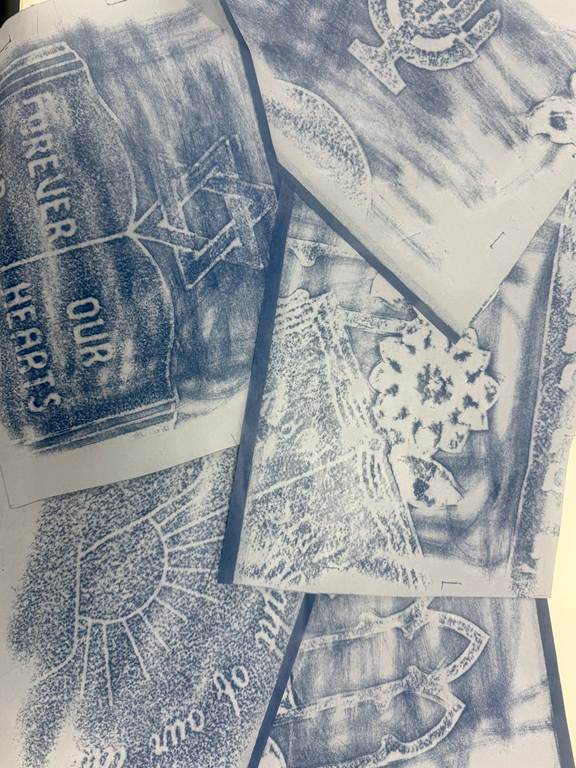
The finished rubbings tell their own story: a star, a sun, a flower, and words of love carried home on paper.Photo courtesy of The Legacy Foundation.
That is what anthropologists do. They slow down. They look closely. They listen to people who can no longer speak for themselves.
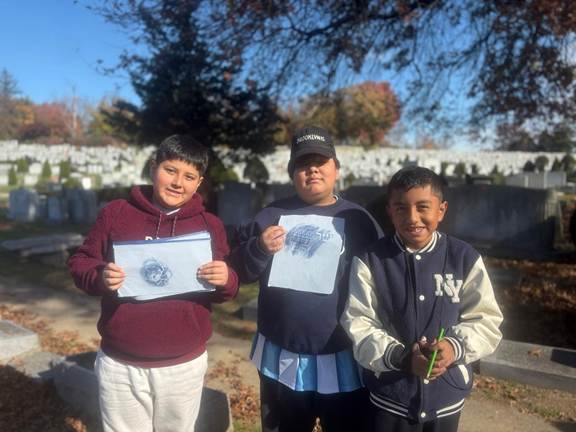
Three friends proudly display a star and a candelabra they found together.Photo courtesy of Andrew Portnoy, PS 889.
These stones were made to be read. Most days, they wait quietly under the trees. On this sunny fall morning, a group of young anthropologists from PS 889 read them out loud.
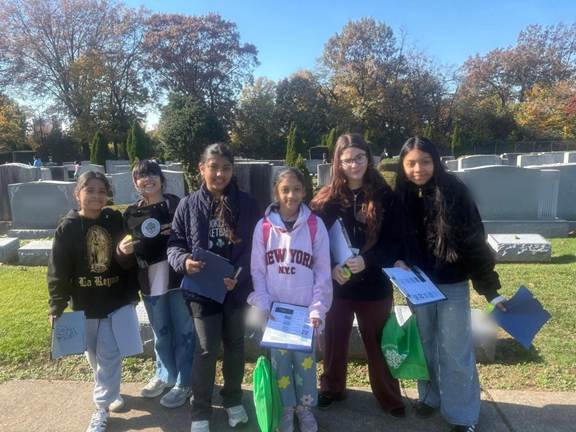
Six friends pause for a photo, clipboards and rubbings in hand.Photo courtesy of Andrew Portnoy, PS 889.
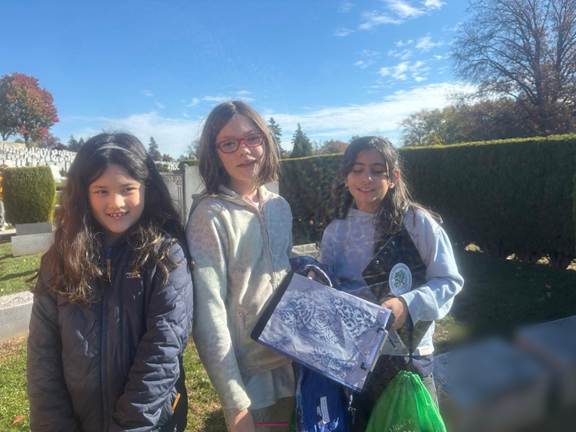
Three classmates share a flower rubbing beside a tall green hedge.Photo courtesy of Andrew Portnoy, PS 889.
Before they climbed back on the bus, the students filled out a short exit survey. We asked them one simple question. What was something new you learned today? Their answers were the best part of our week. Here are a few of them, in their own words, with the spelling lightly tidied up.
Many of them discovered that a carving is never just a decoration.
“I used to think the symbols were designs. Now I know they have special meaning.”
“Well, I learned that the symbol was like a message and it meant something. Because before, when I saw it, I had no clue what it was.”
“I learned that you can learn a lot about someone just by looking at a symbol on a stone.”
“I learned how you can understand who the person was by looking at the symbols and learning about their families.”
“That the stones on the footstones mean something. Before, I thought the footstones got stones on them because the stones got kicked on.”
The emoji connection stuck, too.
“Emojis are not just emojis. There’s a lot behind those emojis.”
“I learned that emojis can be what your personality is or was.”
“I really liked how we all compared ancient symbols back then to emojis here in the present.”
“I learned that a lot of symbols come from ancient Egypt, and I learned what some symbols mean, like the Star of David or the candles. So I learned a lot of cool things.”
And the hunt itself was a hit.
“I liked how we had to do a scavenger hunt and find the symbols. And along the way we would see other symbols that weren’t on the list. It was really fun.”
“I loved learning about the meanings of the symbols on the stones. Looking around and making rubbings was also exciting. I would do this trip again!”
“I really did like the special paper and the tennis ball. And I really did like the trip a lot. Thank you!”
“I learned about anthropology, and I like how I learned about it in a creative way.”
“Something that I learned was that anthropologists really have to look hard for things.”
“I had a very good time!”
“I thought this trip was really cool!!!”
One student summed it all up better than we ever could.
“I had never been to a cemetery in my life. That trip was the best trip of my life.”
Thank you to Mr. Portnoy, Ms. Markin, and Ms. Serrano for bringing their students and for preparing them so well. Thank you to every parent who came along, knelt in the grass, and made this day possible. Thank you to Adam and Jess for joining us and cheering the students on. And thank you most of all to the fifth graders of PS 889, who reminded us why this work matters.
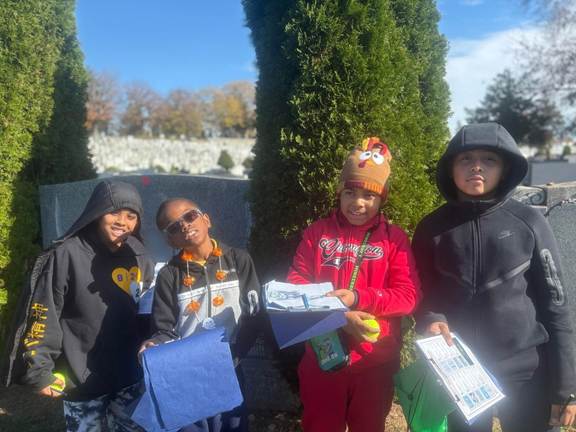
Four boys show off their rubbings and hunt sheets before heading back to the bus.Photo courtesy of Andrew Portnoy, PS 889.
Come back anytime. The stones will be waiting.
To every family whose stones taught our young anthropologists so much, may their memories be a blessing.
Photos by Deirdre Mooney Poulos, Andrew Portnoy & Jessica Ginsberg