Rabbi Eugene Kohn and the Reconstructionist Movement
Blog by Priya Perumal
Tuesday, June 12, 1945. The war in Europe has been over for a month. In the Hotel McAlpin in Manhattan, across the street from Macy’s, more than two hundred Orthodox rabbis gather. They have come to excommunicate a fellow rabbi, Mordecai Kaplan. Their target is a new prayer book, the Sabbath Prayer Book. By most accounts, a copy of it is set on fire. On its title page are the names of its two editors. One is Kaplan. The other is Rabbi Eugene Kohn.
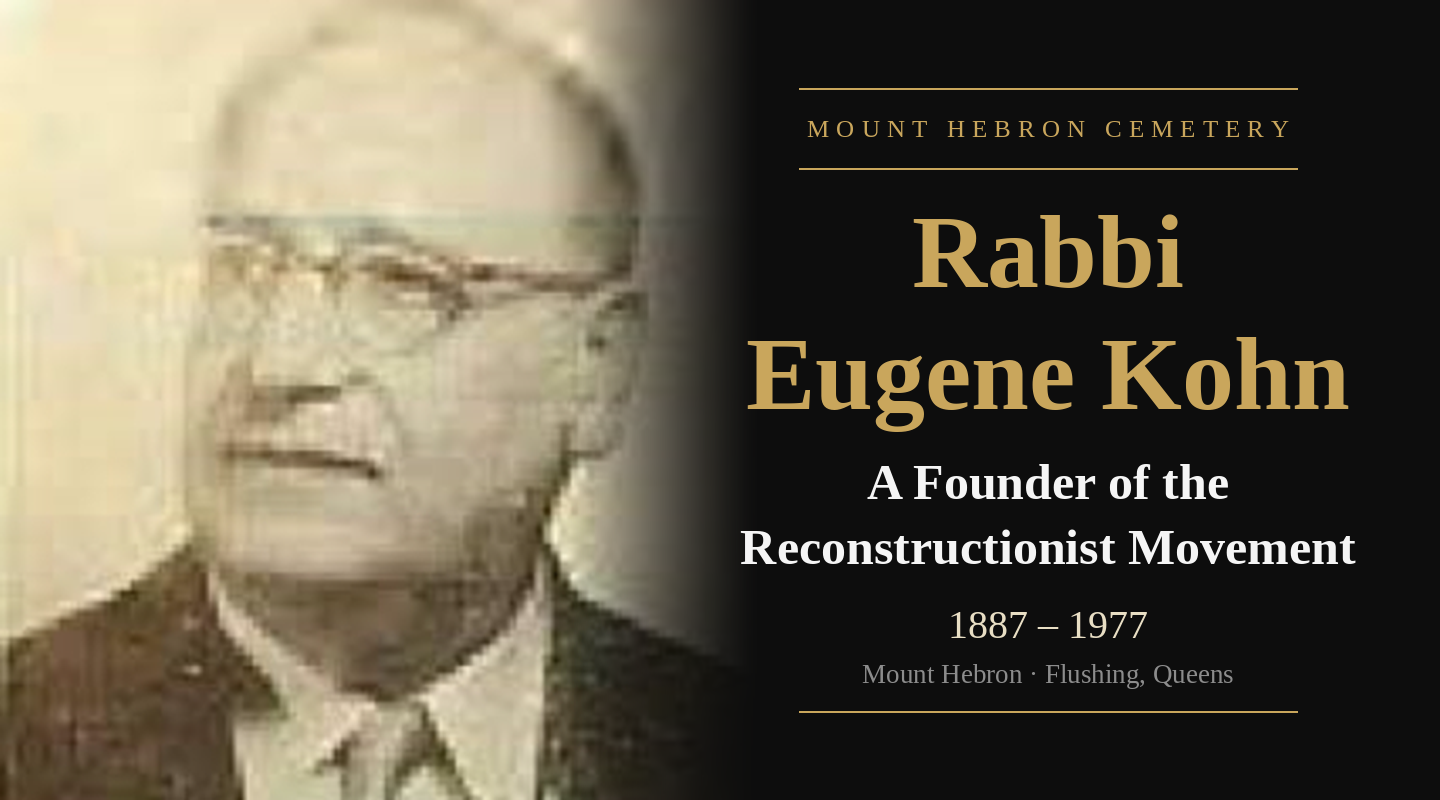
Eugene Kohn was born in Newark, New Jersey, on January 26, 1887. His parents, Siegfried and Bertha Kohn, were Czech Jews. The family name tells part of the story. Kohn comes from kohen, the Hebrew word for the priests descended from Aaron. His Hebrew name was Yitzchak, son of Yehoshua, HaKohen.
Learning ran in the family. His older brother, Jacob, became a Conservative rabbi and a scholar. Eugene followed. He earned his bachelor’s degree from New York University in 1907. Then he went to the Jewish Theological Seminary. One of his teachers there was a young rabbi named Mordecai Kaplan, who taught him how to preach. Kohn was ordained in 1912. The meeting would shape the rest of his life.
His first pulpit was in Baltimore, Maryland, from 1912 to 1918. There he met Mildred, the woman he would marry. They wed on June 16, 1915, at Ansche Chesed, a Conservative congregation in Manhattan. The rabbi who married them was his brother Jacob, who led Ansche Chesed at the time. Eugene and Mildred had four children, Rebecca, Gustave, Theresa, and Aaron.
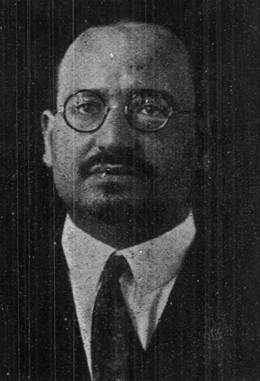
Life in the pulpit was harder. Kohn moved again and again. After Baltimore came Perth Amboy, New Jersey. Then Milwaukee, Wisconsin. Then Youngstown, Ohio. Then Bayonne, New Jersey. From 1936 to 1939 he served a congregation in St. Albans, Queens, not far from where he would one day be buried. Most of these posts lasted only two or three years. He also worked on the staff of Young Judaea, the Zionist youth movement. He was a thinker and a writer, and the pulpit may never have been the right fit.
His real home was a set of ideas. In 1934, Kaplan published Judaism as a Civilization. He argued that Judaism was more than a religion. It was a whole civilization, with its own language, literature, art, land, customs, and community. The book was well received. In 1935 Kaplan, Kohn, Milton Steinberg, and Ira Eisenstein launched a magazine to spread those ideas. They called it The Reconstructionist. In 1938, Kohn became its first managing editor. He kept that job for more than two decades, until he retired.
Kaplan was the movement’s great voice. Kohn was often its pen. He edited Shir Chadash, a book of readings and prayers, in 1939. With Kaplan and Eisenstein, he edited The New Haggadah in 1941. With Kaplan, he edited the Sabbath Prayer Book in 1945, the book that was burned at the McAlpin. Three years later came The Reconstructionist Prayer Book. In 1951, with Kaplan and J. Paul Williams, he compiled The Faith of America, a collection of readings and prayers for American holidays like Labor Day and Flag Day. He also wrote his own books, among them The Future of Judaism in America (1934), Religion and Humanity (1953), and Good to Be a Jew (1959).
Those books carried a simple idea. Judaism is a living, evolving civilization. The Jewish people come first, and the tradition must keep growing to survive in a changing world. Kaplan had shown what that could look like years earlier. On March 18, 1922, his twelve-year-old daughter, Judith, stood before his new congregation, the Society for the Advancement of Judaism. She became the first girl in America to celebrate a bat mitzvah in public. Many people were shocked. Today the ceremony is so common it is hard to imagine a time without it. Reconstructionism also asks its followers to live out Jewish values, including tikkun olam, the work of repairing the world. Kohn believed these ideas could help Judaism survive the modern age.
He lived to see the movement stand on its own. In 1968, it opened its own rabbinical college in Philadelphia. In his last year, Kohn lived at the Geriatric Center of the Long Island Jewish Medical Center in New Hyde Park. He died there on Friday, April 1, 1977. He was ninety years old. Passover, the holiday of his New Haggadah, began the next evening. He was laid to rest at Mount Hebron.
His grave is marked by a low, flat stone. Carved at the top are two hands with fingers spread, the sign of a kohen giving the priestly blessing. Below is his Hebrew name and the date, the 13th of Nisan, 5737. Then the English. Rabbi Eugene Kohn. Jan. 26, 1887. Apr. 1, 1977. The last line is Hebrew. It echoes the prophet Micah. He walked humbly with his God.
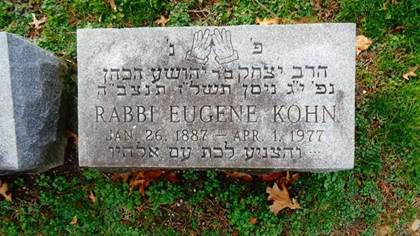
Rabbi Eugene Kohn’s gravestone at Mount Hebron Cemetery, Flushing, Queens, with the raised hands of the kohanim.
May his memory be a blessing.
Works Cited
“Eugene Kohn.” Open Siddur Project, opensiddur.org/profile/eugene-kohn/. Accessed 13 Nov. 2026.
“Eugene Kohn.” Wikipedia, Wikimedia Foundation, en.wikipedia.org/wiki/Eugene_Kohn. Accessed 13 Nov. 2026.
Gravestone of Rabbi Eugene Kohn. Mount Hebron Cemetery, Flushing, Queens, New York. Photograph, Mount Hebron Legacy Foundation.
“Judith Kaplan Eisenstein.” Wikipedia, Wikimedia Foundation, en.wikipedia.org/wiki/Judith_Kaplan_Eisenstein. Accessed 13 Nov. 2026.
“Kohn, Eugene.” Encyclopaedia Judaica, 2nd ed., Jewish Virtual Library, www.jewishvirtuallibrary.org/kohn-eugene. Accessed 13 Nov. 2026.
“Kohn, Jacob.” Encyclopaedia Judaica, 2nd ed., Encyclopedia.com, www.encyclopedia.com/religion/encyclopedias-almanacs-transcripts-and-maps/kohn-jacob. Accessed 13 Nov. 2026.
“Prof. Mordecai M. Kaplan Excommunicated by Orthodox Rabbis; His Prayer Book Burned.” Jewish Telegraphic Agency, June 1945, www.jta.org/archive/prof-mordecai-m-kaplan-excommunicated-by-orthodox-rabbis-his-prayer-book-burned. Accessed 13 Nov. 2026.
“Rabbi Eugene Kohn, 90, Founder of a Movement.” The New York Times, 2 Apr. 1977, www.nytimes.com/1977/04/02/archives/rabbi-eugene-kohn-90-founder-of-a-movement.html.
Rechcigl, Miloslav, Jr. Notable Czech and Slovak Americans. AuthorHouse, 2021.
Silver, Zachary. “The Excommunication of Mordecai Kaplan.” Kaplan Center for Jewish Peoplehood, kaplancenter.org/?p=755. Accessed 13 Nov. 2026.
“The Reconstructionist Journal.” Wikipedia, Wikimedia Foundation, en.wikipedia.org/wiki/The_Reconstructionist_Journal. Accessed 13 Nov. 2026.