Ben Bernie: The Old Maestro of Jazz and Radio
Blog by Jonathan Moskowitz
May 30, 1891 to October 20, 1943
It is a night in the 1930s, and a family is gathered around the radio. A smooth, easy voice comes through the speaker. It sounds as if its owner is smiling. He greets the audience as the Old Maestro and says his famous word three times. Yowsah, yowsah, yowsah. Nobody knows exactly what it means. Nobody cares. The band swings in behind him, and the whole room taps its feet. The man behind the voice is a fiddler who grew up poor, one of eleven children. His name is Ben Bernie.
He was born on May 30, 1891. Most sources say he was born in New York City. Wikipedia says Bayonne, New Jersey. His family lived in both places, so that may explain the difference. His parents were Julius and Anna Anzelevitz, Jewish immigrants. Even the family name is spelled several ways in the sources. Ben was one of eleven children. The Foundation's earlier text says his father ran a horseshoeing shop on South Street under the Brooklyn Bridge, and later became the village blacksmith in Bayonne. The family moved back to Manhattan when Ben was about thirteen. We could not confirm these details.
Life was hard. Ben said later that the family had been so poor that he still thought of fruit as a luxury. But music was a part of the home. His parents sacrificed to pay for his violin lessons. He went to Townsend Harris High School and studied at the New York College of Music. Some sources add engineering studies at Cooper Union or Columbia, though accounts differ. The Foundation's earlier text says he played a concert at Carnegie Hall at 15, but we could not verify that either. What the sources agree on is that he had talent, and that music won out over school.
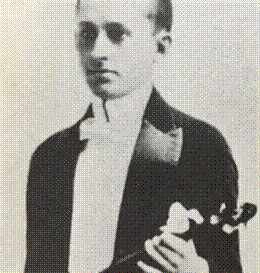
A young man in formal wear holding a violin, presented by the Foundation with Ben Bernie's story. The photographer, the date and the identification are not confirmed.
In 1908, according to the Foundation's earlier text, he left school and went into vaudeville as an eccentric violinist. He earned about $12 a week at first. He appeared at small theaters, and a booking agent for the Loew circuit gave him a tryout in Brooklyn. He performed under the name Ben Ansel for a time. On the road, he worked on the thing that would one day make him famous. He took requests from audiences and talked to them between songs. The patter became part of the act.
Back in New York, he teamed up with a childhood friend named Phil Baker, who played the accordion. As Bernie and Baker, the two made a violin-and-accordion act. On July 26, 1918, in New York, they recorded two sides for Victor Records, a waltz called Waters of Venice by Albert Von Tilzer, and a fox trot called Good-bye Alexander. Victor released the record in January 1919. Baker later became a radio comedian himself.
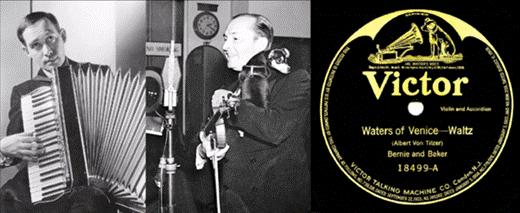
A composite showing two musicians, one with an accordion and one with a violin, beside the Victor label for Waters of Venice by Bernie and Baker, number 18499-A. The Discography of American Historical Recordings dates the recording to July 26, 1918. The photographs' sources and dates are not confirmed, and the identification of the musicians is the Foundation's.
After World War I, the country went wild for jazz. Bernie was inspired by Paul Whiteman, the biggest bandleader of the day. He formed his own orchestra and called it Ben Bernie and All the Lads. In 1923, they opened at the new Hotel Roosevelt in New York for what was meant to be a short engagement. The guests loved them. The short job became a residency that lasted until 1929. It was at the Roosevelt that Bernie's first local broadcasts went out over the air, and where he began to mix patter with the songs.
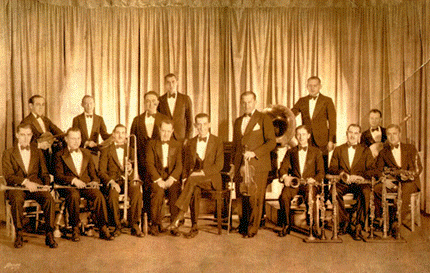
A sepia group portrait of fifteen men in evening clothes with violins, brass, saxophones and clarinets in front of a curtain, presented by the Foundation as Ben Bernie's orchestra. The musicians, the date and the photographer are not confirmed.
The orchestra recorded for Vocalion from 1922 to 1925, and then for Brunswick until 1933. In 1923 they recorded Who's Sorry Now. In 1925, they made the first recording of a tune that became one of jazz's best-loved standards. It was Sweet Georgia Brown, which Bernie co-wrote with Maceo Pinkard and Ken Casey. The record was a number one hit for five weeks. Today the song is best known as the theme of the Harlem Globetrotters. The band also had a number one hit in 1926 with Sleepy Time Gal. A short film of Ben Bernie and All the Lads was made in the early sound process called Phonofilm in 1924 or 1925.
Radio was the next stage. On November 15, 1926, his orchestra was heard in a remote broadcast from the Hotel Roosevelt on the first network program of the National Broadcasting Company. The Foundation's earlier text says that he lost a great deal in the stock market crash of 1929 and rebuilt his career in radio. We could not confirm the loss. What we do know is that by the 1930s, his show, usually called Ben Bernie, the Old Maestro, was among the top ten programs on the air. He had his own show from 1933 to 1937. His theme song was It's a Lonesome Old Town. His announcers included Harlow Wilcox and Harry von Zell. The singer Dinah Shore sang off and on with his band.
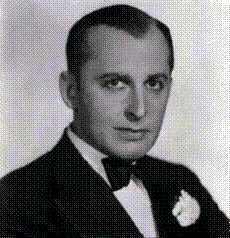
A studio portrait of a man in a tuxedo with a white flower in his lapel, identified by the Foundation as Ben Bernie. The photographer, the date and the source are not confirmed.
Part of his charm was the way he talked. His introductions to the next singer were almost as popular as the songs. He inserted his word, yowsah, into the music, as a kind of spoken beat, and it caught on. It became a national catchphrase. He closed each show with a sign-off that millions knew. Yowsah, yowsah, yowsah, and au revoir, children, and God bless you and pleasant dreams.
Then there was Walter Winchell. The newspaper gossip columnist and the bandleader were good friends in real life. On the air, they staged a feud, in the way that Jack Benny and Fred Allen later did. It gave both men more attention. The fight spilled into two movies in 1937, Wake Up and Live and Love and Hisses, in which they played themselves. Bernie also acted in Stolen Harmony in 1935. Warner Brothers even made fun of the pair in its cartoons. They appear as Ben Birdie and Walter Windpipe in The Coo-Coo Nut Grove in 1936.
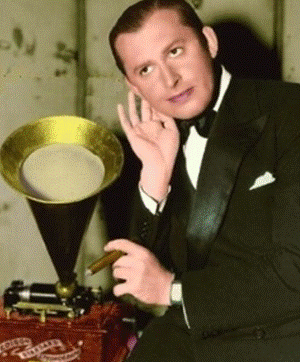
A colorized photograph of a man in a tuxedo holding a cigar beside an Edison phonograph, identified by the Foundation as Ben Bernie. The photographer, the colorist and the date are not confirmed.
His private life is less well recorded. The Foundation's earlier text says he married Rose Harris on December 24, 1915, and that they had a son, Jason. They divorced in 1935. That year he married Dorothy Wesly, and they stayed together for the rest of his life. We could not confirm those details independently. The Foundation's earlier text also says he was a lifelong cigar smoker. In early 1943, while he was performing in Chicago, he came down with pleurisy. It says that he kept entertaining troops and war workers, against his doctors' advice.
Ben Bernie died on October 20, 1943, at the age of 52. The Foundation's earlier text says it happened in his Beverly Hills apartment, from a lung infection with heart complications. The New York Times, according to Wikipedia, reported that 1,200 people attended his funeral in New York, where friends from stage, screen and radio said farewell to the Old Maestro. He was buried at Mount Hebron Cemetery. In 1960, he received a star on the Hollywood Walk of Fame, in the radio category, at 6280 Hollywood Boulevard. Decades later, the band Chic took his word for a hit, Dance, Dance, Dance (Yowsah, Yowsah, Yowsah).
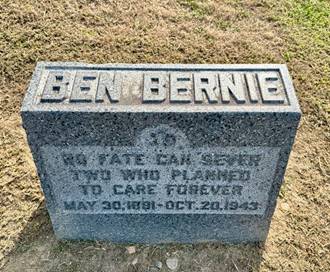
Gravestone of Ben Bernie at Mount Hebron Cemetery, Flushing, Queens. Photo: The Legacy Foundation (photographer and date to be confirmed).
His stone is a low block of dark speckled granite. His name is cut across the top in raised letters. Below it are four lines. NO FATE CAN SEVER TWO WHO PLANNED TO CARE FOREVER. Under them are the dates, May 30, 1891 and Oct. 20, 1943. The words speak of two people. The stone does not say who the second one is. A few small pebbles lie at its base. Someone came to visit. The man who told the country to dance, and who said goodnight to America, still has someone saying goodnight to him.
May his memory be a blessing.
Works Cited
"Ben Bernie." JazzStandards.com, jazzstandards.com/biographies/biography_6.htm. Accessed 17 Nov. 2026.
"Ben Bernie." Wikipedia, Wikimedia Foundation, en.wikipedia.org/wiki/Ben_Bernie. Accessed 17 Nov. 2026.
"Bernie, Ben." Discography of American Historical Recordings, UC Santa Barbara Library, adp.library.ucsb.edu/names/108895. Accessed 17 Nov. 2026.
"Victor 18499 (Black label (popular) 10-in. double-faced)." Discography of American Historical Recordings, UC Santa Barbara Library, adp.library.ucsb.edu/index.php/objects/detail/13417/Victor_18499. Accessed 17 Nov. 2026.