The Sergeant Who Saved Everything:
Jerome "Jerry" Bogus
Blog by Deirdre Mooney Poulos
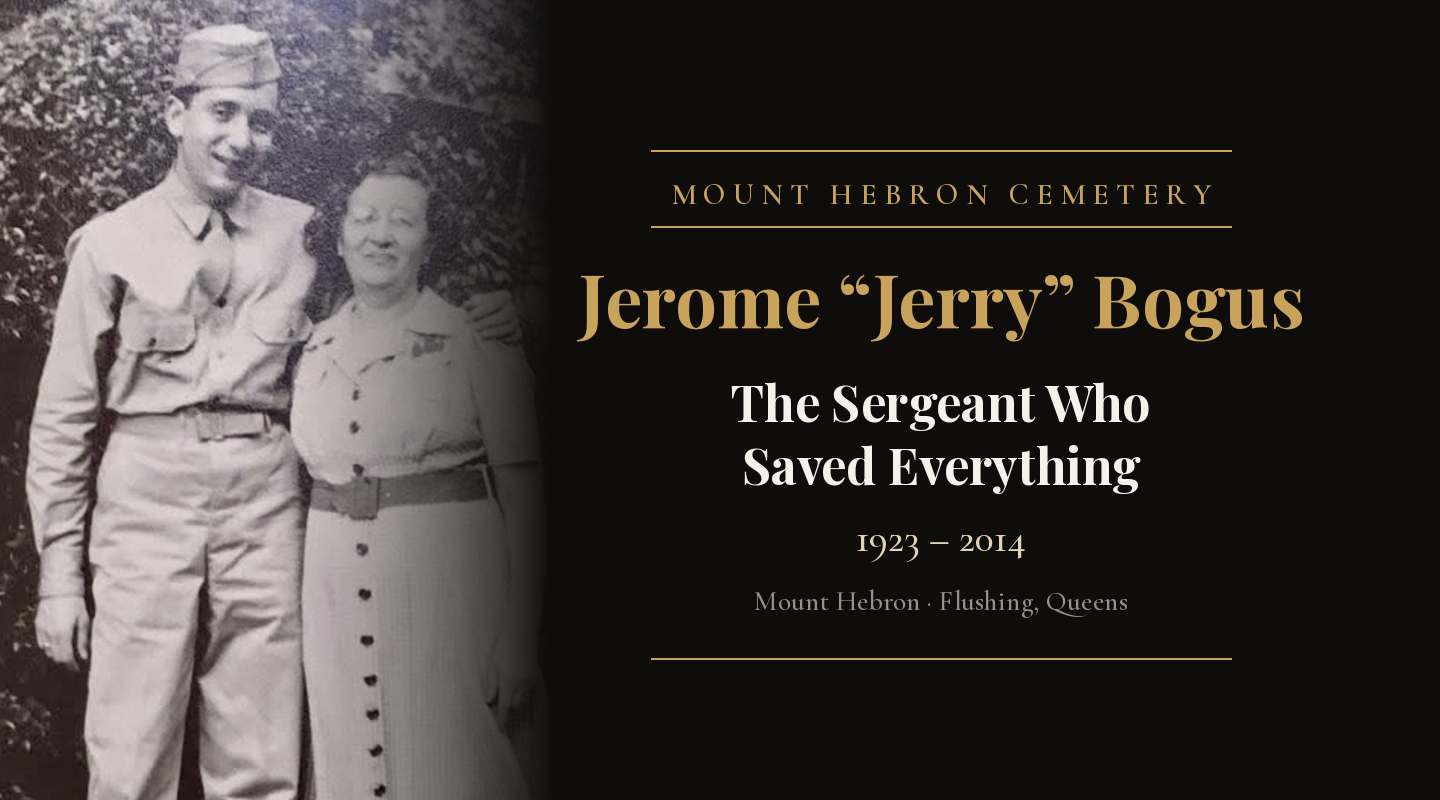
A tall young soldier stands on a Bronx sidewalk in his summer khakis. His cap tips to one side. His arm is wrapped around his mother's shoulders, and he is grinning. She wears a checked dress with a row of dark buttons and a wide belt, and she leans into him just slightly, the way mothers do when they are proud and trying not to show it too much.
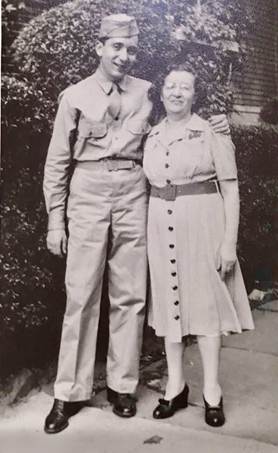
Jerry and his mother, Gussie, in the Bronx. Courtesy of the Bogus family.
His name was Jerome Lewis Bogus. Everyone called him Jerry. Her name was Gussie.
Jerry never fired a shot at the enemy. He never crossed an ocean in uniform. But he answered when he was called, he served until the job was done, and he came home with stories his family would tell for the rest of their lives. Some of them are about duty. Some of them are about loss. And a surprising number of them are about dental equipment.
Jerry's parents both came from Poland. His father, Philip Bogus, was from Grajewo, a town the Yiddish speakers called Grieve. His mother, Gussie Schlosser, came from the great Jewish city of Bialystok. The two married in New York in 1911.
Jerry was born in the Bronx on March 24, 1923, and spent his life moving between the Bronx and Brooklyn. In the Bronx, the family lived on Burke Avenue and on Walton Avenue, near the Grand Concourse. In Brooklyn, they lived by the ocean in Brighton Beach, on Brighton 4th Street, Brighton 6th Street, and Brightwater Avenue. There was an older sister, too. Her name was Helen.
In January 1941, Jerry graduated from high school in Brooklyn. It should have been a happy month. Instead, it came only weeks after his father died suddenly. Jerry had dreamed of medical school. Now he was the man of the house, with a mother and a sister to support, and the war in Europe was pressing closer every day.
So he did what so many children of the Depression did. He went to work during the day and took college classes at night. His job was in electroplating, coating metal parts in thin layers of other metals. When he registered for the draft on June 30, 1942, at nineteen years old, he listed his employer as the Great Metal Novelty Corporation in Bushwick, Brooklyn. The company stamped and built metal goods, from radio chassis to small industrial hardware, and it was doing defense work for the British Navy.
That kind of job was supposed to keep a young man home. Draft boards could defer workers they judged to be necessary to war production. But by 1943, the country was running short of men. That year, newspapers reported that local draft boards were scraping the bottom of the manpower barrel, with only about a million men left in Class 1-A. Jerry's draft board decided it wanted him too.
On December 28, 1943, Jerry reported to the Armed Forces Induction Station at Grand Central Palace, 480 Lexington Avenue. Before the war, the thirteen-story hall had hosted auto shows, boat shows, and the city's great flower show. In World War I it had been a hospital for soldiers coming home from France. Now it was a factory for soldiers. By the time it closed in September 1945, more than a million men had passed through its doors.
Jerry was inducted that day and handed a sheet of orders that still survives. It welcomed him with an exclamation point. "You are now a soldier in the Army of the United States! Congratulations!" Then it sent him home for twenty-one days to settle his affairs, with no pay and no Army medical care in the meantime. On January 18, 1944, he was ordered to report to the reception center at Camp Upton, out in Yaphank on Long Island, the same camp where Irving Berlin had written his soldier show Yip Yip Yaphank a generation earlier.
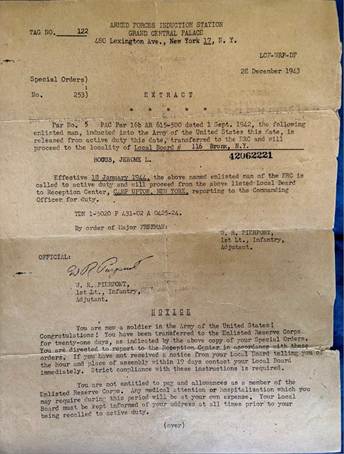
Jerry's induction orders from Grand Central Palace, December 28, 1943. Courtesy of the Bogus family.
At Camp Upton, Jerry was issued his dog tags. They still hang together on their chain. JEROME L BOGUS. His serial number, 42062221. T44, for the year of his tetanus shot. O, for his blood type. And near the bottom, a single stamped letter, H. In World War II, the Army gave soldiers only three choices for religion on their tags. C for Catholic. P for Protestant. H for Hebrew. If anything happened to Jerry, the Army would know to send a rabbi.
Two days after he reported, on January 20, Jerry filled out his emergency addressee card. In case anything happened to him, the Army was to notify his sister, Miss Helen Bogus, at 2090 Walton Avenue in the Bronx. A few weeks after that, the War Department's Office of Dependency Benefits approved a family allowance for his mother, Gussie, starting February 1, 1944. Part of what Jerry earned in uniform would go home to the Bronx every month. His family was counting on it.
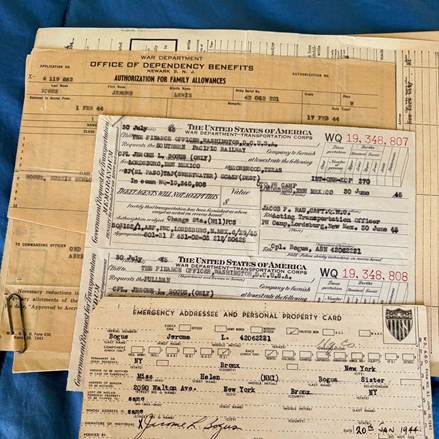
Jerry's family allowance authorization for Gussie, his emergency addressee card, and his 1945 travel orders from Lordsburg. Courtesy of the Bogus family.
After basic training, the Army sent Jerry south to Aberdeen Proving Ground in Maryland and assigned him to an ordnance unit. His records show four months of ordnance basic training. Aberdeen sat on the edge of the Chesapeake Bay, and it was the Army's oldest proving ground, opened in 1917 to test the guns and shells of World War I. By World War II it had become enormous. At its peak, more than 27,000 soldiers and nearly 5,500 civilians worked there, testing weapons and training the men who would keep them running. The bazooka came out of its work. So did ENIAC, one of the world's first electronic computers, created to calculate firing tables for Army guns.
Jerry kept a souvenir of those ordnance days for the rest of his life. It is a khaki web belt with a brass buckle. On the buckle is the emblem of the Army's Ordnance Department, a round bomb with a flame bursting from the top, with an artillery shell standing guard on either side.
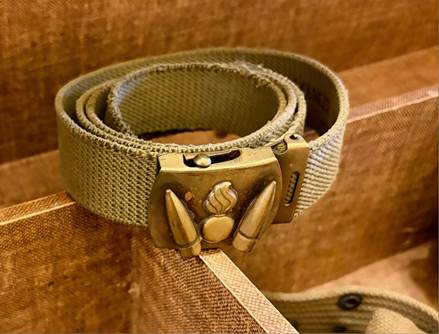
Jerry's belt, with the flaming bomb of the Ordnance Department on the buckle. Courtesy of the Bogus family.
Not all the work at Aberdeen was glamorous. Routine duty for Jerry's unit included fighting the forest fires that broke out in the woods nearby. On one of those fires, Jerry breathed in so much smoke that he ended up in the hospital.
While he lay there recovering, his unit shipped out for the war in the Pacific without him. Then the Army made a mistake that could have come straight out of a novel. Somewhere in the paperwork, Jerry Bogus was listed as dead.
For most young soldiers, that would have been a strange story to tell later. For Jerry, it was an emergency. His mother depended on his military pay. So Jerry set out to prove to the United States Army that he was alive. He won that battle. He was reassigned to a medical supply unit and sent even farther south.
For a Jewish boy born in the Bronx and raised in Brooklyn, the next stops might as well have been another country. The Army stationed Jerry in Ville Platte, Louisiana, deep in Cajun country, where people spoke French at home and gumbo simmered on the stove. Many of the locals had never met a Jew before. Jerry was the first.
He was far from the only city kid feeling that way. Thousands of young Jewish men from New York were drafted and sent to camps across the South, into a world nothing like the one they grew up in. Southern Jewish communities, often small, did their best to make them feel at home. Families invited soldiers to Shabbat dinners and holiday tables. The National Jewish Welfare Board, known as the JWB, helped found the USO and served Jewish soldiers wherever they were sent.
One of the JWB's gifts went into nearly every Jewish soldier's pocket. The Army could not hold separate Orthodox, Conservative, and Reform services on every post. So in 1941, the JWB brought rabbis from all three movements together to create a single prayer book that every Jewish serviceman could use. More than 700,000 copies went out during the war. Jerry carried one. It is a small book bound in brown cloth, with the JWB's star stamped on the cover. His daughter says there is no special story behind it. It was the standard book every Jewish soldier received. But Jerry kept it for the rest of his life.
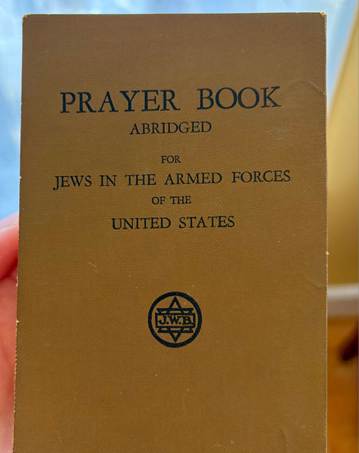
Jerry's Prayer Book Abridged for Jews in the Armed Forces of the United States, issued by the National Jewish Welfare Board. Courtesy of the Bogus family.
Then came Brownsville, Texas, at the very southern tip of the country, where the Rio Grande meets the Gulf of Mexico. Brownsville had a small Jewish community of merchant families, and to them, a polite Jewish soldier from New York was very good news. Jerry became, in his family's words, a target. Invitations to home-cooked dinners poured in. So did not-so-subtle hints about unmarried daughters, sometimes with an offer attached. Marry into the family, and there would be a place waiting for him in the family business.
Jerry ate the dinners. He did not marry the daughters.
Next the Army sent Jerry west, to the prisoner of war camp at Lordsburg, New Mexico. Lordsburg was a railroad town in the Chihuahuan Desert, founded in 1880 along the Southern Pacific line. The camp outside of town had a hard history before Jerry ever arrived. It opened in 1942 to hold Japanese immigrants and Japanese Americans swept up after Pearl Harbor. Some 1,500 were held there. In July 1942, two elderly Japanese men, Toshio Kobata and Hirota Isomura, were shot and killed by a guard. By 1943, the Japanese internees were moved out, and the camp filled with Italian and German prisoners of war, as many as 4,000 at a time.
All across America, more than 425,000 prisoners of war, most of them German, were held in camps by the end of the war. In many camps, the prisoners ran their own internal world, and hard-line Nazi prisoners sometimes enforced discipline on their own men with threats and violence. Jerry saw some of it with his own eyes. A Jewish soldier from the Bronx, watching German soldiers police each other in the New Mexico desert, is a scene that is hard to forget.
But there was another side to Lordsburg, the side Jerry loved to tell. Off duty, he and the other soldiers rode horses out into the desert and took target practice at rattlesnakes. Their long-range Army rifles worried the local ranchers, who came by with friendly warnings. Their message was simple. Not within a mile of the cattle.
On June 4, 1945, the camp issued Special Orders Number 130. Halfway down the page, under the heading To Be Corporal, is the name BOGUS, JEROME L., with a pen line drawn beneath it. The very same order sent more than twenty German prisoners, from privates to sergeants, south to the prisoner of war camp at Camp Maxey, Texas, with guards and an interpreter. On one sheet of paper, a Jewish soldier from the Bronx earned his corporal's stripes and German soldiers from the same camp were shipped out under American guard.
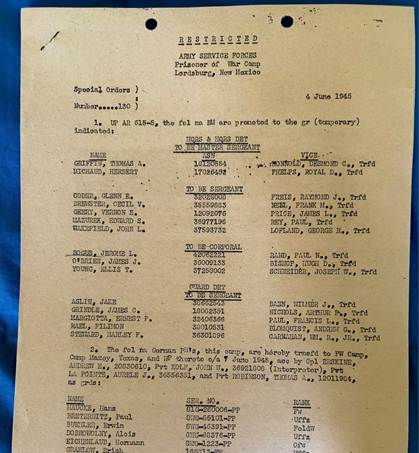
Special Orders No. 130, Prisoner of War Camp, Lordsburg, New Mexico, June 4, 1945. Jerry's promotion to corporal is in the middle of the page. Below it, the German prisoners being transferred to Camp Maxey. Courtesy of the Bogus family.
A few weeks later, on June 30, the camp's transportation officer issued him a government travel request. Cpl. Jerome L. Bogus was headed by Southern Pacific Railway through El Paso and Sweetwater to a new station at Brownwood, Texas. The Pullman ticket that came with it survives too.
Brownwood was home to Camp Bowie, one of the largest training centers in Texas. Built in 1940 and named for Alamo defender James Bowie, it once held as many as 60,000 men. It also held thousands of German prisoners, many of them men from Rommel's army in North Africa. The post had fourteen chapels, a hospital that could care for 2,000 patients, and three dental clinics.
Those dental clinics became Jerry's world. On September 5, 1945, three days after Japan formally surrendered and the war ended, he joined the medical detachment at the camp's regional hospital. The next day he started a new job. His official paperwork describes it in three words: dental supply sergeant. On February 20, 1946, his commanding officer recommended him for promotion to sergeant, and the Army approved it the next day.
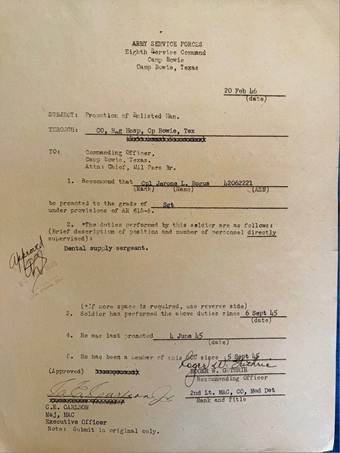
Jerry's promotion to sergeant, Camp Bowie, Texas, February 1946. His duties: dental supply sergeant. Courtesy of the Bogus family.
The war was over, and the Army was shrinking fast. Mountains of equipment were suddenly surplus. One of Jerry's jobs was to dispose of what was no longer needed, and that often meant burying brand new equipment in the ground. Jerry could not bear it. He was a child of the Depression, and he believed nothing usable should ever go to waste. So some of that equipment found its way somewhere else. For the rest of his life, Jerry claimed that at least half a dozen dentists in the Bronx owed the outfitting of their first postwar offices to the surplus he "diverted." He kept a small set of dental tools for himself. His daughter still has them.
There is one more story from those days that Jerry loved to tell, about a colonel who was determined to leave the Army on his own terms. His family says it could have been an episode of M*A*S*H. They also say it proved who really holds the power in the Army. It is not the colonel. It is the supply sergeant, armed with paperwork and the patience to follow every rule exactly.
Tucked among Jerry's papers is something you might not expect to find in a supply sergeant's files. It is a typed copy of the speech General George S. Patton gave to his Third Army in England in the spring of 1944, before the invasion of France. Patton gave the speech several times, without notes, and no official transcript was ever made. Soldiers wrote it down from memory, and typed copies passed from hand to hand across the Army. Jerry's copy is folded in thirds, with letters struck over and words crossed out. The language is famously salty. But in the middle of it is a passage that could have been written for a man like Jerry. Every man has his job to do, Patton tells his troops. Ordnance men keep the guns and machinery running. Quartermasters bring up the clothes and the food. Jerry never served under Patton. But he spent his war keeping the Army supplied, and he kept that speech for the rest of his life.
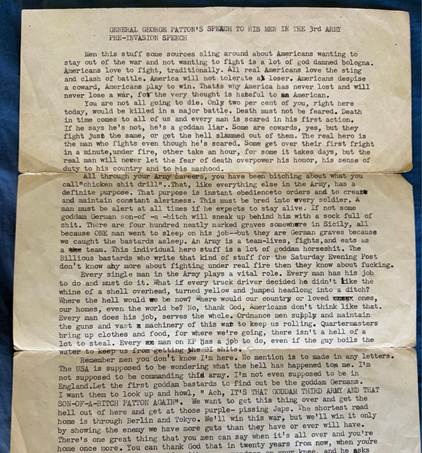
Jerry's typed copy of General George S. Patton's speech to the Third Army. Courtesy of the Bogus family.
Before he left the Army, Jerry was handed one more piece of paper, his Separation Qualification Record. Across the top, it warns that it will not be replaced if lost. The form was meant to help veterans find work, a summary of what they had done in uniform that they could show to an employer or a school. Jerry's tells his whole Army career in three lines. Four months of ordnance basic training. Twenty-one months as a supply clerk. Five months as an administrative noncommissioned officer.
Then a short paragraph describes his last job. He supervised two civilian employees and a group of German prisoners of war. He prepared all the forms, reports, and orders for the ordnance, signal, and chemical warfare supplies on the post, and he was responsible for sorting and storing every one of them. The Jewish soldier from the Bronx who had watched German prisoners police each other in the New Mexico desert finished his Army career as their supervisor.
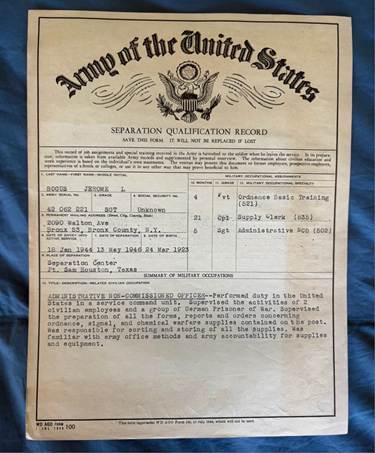
Jerry's Separation Qualification Record, issued at Fort Sam Houston, Texas, May 13, 1946. Courtesy of the Bogus family.
On May 13, 1946, Sergeant Jerome L. Bogus was honorably discharged at Fort Sam Houston, Texas. He went home with the American Theater Campaign Ribbon, the Good Conduct Medal, and the World War II Victory Medal.
He kept those, too. His Good Conduct Medal still sits in its original box, wrapped in the tissue paper it came in. The medal was created in June 1941 for enlisted soldiers who showed exemplary behavior, efficiency, and fidelity. In peacetime it took three years of service to earn. In wartime it took one. Around the eagle on its face are three words. Efficiency. Honor. Fidelity.
Beside it are his ribbon bars, his marksman's badge with its rifle bar, and a small square patch with a gold laurel wreath. That patch was the insignia of the Meritorious Service Unit Plaque, an honor the Army created in 1944 for service units that did outstanding work. Soldiers wore it on the right sleeve, and with typical GI humor, they nicknamed it the toilet seat.
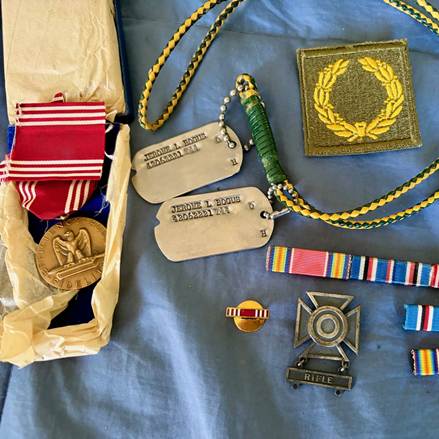
Jerry's Good Conduct Medal in its original box, his dog tags, ribbon bars, marksman's badge, and the gold wreath patch of the Meritorious Service Unit Plaque. Courtesy of the Bogus family.
Jerry came home to the Bronx and picked up right where he had left off, at night school. He finished his degree in chemical engineering at the City College of New York, the tuition-free college that had lifted generation after generation of immigrant children into the professions. Medical school never happened. But Jerry built a long career as a consulting engineer and manufacturer in New York, most of it running his own business.
He never stopped taking care of his family. Jerry lived with his mother, Gussie, and his sister, Helen, who never married, for all of their lives, and he was their caretaker. He married in 1964, and a year later his daughter, Felice, was born. The marriage did not last, and it pained him deeply. He never remarried.
He loved golf and long walks. When he was younger, he loved to travel and to go to the theater. In his later years, he became the family's unofficial investment advisor and spent hours following the markets.
And he never threw anything away. He held on to so many Army-issue shorts and T-shirts that, his family swears, he did not buy himself new underwear until sometime in the 1990s. His Army footlocker came home with him too. It is olive drab and scuffed at the corners, and his name and serial number are still stenciled in white on the lid. JEROME L. BOGUS. 42062221. Inside are his wool Army gloves, his web belt, and his canvas pouches, right where he left them.
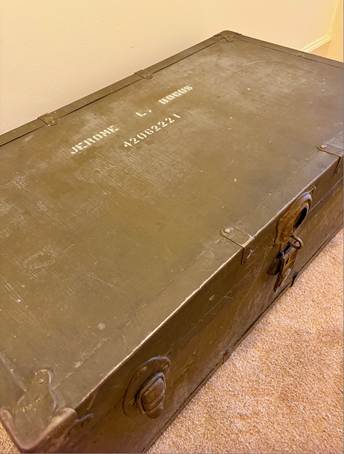
Jerry's Army footlocker, with his name and serial number stenciled on the lid. Courtesy of the Bogus family.
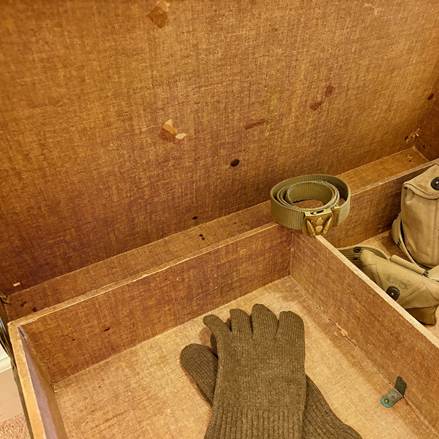
Inside the footlocker, his wool gloves, ordnance belt, and canvas pouches. Courtesy of the Bogus family.
He held on to people, too. For decades after the war, Jerry traded holiday cards with an Army buddy who lived in Acton, Massachusetts. When his friend died, the friend's widow kept sending them. When those cards with the Acton return address finally stopped coming, Jerry felt it deeply.
By 2010, Jerry was living alone in Brooklyn. His family worried about him, and they wanted him closer to his only grandchild. So they persuaded him to move to Raleigh, North Carolina, to be near his daughter's family. It was the first time he had lived in the South since the Army sent him there as a young man. He lived there until his death on January 22, 2014. He was ninety years old.
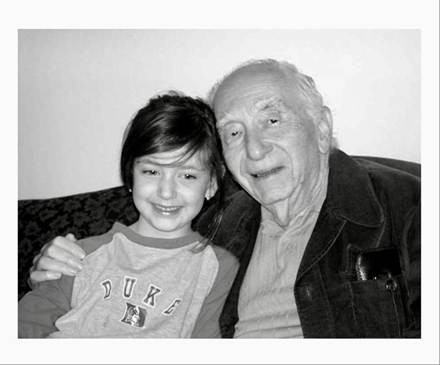
Jerry with his granddaughter. Courtesy of the Bogus family.
Jerry came home to New York one last time. He rests at Mount Hebron Cemetery in Flushing, Queens, in Block 25, among the members of the Stuchiner Young Men's society.
He never made it to medical school. He never fired a shot at the enemy. But he answered when his country called. He sent his pay home to his mother. He convinced the United States Army that he was not dead. He made sure good equipment went to good use. And he kept everything. The footlocker. The dog tags. The prayer book. The orders and the forms and the Pullman ticket, every page of a young man's war.
Because he kept them, we can tell his story.
This Veterans Day, we remember him by name.
Sergeant Jerome Lewis Bogus.
May his memory be a blessing.
All photographs and documents in this blog were generously shared by Jerry's daughter, Felice Bogus, and are reproduced with the family's permission.
Works Cited
"Abridged Prayer Book for Jews in the Armed Forces of the United States (National Jewish Welfare Board 1941)." Open Siddur Project, opensiddur.org/compilations/liturgical/siddurim/kol-bo/abridged-prayer-book-for-jews-in-the-armed-forces-of-the-united-states-national-jewish-welfare-board-1941. Accessed 13 Nov. 2026.
"Aberdeen Proving Ground." Military OneSource, installations.militaryonesource.mil/in-depth-overview/aberdeen-proving-ground. Accessed 13 Nov. 2026.
"Army Good Conduct Medal." Air Force's Personnel Center, www.afpc.af.mil/Fact-Sheets/Display/Article/421873/army-good-conduct-medal. Accessed 13 Nov. 2026.
Bogus Family Papers. Induction orders, emergency addressee card, family allowance authorization, Special Orders No. 130, government transportation requests, promotion recommendation, Separation Qualification Record, dog tags, medals, prayer book, footlocker, and photographs of Jerome L. Bogus, 1943 to 2014. Personal collection of Felice Bogus.
Bogus, Felice. Email to the author. Nov. 2026.
"Camp Bowie." Brown County Historical Society, browncountyhistory.org/historycampbowie.html. Accessed 13 Nov. 2026.
"Camp Bowie." GlobalSecurity.org, www.globalsecurity.org/military/facility/camp-bowie.htm. Accessed 13 Nov. 2026.
"Camp Bowie POW Camp." Brown County Historical Society, browncountyhistory.org/pow-camp-bowie.html. Accessed 13 Nov. 2026.
"Camp Upton." Wikipedia, en.wikipedia.org/wiki/Camp_Upton. Accessed 13 Nov. 2026.
"Establishing APG: 1917-1930s." U.S. Army Garrison Aberdeen Proving Ground, home.army.mil/apg/index.php/about/history. Accessed 13 Nov. 2026.
"Executive Order 8809, Good Conduct Medal." National Archives, Office of the Federal Register, www.archives.gov/federal-register/codification/executive-order/08809.html. Accessed 13 Nov. 2026.
"George S. Patton's Speech to the Third Army." Wikipedia, en.wikipedia.org/wiki/George_S._Patton%27s_speech_to_the_Third_Army. Accessed 13 Nov. 2026.
"Good Conduct Medal (United States)." Wikipedia, en.wikipedia.org/wiki/Good_Conduct_Medal_(United_States). Accessed 13 Nov. 2026.
"Grand Central Palace." Wikipedia, www.wikipedia.com/wiki/Grand_Central_Palace. Accessed 13 Nov. 2026.
"Inductions Begin at Grand Central Palace." The World War II Multimedia Database, www.worldwar2database.com/?p=19821. Accessed 13 Nov. 2026.
"Jewish Military Chaplaincy." Berman Jewish Policy Archive, www.bjpa.org/content/upload/bjpa/66ch/66chaplaincy.pdf. Accessed 13 Nov. 2026.
"Jewish Welfare Board." Digitized encyclopedia entry, Universitätsbibliothek Potsdam, digital.ub.uni-potsdam.de/content/pagetext/344848. Accessed 13 Nov. 2026.
"List of World War II Prisoner-of-War Camps in the United States." Wikipedia, en.wikipedia.com/wiki/List_of_POW_camps_in_the_United_States. Accessed 13 Nov. 2026.
"Lordsburg (Detention Facility)." Densho Encyclopedia, encyclopedia.densho.org/Lordsburg_(detention_facility). Accessed 13 Nov. 2026.
"Lordsburg Killings." Wikipedia, en.wikipedia.org/wiki/Lordsburg_killings. Accessed 13 Nov. 2026.
"Lordsburg, New Mexico." Wikipedia, www.wikipedia.org/wiki/Lordsburg. Accessed 13 Nov. 2026.
"MANPOWER: Disorderly Draft." Time, content.time.com/time/magazine/article/0,9171,773991,00.html. Accessed 13 Nov. 2026.
"Meritorious Unit Commendation." 720th Military Police Battalion Reunion Association History Project, 720mpreunion.org/history/medals_ribbons/mu_commendation.html. Accessed 13 Nov. 2026.
"Meritorious Unit Commendation." Wikipedia, en.wikipedia.org/wiki/Meritorious_Unit_Commendation. Accessed 13 Nov. 2026.
"Moore Militaria Dog Tag Formats." Moore Militaria, www.mooremilitaria.com/moore-militaria-dog-tag-formats.html. Accessed 13 Nov. 2026.
Newspaper article on draft reclassification, 1943. Digitized newspaper collection, omeka-s.bapl.org/files/original/45b40578ac7b2bee8dc3e3768009b76fc0343c58.pdf. Accessed 13 Nov. 2026.
Pressler, Millie. "Lordsburg Internment POW Camp." New Mexico History, newmexicohistory.org/?p=632. Accessed 13 Nov. 2026.
Province, Charles M. "General Patton's Address to the Troops." USNA Class of 1963, www.usna63.org/tradition/history/Pattons_Speech.html. Accessed 13 Nov. 2026.
"Yip Yip Yaphank." Wikipedia, en.wikipedia.org/wiki/Yip_Yip_Yaphank. Accessed 13 Nov. 2026.